
Under Sod 4-2-5 is blended into the top 4 to 6 inches of soil before the sod goes down. It is not a starter you sprinkle on top.
Application rate: one 25-pound bag per pallet of sod (500 square feet), which is 50 pounds per 1,000 square feet, blended into the top 4 to 6 inches. Follow the soil test and local rules; this rate supplies 1.0 pound of phosphate (P2O5) per 1,000 square feet, so count it toward the report rather than adding it on top of a separate phosphorus allowance.
A new pool went into a Shelton backyard this summer: gunite, spa, stone patio, a waterfall, a white gazebo in the middle of it all. What the pool project left behind was ours: roughly 17,000 square feet of bare, compacted, rutted ground wrapping the entire property, from the fountain courtyard out front around both side yards to the privacy hedges behind the pool. We rebuilt the grade from the surface down, spread screened topsoil across the whole yard, pitched it away from the coping, and laid fresh-cut sod the same day it came off the farm, with the drone up for every stage. The homeowner's five-star review is on the job page with all fourteen clips. It is the most completely documented lawn on this site, and it anchors this page.
Shelton is having a construction decade, and most of the lawns we install here are what a pool, a teardown, or a subdivision leaves behind: compacted subsoil, machine ruts, and no topsoil. The town runs from the Housatonic riverfront and the old mill blocks downtown up through Huntington Center and Pine Rock Park to the two-acre wooded lots and steep drives of White Hills, on glacial-till loam over ledge with river-valley loam along the water. And 2026 is the first year Shelton is on Aquarion's mandatory twice-a-week watering schedule. This page is everything we know about putting sod down in Shelton.
Sod installation in Shelton, CT, in one box
As of September 2026, here is what installing sod in Shelton, CT involves.
- Watering: Shelton joined Aquarion's mandatory twice-weekly sprinkler schedule in 2026. It runs April 1 through October 31. Hand-held, soaker, and drip are exempt. The five-week New Planting Variance is accepted April 1 to June 15 and September 1 to October 31, not in July or August.
- Best windows: September through October, then April through early June. Summer installs work with hand-watering on off days.
- After a pool or build: loosen compacted ground, add three to four inches of screened topsoil, and pitch the finish grade away from the pool or foundation before sod.
- Sod, not seed: sod covers bare soil beside new water immediately and the yard is usable in two to three weeks.
- Wetlands: grading and clearing stay 25 feet from wetlands and 50 feet from watercourses; construction setbacks are wider on named waterways. The city issues a Certificate of Compliance when standards are met; otherwise a permit is needed.
- Access: steep White Hills drives, downtown street staging, and riverfront ground are planned before delivery. An all-terrain forklift runs pallets from the truck to the seam.
- Soil: glacial-till loam over weathered bedrock on the hills, river-valley loam by the Housatonic, and mature-oak shade on older blocks.
- Sod: Kentucky bluegrass with irrigation in sun, tall fescue and RTF on big unirrigated lots and dog yards, and a bluegrass-fescue blend under oaks.
The Shelton Map: River, Mill Blocks, Hills
Shelton sits in the lower Housatonic Valley, across the river from Derby, with Routes 8 and 110 as its spines. The old mill blocks are at the bottom; Huntington Center, Pine Rock Park, and Long Hill are in the middle; White Hills and Birchbank climb north toward Monroe. Below is how we read an address before the site walk.
| Area | Lot scale and access | Soil and drainage | Water, sewer, and canopy | Install implication |
|---|---|---|---|---|
| White Hills, Birchbank, Route 110 | Two-acre wooded lots, steep drives, new subdivisions | Till over ledge; thin crowns | Wells and septic common; deep edge canopy | Post-construction prep; tall fescue on unirrigated acreage; locate septic and walk the drive |
| Huntington Center | Half-acre to one-acre historic lots | Amended garden soil over till | Aquarion and sewer; mature oaks | Bluegrass-fescue under canopy; hand-prepped edges |
| Pine Rock Park and Long Hill | Quarter- to half-acre family lots | Till with rock; decades of compaction | Aquarion and sewer; dogs and kids | RTF or tall fescue; loosen subgrade; pallets in driveway |
| Downtown, Howe Avenue, Riverwalk | Small lots, tight street staging | Mixed fill on old mill blocks | Aquarion and sewer; river below the dam | Trucks in sequence; check flood map on lowest blocks |
| Indian Well and riverfront | Riverfront lots above the dam | River-valley loam; floodplain | Aquarion or wells; seasonal drainage | Keep existing drainage; wetlands and floodplain review before fill |
| Means Brook and Trap Falls | Wooded reservoir-country lots | Till and wet pockets | Water-supply watershed; wells and septic | Wetlands review near brooks; canopy assessment |
Best sod for White Hills, Shelton, CT: tall fescue on open acreage you cannot irrigate and Kentucky bluegrass with irrigation near the house, because the lots are big and soil over ledge dries fast.
The newer two-acre wooded lots climb toward Monroe on glacial till over ledge. We plan turning radius, overhead branches, where a loaded truck stops, and where the forklift takes over. Wells, septic, construction fill, and compaction are identified before topsoil.
Huntington Center
Best sod for Huntington Center, Shelton, CT: a bluegrass-fescue blend, because mature oaks throw afternoon shade and one blend beats zoning on these lots.
Historic half-acre to one-acre lots have amended garden soil over till, town water and sewer, and precise edges along beds and walks that are finished by hand.
Pine Rock Park and Long Hill
Best sod for Pine Rock Park and Long Hill, Shelton, CT: RTF or tall fescue, because these are family yards with dogs, kids, and weekend traffic on compacted post-war soil.
The subgrade gets loosened before topsoil. These are commonly compact, one-day installs with pallets in the driveway and a durable variety along the dog run.
Downtown, Howe Avenue, and the Riverwalk
Best sod for downtown Shelton, CT: a bluegrass-fescue blend over a rebuilt base, because old mill blocks carry mixed fill and mixed light.
Small lots, street parking, and bridge approaches constrain staging. Trucks come in sequence and the forklift sets pallets where it can. The lowest blocks are on the flood map; fill there is a Planning and Zoning question before it is a lawn question.
Indian Well and the Housatonic riverfront
Best sod for the Shelton riverfront: tall fescue, because river-valley loam over a floodplain wants deep roots and a grade that follows existing drainage.
Seasonal drainage and floodplain conditions govern the finish grade. Any fill goes through wetlands and floodplain review first.
Reservoir country: Means Brook and Trap Falls
Best sod for the Shelton reservoir lots: tall fescue or a blend under canopy, and no grading near a brook without the Inland Wetlands office.
Trap Falls Reservoir and Means Brook Reservoir are Aquarion public-water-supply reservoirs. The wooded watershed lots have brooks, wet pockets, and deep canopy. Means Brook carries a 100-foot construction setback; 22 other named brooks carry 75 feet.
For variety selection, use the Housatonic Valley and inland Fairfield County sod guide. This series also includes the Westport sod guide, the New Canaan sod guide, and the Greenwich sod guide.
The full site walk before the first pallet
The map is a starting point, not a soil survey. On White Hills and Birchbank lots we check a steep private drive for turning radius, overhead branches, culverts, the place a loaded tri-axle can stop, and the route where the forklift takes over. Many are on wells and septic, so well yield and the leach field come before the first truck. Huntington Center is a compact, precise job: porch-front Capes and Colonials, mature oaks deciding the sun, and hand work at beds and walks. Pine Rock Park and Long Hill carry decades of compaction under active family lawns; without a loosened subgrade, the new lawn lives on the sprinkler. Downtown's old mill blocks have mixed fill, tight staging, and the tidal river below the dam. At Indian Well, the finish grade sheds toward the drainage the lot already has, never toward the river.
Means Brook and Trap Falls require the same discipline before grading. The wooded land draining to Aquarion's reservoirs has wet pockets and deep canopy. A canopy assessment comes before anyone promises turf beneath trees, and wetlands review comes before any grading near water.
17,000 Square Feet Around a New Pool, From the Air
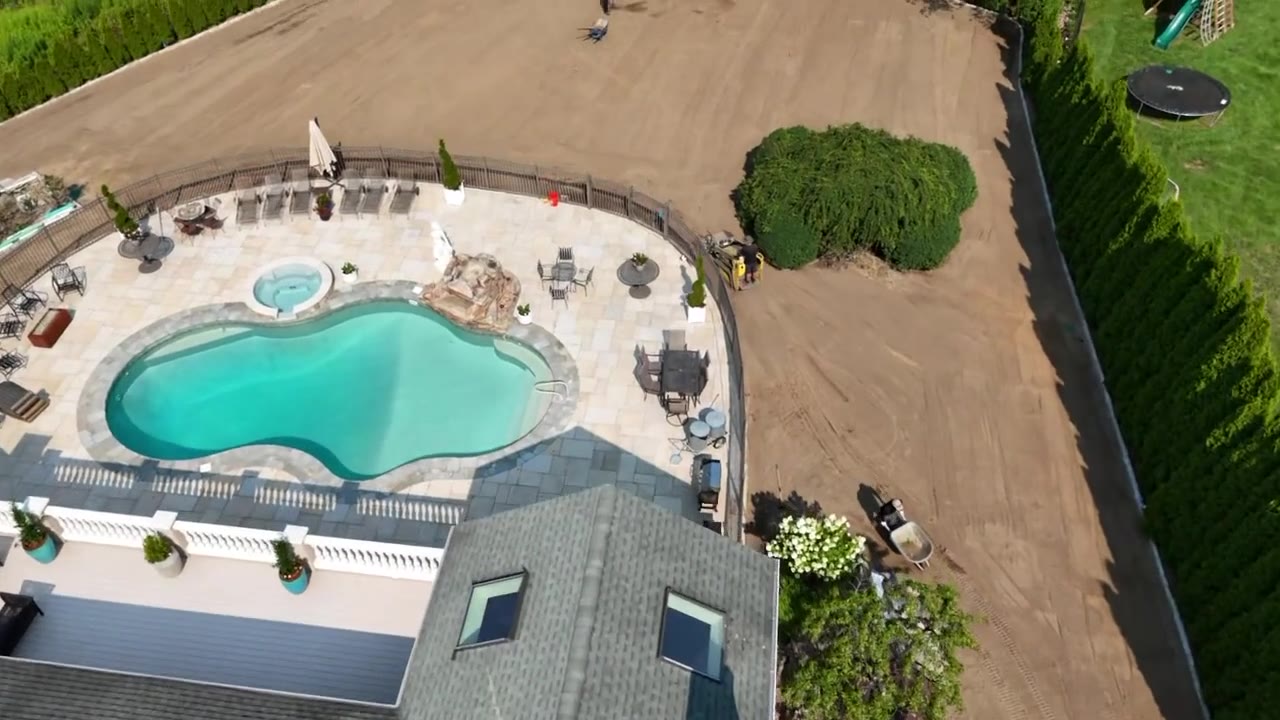
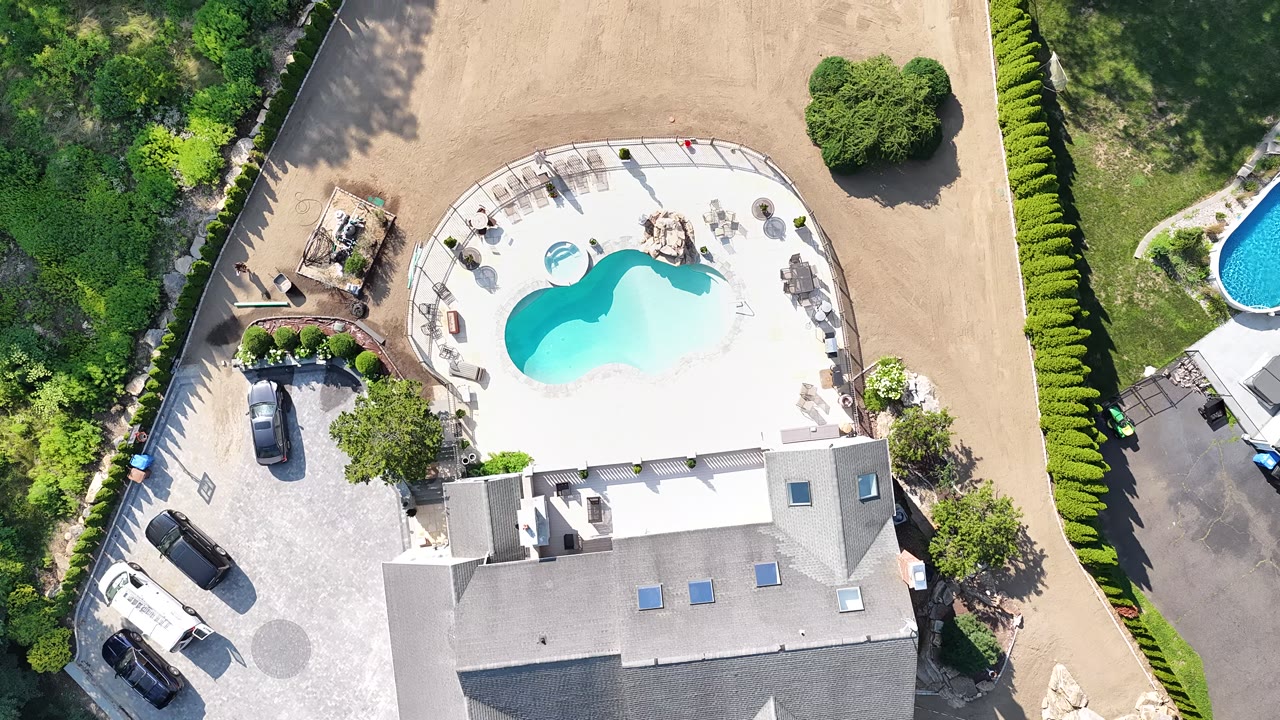
A backyard pool project left roughly 17,000 square feet of bare ground after months of machine traffic. The homeowners wanted to use the yard with the pool this season. We handled prep and installation, and the full job page has every clip.
The yard a pool project leaves behind

Packed subsoil is a poor lawn base. Roots cannot push into it and water sits on top, so the fix is not cosmetic raking.
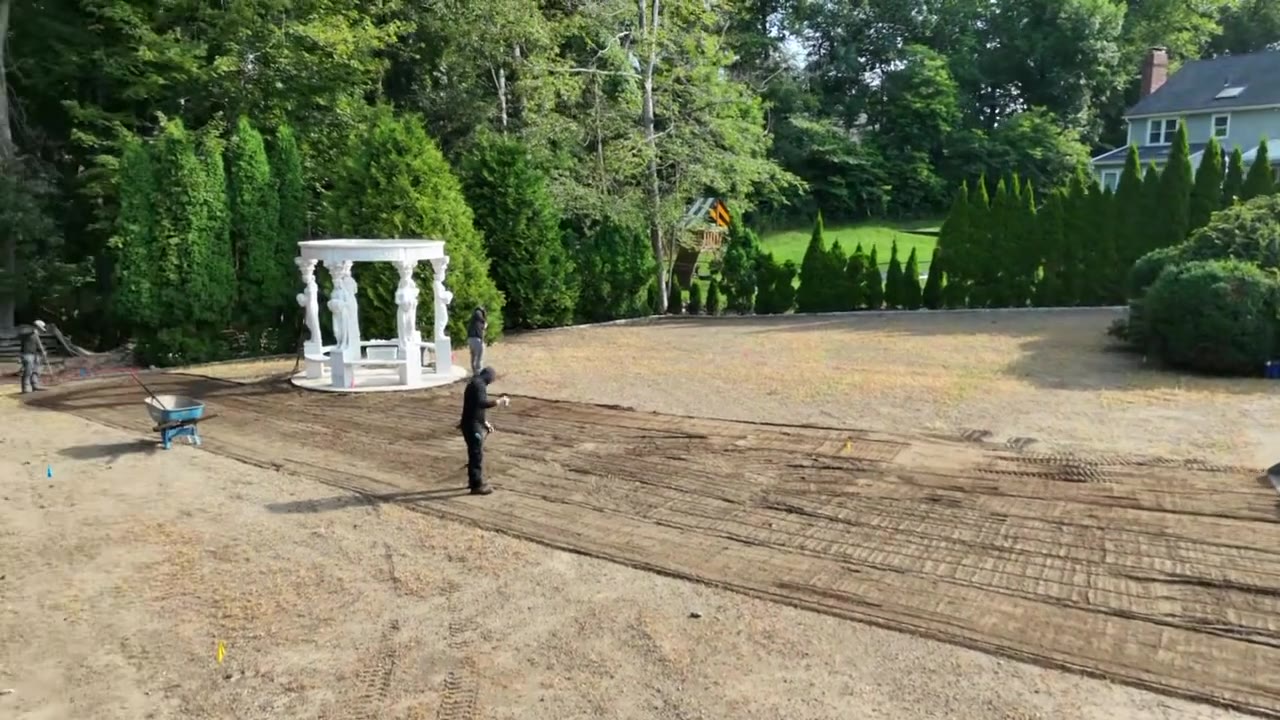
Prep: topsoil in strips, rakes around the gazebo
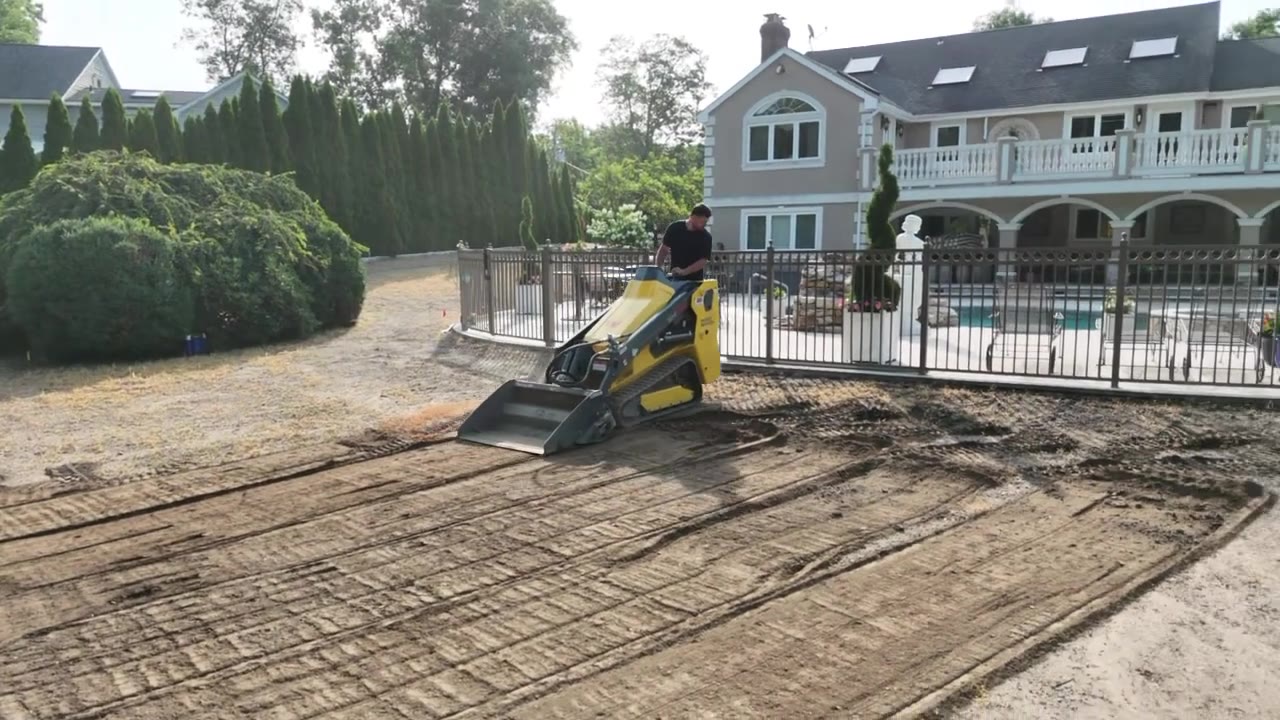
The crew loosened compacted ground, spread screened topsoil in long strips, and pulled a smooth grade away from the pool.
The finish grade, done
One continuous plane of screened topsoil wrapped the pool fence and gazebo. Prep was most of the project.
Install day, mid-morning
Fresh-cut pallets arrived with the crew. Rows advanced with staggered seams so no four corners met.
The pallet line

The forklift ferried pallets from street to seam, so no pallet sat on finished lawn.
The last strip beside the patio

The last strip went down fresh off the farm, the same day it was cut.
The finished lawn
Wall-to-wall sod ran from the rear hedges around both side yards and the fountain courtyard.

“I had an excellent experience with CT SO company from start to finish. They prepared the ground and installed new sod with great care and professionalism. The crew was punctual, hardworking, and paid attention to every detail. What impressed me the most was how comfortable they made me feel throughout the entire process. They took the time to explain each step, answered all of my questions, and made sure I knew what to expect. Their communication was outstanding, and I always felt confident that my yard was in good hands. The finished lawn looks beautiful, and the quality of their work exceeded my expectations. I highly recommend this company to anyone looking for reliable, honest, and skilled lawn professionals. I'm very happy!!! Thank you for transforming my yard!”
> “In Shelton the lawn is whatever the pool company, the builder, and the machines left behind. The prep is the job; the sod is the last day.” > > “Nobody seeds 17,000 square feet next to a brand-new pool. You would spend the summer skimming dirt.” > > “The pallet line runs from the street to the seam. If a pallet is sitting on finished lawn, somebody planned it wrong.” > > CT Sod crew, Shelton, summer 2026
Every clip from the Shelton job
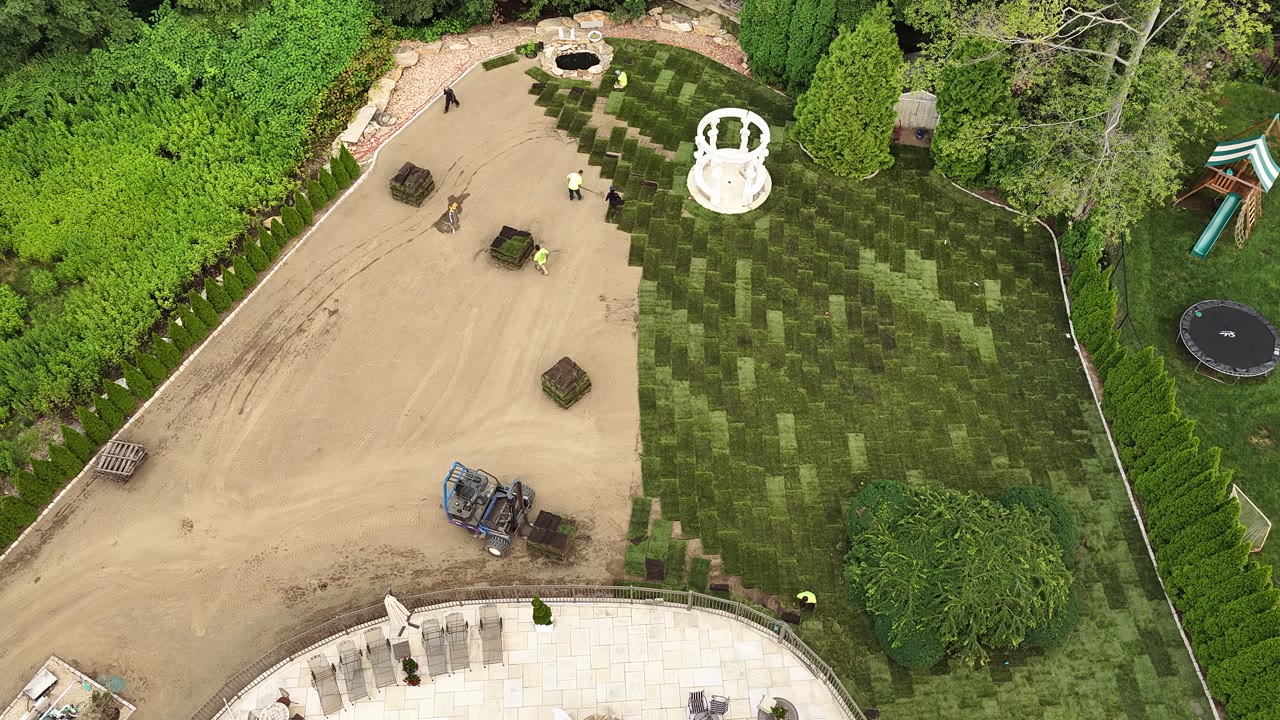

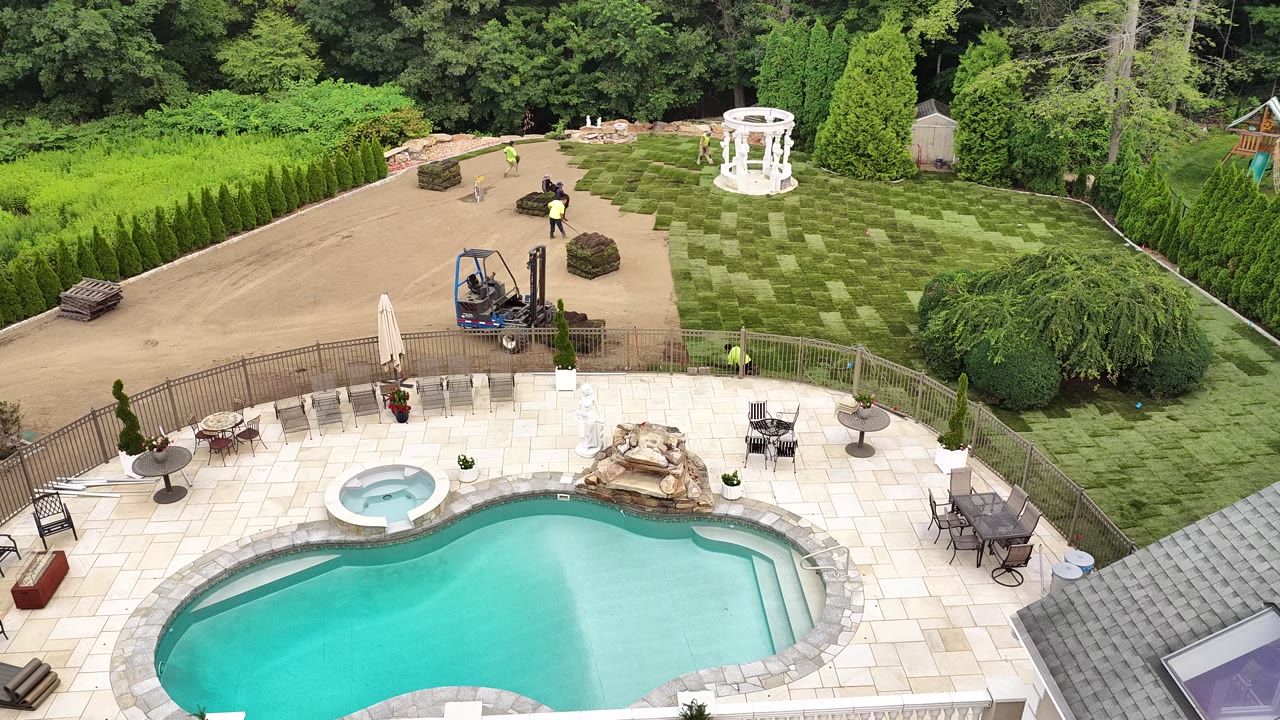
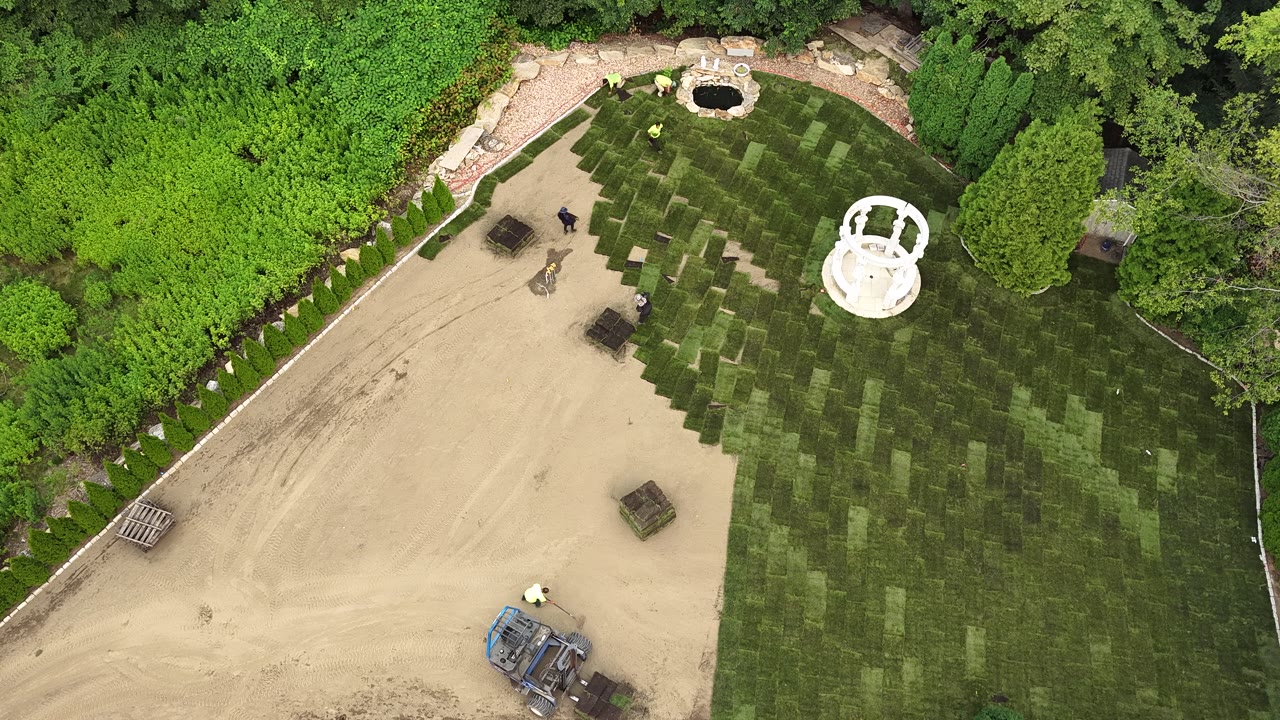
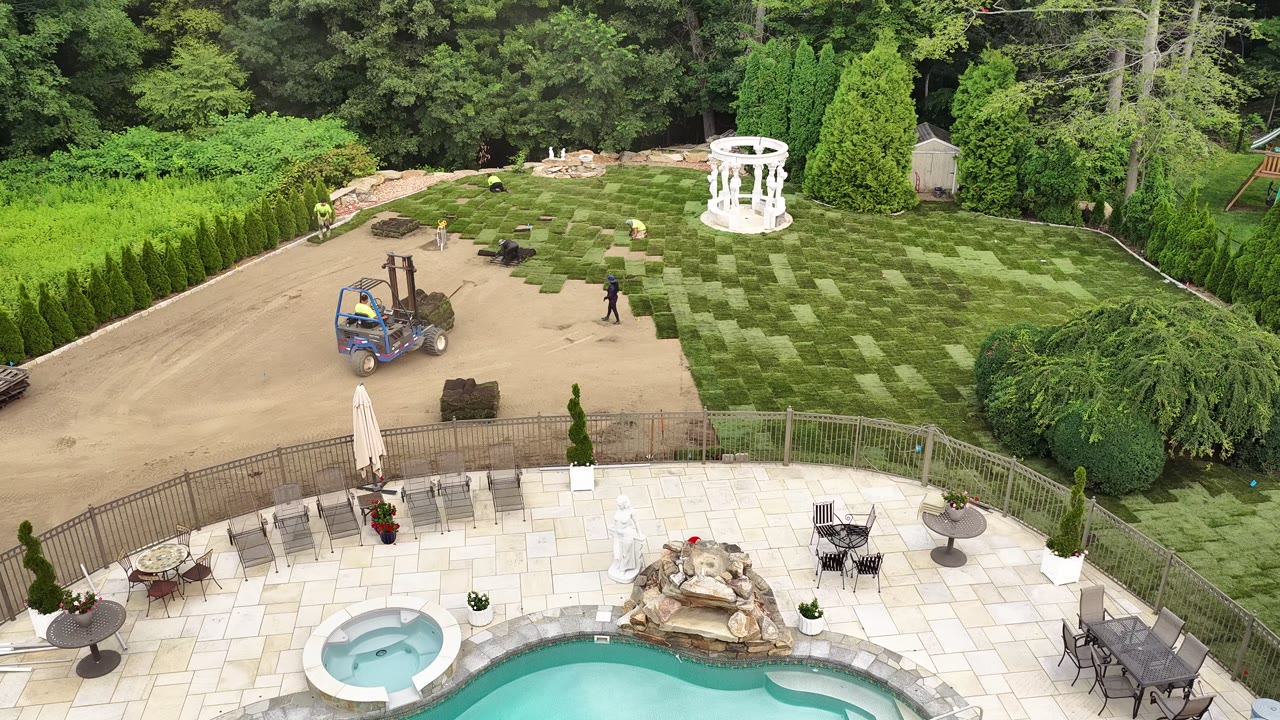

The same crews handle every sod installation in Shelton; if your landscaper handles prep, Shelton sod delivery uses the same fresh-cut standard.
More from the 17,000-square-foot timeline
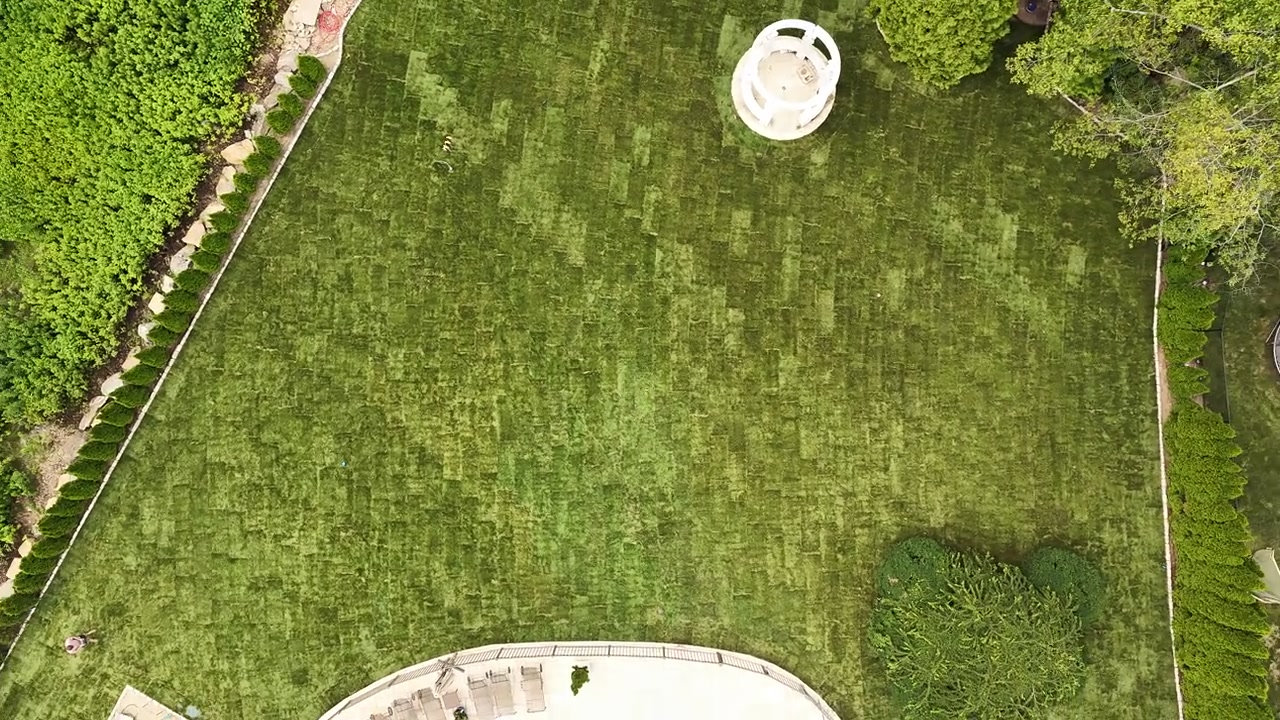
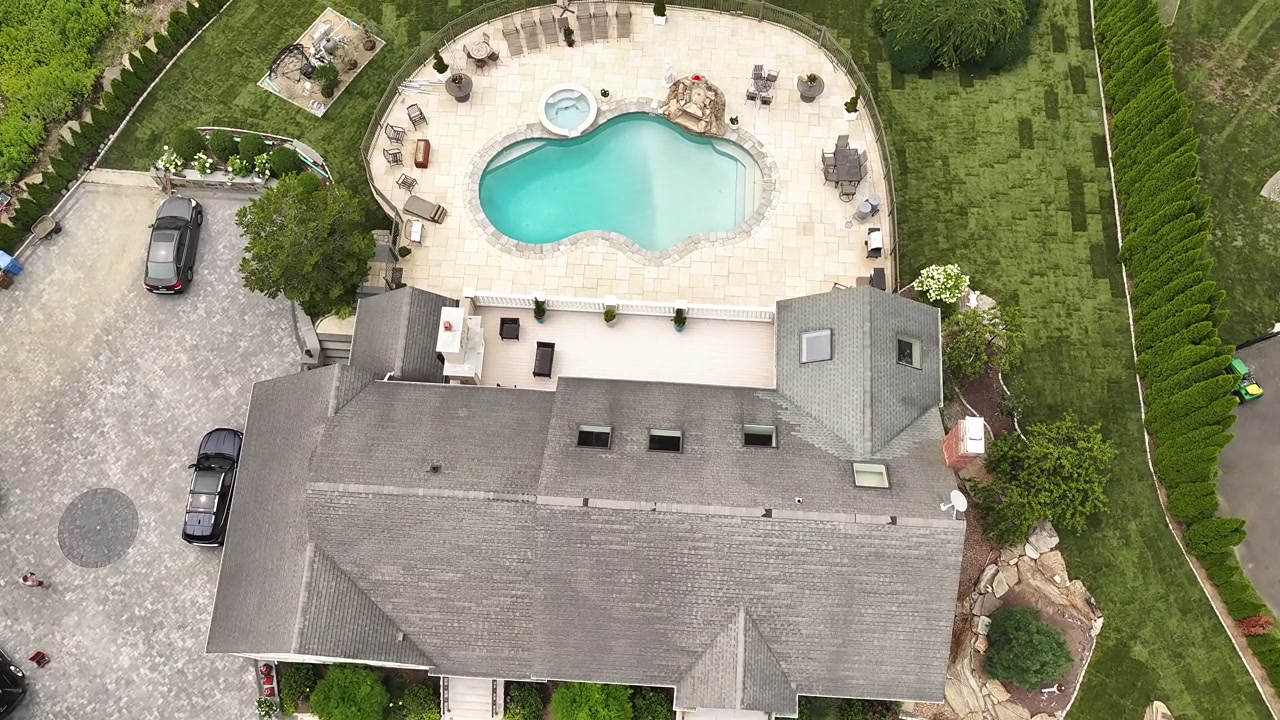
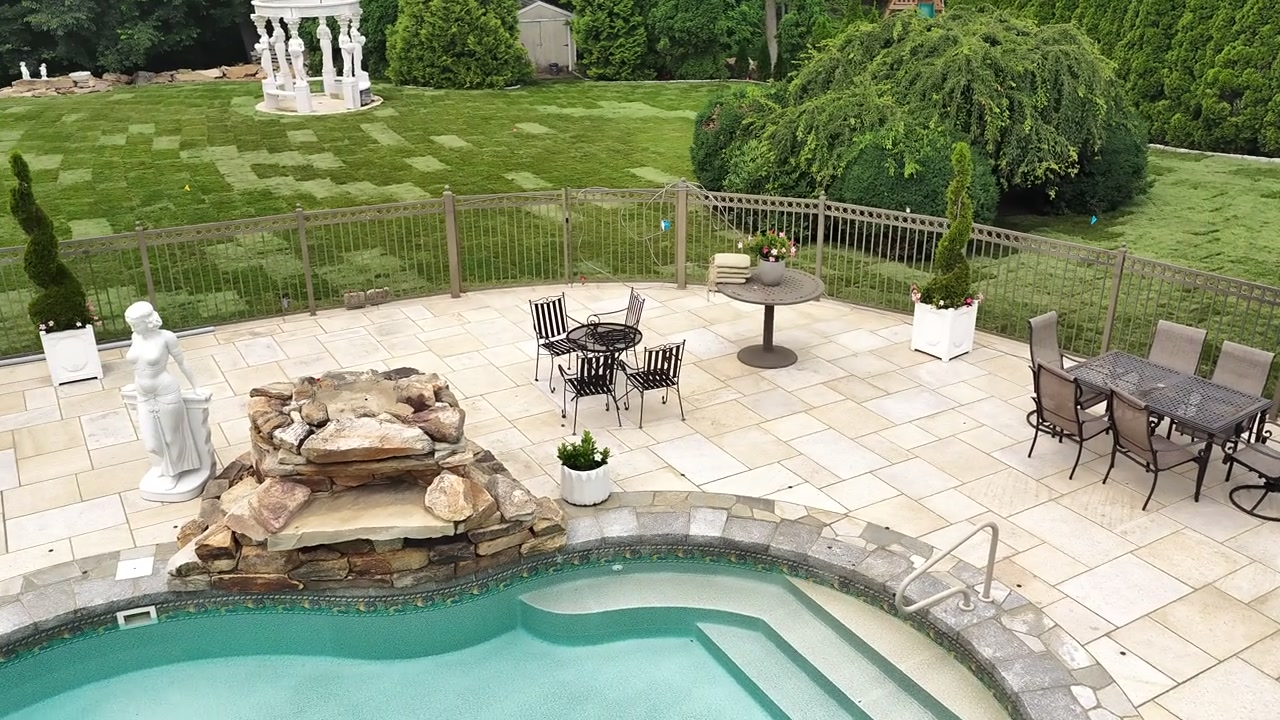
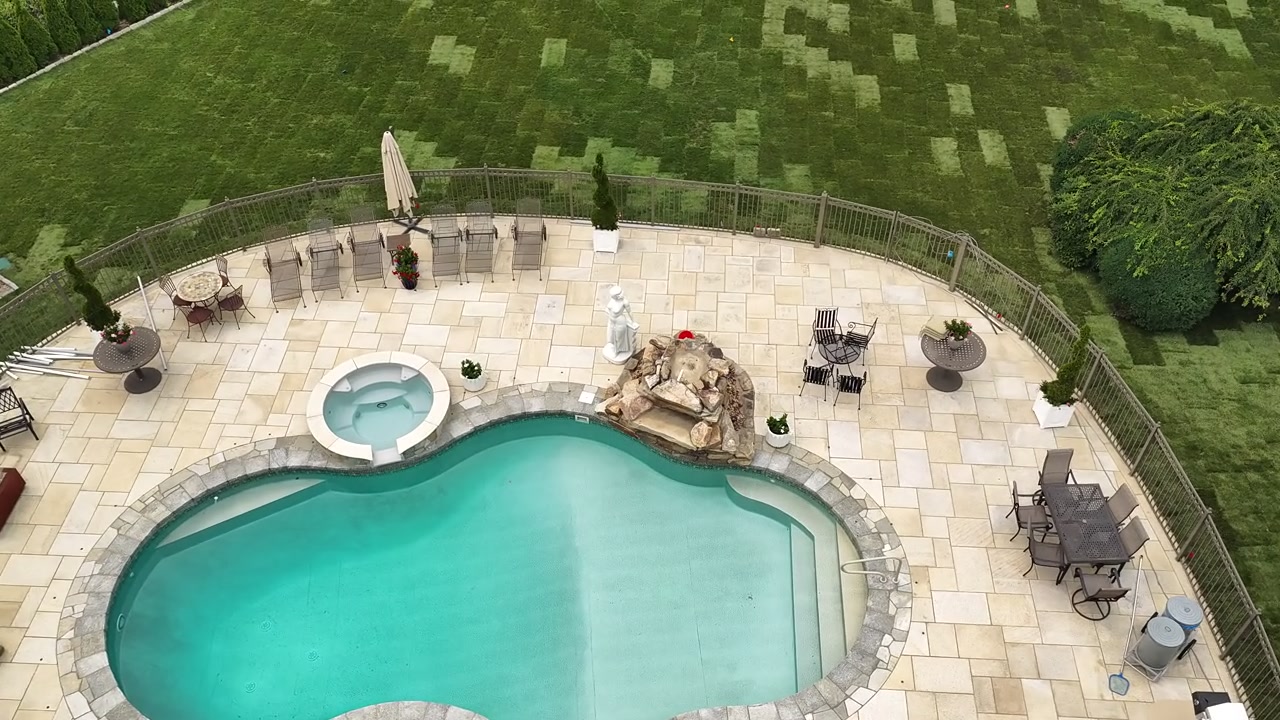
From the air, the scale of the pool yard was obvious: the pool, spa, stone patio, and fence were finished; everything beyond the fence was dirt around the gazebo and out to the privacy hedges. Months of excavation, concrete, masonry, and repeated machine routes had packed the ground hard and removed the topsoil. The compact track loader ferried and dumped screened topsoil in long strips while wheelbarrows and rakes worked around the gazebo and pool fence. That surface was pulled into a smooth, continuous grade so runoff would shed toward the tree line rather than the coping.
With equipment off the yard and wheelbarrow routes raked out, the finish grade had no ruts, ridges, or tire tracks. Fresh-cut pallets arrived with the crew. By mid-morning the back half was green, the white gazebo stood in lawn rather than dirt, and the stair-stepped working edge advanced toward the patio. Rolls were laid in tight, brick-style rows with staggered seams. The forklift fed the seam from the street, and staged pieces fanned down the slope exactly where the crew needed them next. The full reveal ran from the hedges behind the pool past the gazebo and tree line, around both side yards, and out front around the fountain courtyard, walkway, and stone-edged beds. Each of those edges was hand trimmed.
The homeowner's existing Google review credits the ground preparation, step-by-step explanations, and communication before it mentions the grass. On a project that runs alongside a pool build, that process is what the owner lives with for weeks. Read customer reviews.
The Lawn a Pool Build Leaves Behind: Sod, Not Seed
Shelton pool yards are a frequent call. Bare dirt brings dust and silt beside new water, while seed keeps the yard closed for months. Sod locks the finish grade in place and finishes the landscape immediately.
Months of equipment compact the top foot and strip topsoil. The fix is to loosen the subgrade, spread three to four inches of screened topsoil, and pitch water away from the pool. The reliable order is pool shell and utilities; patio, coping, walls, and settled backfill; fence or marked fence line; tested irrigation at finish grade; loosened clean subgrade; screened topsoil and finish grade; then sod cut and laid the same day.
Protect finished sod with mats or plywood, never stockpile material on it, and mark later trench lines. Keep regular traffic and furniture off for two to three weeks. See New Canaan pool prep and installation, Kentucky bluegrass around a Milford pool, and sod versus seed.
Why sod changes the pool-yard decision
Bare dirt and a new pool are a poor combination. A seeded 17,000-square-foot yard leaves exposed soil beside new water for a season: wind carries dust onto the patio and into the pool, storms move silt toward the coping, and the skimmer and filter take the consequence. A seeded lawn also cannot take regular foot traffic for months, turning the first pool summer into a season of keeping children, guests, furniture, and activity off the whole yard.
Sod holds the finish grade in place the day it goes down instead of letting the first storm reshape low spots. It also gives the finished pool investment the landscape it was built to have. On the Shelton job, the preparation was most of the project; once the bed was ready, the green part moved quickly.
The sequence matters: Pool shell, plumbing, and electrical complete; then patio, coping, walls, and settled compacted backfill; then the fence or a marked fence line; pressure-tested irrigation with heads at finish grade; loosened subgrade with rock, spoils, and debris removed; screened topsoil and a finish grade away from the coping; and finally sod cut that morning, with water running on completed sections while the rest is laid. Put mats or plywood on any later equipment route, keep stone, pavers, and pallets off the new lawn, and mark pool-cover and fence trench lines before grading. A gentle tug tells you when sod has knitted in; keep pool-day crowds and furniture off for two to three weeks.
New Builds and Teardowns in a Town That Is Building
White Hills subdivisions, Huntington teardowns, and additions create construction fill, compaction, and drainage changes. Unsuitable fill comes out or stays deep; compacted ground is loosened; three to four inches of screened topsoil goes over it; and the finish grade moves water away from foundations, walls, and drives. Call 811, put irrigation heads at finish grade, and use a soil test to document fertilizer need. On White Hills lots, locate the well, confirm yield, and protect the septic field and reserve area. See best topsoil for sod, site prep, and why sod cannot go over existing grass.
Construction lots: the conditions underneath the lawn
White Hills subdivisions, Huntington teardowns, and additions throughout Shelton leave a different base than an established lawn. Construction fill must come out or remain well below the root zone. Compacted subgrade needs to be ripped or tilled. Three to four inches of screened topsoil goes over loosened ground, and the finish grade must move water away from new foundations, walls, and driveways. Call 811 before grading, confirm irrigation heads are at finish grade rather than buried under new topsoil, and use a soil test to document the new-lawn phosphorus exception. A White Hills plan adds well location and yield plus the septic field and reserve area, because both often sit below the best lawn area. The New Canaan sod guide carries the full well-yield and septic planning that transfers to these lots.
The Shelton Rules That Touch a Lawn Job
Confirm anything affecting a specific lot with the office named.
Watering: Shelton's first year on Aquarion's schedule
Shelton was added to Aquarion's mandatory twice-weekly sprinkler irrigation schedule in 2026, along with Bridgeport, Monroe, Redding, and Stratford, and the schedule runs April 1 through October 31, according to Aquarion's April 2026 announcement.
Even-numbered and unnumbered addresses water Sundays and Wednesdays; odd-numbered addresses water Saturdays and Tuesdays, before 10 a.m. or after 6 p.m. Drip, soaker, and hand-held watering are exempt. The five-week New Planting Variance is accepted April 1 through June 15 and September 1 through October 31, not July or August. See Aquarion's irrigation FAQs and variance programs.
Inland wetlands: Shelton's setback table and Certificate of Compliance
In Shelton, grading, filling, tree removal, and clearing must stay at least 25 feet outside a wetland boundary and 50 feet from a watercourse; work that cannot meet the standards needs an Inland Wetlands permit under Appendix A of the city's regulations.
| Activity | Minimum distance | From |
|---|---|---|
| Grading, filling, tree removal, clearing, disturbance | 25 feet | Wetland boundary |
| Grading, filling, tree removal, clearing, disturbance | 50 feet | Any watercourse |
| Septic and construction | 50 feet | Wetland boundary or unnamed watercourse |
| Septic and construction | 100 feet | Housatonic River, Far Mill River, Means Brook |
| Septic and construction | 75 feet | 22 named brooks in Appendix A |
Under R.C.S.A. 22a-39-2 “deposit” includes fill, grade, dump, place, discharge, or emit. Under R.C.S.A. 22a-39-3.1(d), maintenance of existing landscaping on residential property is permitted as of right, but removal or deposition of substantial material is not.
The city checks construction activity, including pools and detached structures, against its Standards of Conformity before issuing a Certificate of Compliance. Wetlands can include previously filled or graded ground with wet soils. See the Shelton Inland Wetlands page and city regulations.
Complete Shelton wetlands standards and permit process
Shelton's Standards of Conformity do not use one universal upland-review number. Their separate activity distances are 25 feet from the wetland boundary for grading, filling, tree removal, clear-cutting, and other disturbance; 50 feet from every watercourse for those same activities; 50 feet from a wetland boundary and unnamed watercourse for septic systems, leaching fields, and construction; 100 feet from the Housatonic River, Far Mill River, and Means Brook; and 75 feet from Round Hill Brook, White Hills Community Brook, Upper White Hills Brook, Nicholdale Brook, Indian Hole Brook, Nelson Brook, Sharps Brook, Harvey Pete Brook, Boehm Brook, Walnut Tree Brook, Walnut Brook, Hazelton Brook, Pole Brook, Curtis Brook, Hawley Brook, Burying Ground Brook, Ivy Brook, Wells Hollow Brook, Butternut Hollow Brook, Black Brook, Pumpkin Ground Brook, and Booth Hill Brook.
The Inland Wetlands agent checks construction activity, including pools and detached structures, against those standards before issuing the Certificate of Compliance. Meet the standards and the certificate issues; miss them and the application goes to the Commission. Section 4.3 requires a permit for filling, excavating, or grading in a wetland or watercourse. Residential maintenance of existing structures and landscaping is an as-of-right use, but not removal or deposition of material into a wetland or watercourse. Under a permit, the applicant notifies the Wetland Coordinator at least 48 hours before grading or stumping. Wetlands can include filled, graded, or excavated sites with wet soils, so a low corner filled years ago can still be a wetland on paper. Work done without authorization carries an after-the-fact surcharge of three times the basic fees.
For a lawn, the practical line is simple: existing-lawn sod with no grading or fill is maintenance; grading or topsoil within 25 feet of a wetland or 50 feet of a brook, pond, or wet swale involves the office before work. Shelton Inland Wetlands and the City of Shelton Inland Wetlands and Watercourses Regulations, including Sections 2.2, 4.1(d), 4.3, 11.11(b), 18.10, and Appendix A, are the primary sources.
Grading, stormwater, and the right-of-way
Shelton regulates construction runoff through Ordinance 854, illicit storm-drain discharges through Ordinance 855, and work in a city right-of-way through Ordinance 791. Regrading that changes drainage is reviewed through Building site and plot plans with Planning and Zoning and Inland Wetlands as applicable; no unverified numeric grading threshold is stated here. See Shelton Engineering and the Building Department.
The river below the dam
Below the Lake Housatonic dam the river is tidal and low riverfront blocks sit on the FEMA flood map. Regrading and fill are Planning and Zoning questions before lawn questions, including asking whether coastal site plan review applies to the parcel.
Fertilizer: Connecticut's statewide law
Connecticut restricts phosphorus fertilizer on established lawns unless a soil test shows need or a new lawn is being established. The winter blackout is December 1 through March 15, and application remains 20 feet from water. See Connecticut lawn rules by town.
Crew hours and leaf blowers
Shelton has no gas leaf blower ordinance; town noise rules govern machines and lawn equipment. Current city materials reviewed for this guide do not publish a specific work-hour window; state and local noise limits still apply.
Stormwater, coastal questions, fertilizer, and noise
Shelton regulates stormwater management and operations through Ordinance 854 and illicit discharge to the public storm-drainage system through Ordinance 855, administered by the City Engineer. Construction in a city highway right-of-way, including driveway work in the right-of-way, requires an excavation permit under Ordinance 791. Finish grade cannot send new runoff into a street drain or neighboring lot. A topsoil truck damaging a driveway apron in the right-of-way is a permit question. Regrading that changes lot drainage is reviewed through the Building Department's site-plan and plot-plan process with Planning and Zoning and Inland Wetlands as applicable; retaining walls and terraces over six feet need a building permit. No published regrading threshold is stated here.
Below the Lake Housatonic dam downtown, the river is tidal and the lowest riverfront blocks are on the FEMA flood map. Regrading and fill are Planning and Zoning questions, including whether Connecticut coastal site-plan review applies to the particular parcel. Connecticut's statewide fertilizer law allows the new-lawn exception but bars application from December 1 through March 15 and within 20 feet of water. Shelton has no gas leaf-blower ordinance; current city materials reviewed for this guide do not publish a specific work-hour window; state and local noise limits still apply.
Nine Towns, Nine Rulebooks
Same crews, same sod, four towns; the calendar and permit set change at the town line, and in Shelton the calendar just changed.
Access: Steep Drives, Mill Blocks, and the Pallet Line
White Hills brings steep grades and long drives; downtown brings tight street parking and bridge approaches; riverfront lots bring seasonally soft ground. We inspect turning, branches, culverts, staging, and bearing conditions before a truck or machine enters.
Every Shelton delivery includes an all-terrain forklift. On the 17,000-square-foot job it ran street to seam all day. Tell us if the drive is steep, gated, or on the river when booking.
When to Install Sod in Shelton
September and October are strongest: warm soil, cool nights, rain, and the fall variance window. Read why September works and fall sod installation.
April through early June establishes well and often follows pool completion. Apply for a variance when booking.
July and August work with irrigation and committed hand-watering, but have no New Planting Variance. Read summer heat guidance.
Late season works while the ground remains workable. Read how late sod can be laid and sod versus seed in fall.
Watering a New Shelton Lawn Two Days a Week
| Stage | Hill lots | Riverfront and amended lots | Aquarion lots | Well lots |
|---|---|---|---|---|
| Day 1 | Soak promptly; wet soil below sod | Same | Sprinkler on designated day; hose or soaker any day | Run zones in sequence |
| Days 2 to 7 | Twice daily; inspect beneath sod | Daily; twice in heat | Variance in spring and fall; otherwise exempt methods off days | Early after overnight recovery |
| Days 8 to 14 | Daily; use tug test | Every other day | Same | Same |
| Days 15 to 21 | Every other day, deeper | Twice weekly, deep | Regular schedule usually covers it | Twice weekly, early |
| Weeks 4 and 5 | Deep and infrequent | Same | Variance expires at five weeks | Deep and infrequent |
| Week 6 onward | Regular schedule | Same | Regular schedule | Train roots deeper |
Drip, soaker, and hand-held watering are exempt; a hose-end sprinkler is not. First mow at 14 to 21 days with firm ground and the mower high. See the sod installation guide and first 14 days watering guide.
Watering details for Shelton's first scheduled season
Automatic, in-ground, and hose-end sprinklers run only on two designated days: even-numbered and unnumbered addresses on Sunday and Wednesday, odd-numbered addresses on Saturday and Tuesday, between 12:01 a.m. and 10 a.m. or 6 p.m. and midnight. There is no scheduled sprinkler irrigation on Mondays, Thursdays, or Fridays. Drip irrigation, soaker hoses, hand-held watering, and system testing or repair are allowed at any time. Aquarion asks well users to follow the schedule voluntarily, but well lots are outside it; the limiting fact there is yield.
A New Planting Variance allows any-day watering for five weeks before 10 a.m. or after 6 p.m., with one two-week extension. It is accepted April 1 to June 15 and September 1 to October 31, not July or August. The Large Property Variance is for lots of two acres or more. Apply when booking, not after sod is down. Aquarion's 2026 announcement, irrigation FAQs, and variance programs are the sources.
On hill lots, soak immediately and inspect beneath the sod; through the first week, check twice daily and lift a corner in the afternoon. Riverfront and amended lots usually need a daily check, twice in heat. From days 8 to 14, hill lots usually water daily and riverfront lots every other day; use the tug test. From days 15 to 21, water hill lots every other day and riverfront lots deeply twice weekly. Weeks 4 and 5 shift to deep, infrequent watering; by week 6 use the regular schedule. Well lots run zones in sequence, recover overnight, and never run every zone at once. First mow is at 14 to 21 days with firm ground and the mower at its highest setting.
Sizing a Shelton Sod Project
Shelton sod planner
Project quantities, access, and watering logistics. No pricing.
Planning output
Enter the lawn area to see project quantities and logistics.
Daily establishment water is a planning figure at a quarter inch a day.
Planning figures only. Every install is quoted after a site walk; the sod calculator and Connecticut installation cost guide cover budgeting separately.
How to Read a Shelton Sod Quote
After a pool build, four lines decide the job.
| Line | What it should say | Why it decides a Shelton job |
|---|---|---|
| Subgrade | Loosened or tilled before topsoil | Pool machinery compacted it |
| Topsoil | Screened, with yards and average depth | Depth determines the root zone |
| Grade and drainage | Pitched away from coping and foundation | Keeps silt out of the pool |
| Watering | Written plan, variance named, summer addressed | Shelton is on the two-day schedule |
Install-only scopes say the landscaper handles prep. A Shelton customer with a wooded lot who struggled with seed for years wrote on our reviews page that bluegrass-fescue sod was his final attempt and it worked.
Quote, access, and scheduling detail
A Shelton quote should say whether subgrade is loosened or tilled before topsoil; screened topsoil yards and average depth; finish grade away from coping and foundation; and the watering method, variance, and July or August plan. Install-only means the landscaper or pool contractor's landscaper handles preparation and the written scope says so. Full service identifies loosened subgrade, haul-off, screened fill, screened topsoil, grade, and installation.
For access, White Hills has steep drives and long private lanes; Howe Avenue has on-street staging and bridge approaches; Indian Well has floodplain ground that must hold a machine. The all-terrain forklift rides on the truck. On the documented job it moved pallets from street to seam all day. In September and October, warm soil, cooler nights, rain, and the fall variance make the strongest window. April through early June also establishes well and often follows pool completion. July and August succeed with committed irrigation but no New Planting Variance. Sod can go down into November while ground is workable.
Most residential installs take one day after preparation. Under 6,000 square feet is commonly one day; 6,000 to 12,000 is one long day or two; above 12,000 is two to three days, with post-construction preparation staged first. Planning water is a quarter inch per day: area times 0.25 inch times 0.623 gallons, rounded to the nearest hundred. The Shelton planner turns those inputs into a phone-usable plan.
The two Shelton service models
Install-only means the pool contractor, builder, or landscaper prepares the base and CT Sod receives a documented finish grade, access plan, and watering plan before delivering and installing fresh-cut sod. It is the right model when the site contractor owns earthwork and drainage. Full service means CT Sod scopes loosening compacted subgrade, hauling unsuitable material, screened fill where needed, screened topsoil, finish grading, access, and sod installation under one written scope.
That distinction is practical across the service area. The same crew can be the sod-only subcontractor on a finished pool-yard base in Shelton, the last trade after a landscaper's preparation in Westport, or the full preparation-and-installation crew on a New Canaan construction lot. In all three cases, the written quote says who owns subgrade, topsoil depth, drainage, pallet access, and the watering plan. CT Sod is a sod delivery and installation company based in Milford, Connecticut, about twenty minutes from Shelton; the office phone is (203) 806-4086.
Why Shelton Owners and Their Pool Contractors Use a Sod-Only Crew
CT Sod is a sod delivery and installation company based in Milford, Connecticut, twenty minutes from Shelton, with crews in every Shelton neighborhood; the phone is (203) 806-4086.
On a large pool yard, sod-focused repetition shows in seams, pallet flow, drainage, and same-day farm timing. Builders use the crew as a sod subcontractor, including white-label work. Choose install-only when your landscaper prepares the base, or full service for loosening, hauling, screened fill, screened topsoil, grading, and installation under one written scope.
Step 1: mix one bag of Under Sod 4-2-5 per pallet into 4–6 inches of soil beneath new sod. Step 2: apply Over Sod 8-0-6 at one bag per four pallets 30 days later,.
Compare the full sod installation process, then browse sod installation in Connecticut by county and town.
Ready For A Finished Lawn?
Need it installed?
Sod-only crews, up to 30,000 sq ft a day across the Northeast.
Frequently Asked Questions
Is Shelton on Aquarion's twice-a-week watering schedule?+
How do I water new sod in Shelton under the new schedule?+
Should I sod or seed around my new pool?+
What did the pool company's machines do to my yard?+
How long does sod installation take in Shelton?+
Do I need a wetlands permit to install sod in Shelton?+
Can you get a truck up a steep White Hills driveway?+
What sod is best for Shelton?+
My White Hills house is on a well. Does the watering schedule apply?+
What company installed the 17,000 square foot lawn around the pool in Shelton?+
Should the lawn go in before or after the pool, patio, and fence?+
Can I just have sod delivered to Shelton for my own crew?+
Keep Reading
17,000 Sq Ft Sod Installation — Shelton, Fairfield County, CT

Greenwich, CT Sod Guide: Rules, Access & an 11,000 Sq Ft Job

The New Canaan, CT Sod Guide: Estate-Scale Installs, Ridge Soil, Wells and Septic, Wetlands Rules, and What Three Real Jobs Taught Us
