
Fresh-cut sod is thinner than most people expect. The layer that matters, the soil and roots under the grass, averages about ¾ inch on the Northeast farms that cut our sod and runs up to 1 inch. That one measurement decides how far below your walkway, driveway, patio, and sprinkler heads the prepared soil has to sit. It also changes with the grass: bermudagrass and zoysiagrass in the South are cut thinner, St. Augustinegrass thicker, and the sod laid in football stadiums thicker still. This page gives the number for each, where the number comes from, and how to grade for it.
Quick answer, as of September 2026. The soil-and-root layer of cool-season sod (Kentucky bluegrass, tall fescue, RTF, and blends) averages ¾ inch (3/4 inch) and runs up to 1 inch in the Northeast. The national guideline specification is 0.6 inch, plus or minus ¼ inch, measured without the grass blades or the thatch. Warm-season sod splits in two: bermudagrass, zoysiagrass, and centipedegrass ship with about ½ inch of soil or less, and St. Augustinegrass is cut thicker, from about ¾ inch to a little over 1 inch. Thick-cut sod for stadium fields is a different product, cut 1 to 2 inches deep. To finish flush, set the firmed, prepared soil below every hard edge by the thickness of the soil layer on your sod: ¾ to 1 inch for Northeast sod.
What sod thickness actually measures
Sod thickness, as the industry specifies it, is the thickness of the soil at the time of cutting. The guideline specification that sod producers and landscape architects work from says sod is machine cut at a uniform soil thickness of about 0.6 inch, plus or minus ¼ inch, and that the measurement excludes top growth and thatch (Turfgrass Producers International guideline, as reprinted by Sod Solutions). The Defense Department's sodding specification for military construction uses ¾ inch, plus or minus ¼ inch, measured the same way (UFGS 32 92 23).
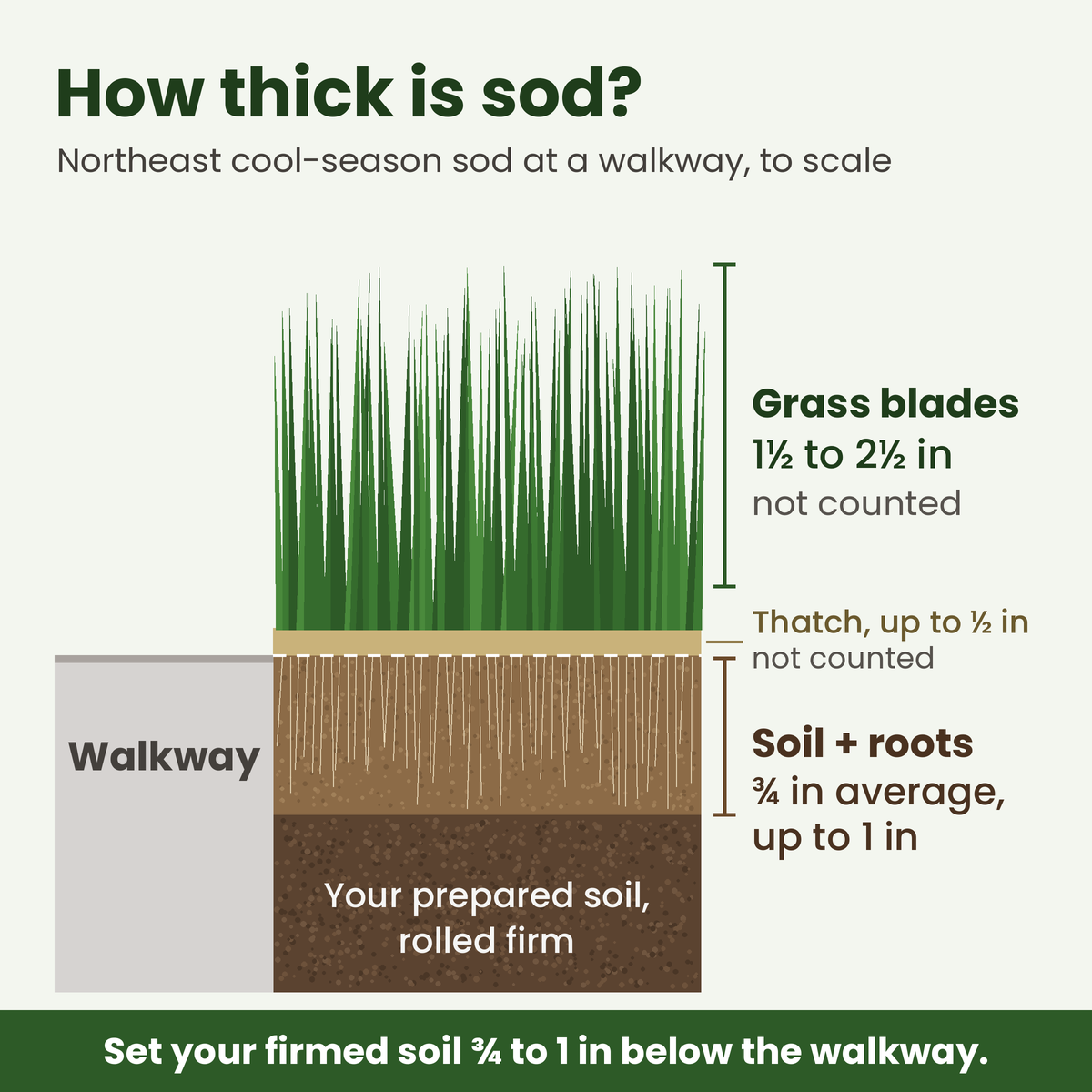
A piece of sod has three layers, and only one of them counts:
- Grass blades. Mowed to a uniform 1 to 2½ inches before harvest under the same guideline (the cool-season version published by the RTF Turf Producers Association). Not counted.
- Thatch. The tan, fibrous mat between the green and the soil. The specification allows up to ½ inch. Not counted.
- Soil and roots. The layer the harvester blade slices loose from the field. This is the thickness that raises your grade, and the only number you grade for.
| What is being measured | Typical number | What it is used for |
|---|---|---|
| Soil-and-root layer of lawn sod | ¾ inch on average, up to 1 inch (Northeast cool-season sod) | Setting the grade at walks, drives, patios, and sprinkler heads |
| Whole piece, bottom of the soil to the blade tips | About 2¼ to 3½ inches (cool-season sod as delivered) | Nothing in site prep. Blades and thatch do not raise the grade |
| Thick-cut sports sod | 1 to 2 inches of soil, 1½ inches most often | Stadium and athletic fields that have to be played on right away |
You will see sod described as 1½ to 2 inches thick, and an earlier headline on this page carried that number. The number is real, but it belongs to one of the other two rows: it is either a whole piece measured to the tips of the grass, or thick-cut sod grown for stadiums. Grade a home lawn 1½ to 2 inches low and the finished lawn sits in a trough, ½ inch to more than 1 inch below every walkway, where water collects and the edge of the pavement stands proud.
Cool-season sod: ¾ inch, up to 1 inch in the Northeast
Nearly everything cut for the Northeast is cool-season sod, and that is what we deliver: Kentucky bluegrass, tall fescue, RTF, and bluegrass-fescue blends, cut to order on farms across the region. On those farms the soil-and-root layer averages ¾ inch and runs up to 1 inch. That sits at the fuller end of what the universities and the specifications publish:
- Virginia Tech turf specialist John R. Hall III: sod is normally cut with ¾ inch, plus or minus ¼ inch, of soil attached, and growers change the cut from day to day with the age and quality of the sod and the moisture in the soil (SportsTurf, 2005).
- University of Maryland Extension: the roots and soil together should be ½ to ¾ inch thick (UMD Extension).
- University of Tennessee Extension: slabs of tall fescue, or tall fescue with Kentucky bluegrass, may carry more than ⅝ inch of soil (publication W160-C).
- Duke University's construction standard for its own campus: fescue sod on a soil base of ¾ inch minimum and 1¼ inches maximum (Duke standard 32 92 23).
- USDA's Economic Research Service, describing the national industry: sod is cut with ½ to ⅝ inch of soil attached (USDA ERS).
Thickness also moves with the day. Hall's point is that the same farm changes its cut with the maturity of the field and the moisture in the soil. Two deliveries of the same grass can measure differently, which is why the last step before final grading is to measure the sod that actually arrived.
Why farms cut thin
More soil does not make better sod. The research and the extension guidance point the same way:
- Thin sod roots faster. University of Maryland turf specialist John R. Hall reported in 1972 that Merion Kentucky bluegrass cut at ½ inch showed faster root appearance, denser roots, and deeper rooting than the same sod cut at 1 inch and 1½ inches, and that ¾ inch beat 1¼ inches for mixtures of tall fescue and bluegrass (Weeds Trees and Turf, 1972). Michigan State's sodding bulletin says the same: thinly cut sod roots faster than sod with a lot of soil under it (MSU Extension E2911).
- Extra soil is dead weight. Hall put sod cut at 1¼ inches at about 175 tons per acre against 100 tons per acre at ¾ inch. That is 75 percent more weight to harvest, truck, and carry for the same lawn. Michigan State adds that heavy sod is more prone to tear.
- Soil that comes with the sod can work against you. If the farm's soil is finer than your planting bed, that layer slows water on its way down to the root zone (MSU). Hall's 2005 checklist makes the same point about layering and recommends sod grown on soil close in texture to the soil on the site.
- Too thin has a cost too. USDA's review notes that sod cut much thinner than ½ inch has trouble holding enough moisture to stay fresh until it is installed. James Beard of Texas A&M wrote that thick-cut sod, slower to root, tolerates drought better where there is no way to irrigate, and that thin-cut sod needs water more often (California Turfgrass Culture, 1976).
Warm-season sod: two different answers
Warm-season sod is a Southern product. This section is here because the question is a national one, and south of the transition zone the answer is different. The numbers below come from the universities and specifications named, not from our own trucks.
Warm-season sod is usually sold as flat slabs instead of rolls: 16 by 24 inches, 2.66 square feet each, on pallets of 400 to 500 square feet (Sod Solutions). How the roll and slab formats compare is covered in how sod is sold.
Bermudagrass, zoysiagrass, and centipedegrass: about ½ inch
These are among the thinnest-cut lawn sods in the country. University of Tennessee Extension puts the average depth of soil shipped with centipedegrass, hybrid bermudagrass, and zoysiagrass at ½ inch or less, because a strong network of stolons and rhizomes holds the slab together without it. Duke University specifies bermudagrass sod at ½ inch minimum and ¾ inch maximum of soil. The guideline specification for EMPIRE zoysiagrass repeats the national number, about 0.6 inch, plus or minus ¼ inch.
They are also mowed short at the farm: ½ to 1 inch for bermudagrass, ¾ to 1½ inches for zoysiagrass, and 1 to 2 inches for centipedegrass (USDA ERS). A slab of hybrid bermudagrass can measure barely more than an inch from the bottom of the soil to the tips of the blades.
St. Augustinegrass: about ¾ inch to a little over 1 inch
St. Augustinegrass goes the other way. It spreads by thick stolons on top of the ground and has no rhizomes (Texas A&M AgriLife Extension). In Beard's table of sod-cutting depths (California Turfgrass Culture, 1976) it sits in the thick group with tall fescue, at 0.7 to 1.2 inches, above the 0.5 to 0.8 inch listed for Kentucky bluegrass, bermudagrass, and zoysiagrass. One Central Texas supplier says its harvesters are set to take 1 inch of soil with the grass (The Grass Outlet). It is mowed taller at the farm too, 2 to 3 inches (USDA ERS), so a St. Augustine slab stands 3 to 4 inches overall.
In south Florida some of it is grown on muck, an organic soil that is lighter than mineral soil (USDA ERS), so a slab of the same thickness weighs less.
Grading for warm-season sod
The rule is the same and the number moves. For bermudagrass, zoysiagrass, and centipedegrass, the firmed soil sits about ½ to ¾ inch below hard edges. For St. Augustinegrass, ¾ inch to 1¼ inches. Low mowing raises the stakes: bermudagrass lawns are kept at ½ to 1½ inches (Sod Solutions), so an edge that finishes ½ inch high is an edge the mower scalps. Measure a slab from your own delivery before the final pass.
| Grass | Soil layer as cut | Mowed height at the farm | Source for the soil layer |
|---|---|---|---|
| Kentucky bluegrass and bluegrass blends (Northeast) | ¾ inch on average, up to 1 inch | 1½ to 2 inches | CT Sod deliveries; national guideline 0.6 inch plus or minus ¼; Virginia Tech ¾ inch plus or minus ¼ |
| Tall fescue, RTF, and fescue-bluegrass mixes | ¾ to 1 inch in the Northeast; more than ⅝ inch (Tennessee); ¾ to 1¼ inches (Duke) | 2 to 3 inches | CT Sod deliveries; Univ. of Tennessee W160-C; Duke standard 32 92 23 |
| Hybrid bermudagrass | ½ inch or less (Tennessee); ½ to ¾ inch (Duke) | ½ to 1 inch | Univ. of Tennessee W160-C; Duke standard 32 92 23 |
| Zoysiagrass | ½ inch or less (Tennessee); 0.6 inch plus or minus ¼ (EMPIRE guideline) | ¾ to 1½ inches | Univ. of Tennessee W160-C; Sod Solutions and TPI guideline |
| Centipedegrass | ½ inch or less | 1 to 2 inches | Univ. of Tennessee W160-C |
| St. Augustinegrass | 0.7 to 1.2 inches; 1 inch at one Texas farm | 2 to 3 inches | Beard, 1976; The Grass Outlet |
| Thick-cut sports sod | 1 to 2 inches, 1½ most often | Set by the field manager | SportsField Management, 2014 and 2017 |
Mowed heights in the table are USDA's figures for sod in production.
Thick-cut sod: where 1½ to 2 inches is real
Stadium fields are where the big number is real. When a professional or college field is replaced in season, it is resodded with turf cut 1½ to 2 inches thick that can take a game right away (SportsField Management, 2014). Field managers describe typical thick-cut sod as 1 to 2 inches deep, most often 1½ when the turnaround is short, and they are plain about the cost: thicker sod weighs more, trucks carry less of it, and the field has to be prepared to match the depth of the cut (SportsField Management, 2017). One sand-based bermudagrass product grown to 1½ inches weighs about 17 pounds per square foot (Carolina Green).
The weight is the point. Thick-cut sod stays put under cleats before it has rooted. A home lawn has two to three weeks to root before anyone plays football on it, so it gets the thin cut that roots faster. Our athletic field sod guide covers thick-cut, big-roll, and washed sod for schools and towns.
How low to set your soil
The firmed, finished soil sits below every hard edge by the thickness of the soil layer on your sod. Do that and the soil line of the new lawn lands level with the walkway, the grass stands above it, and a mower wheel rolls from pavement to lawn without dropping or climbing. Michigan State's version of the rule is to keep the soil surface about 1 inch below the level of sidewalks and the driveway. Ours, for the sod we deliver, is ¾ to 1 inch.
| Sod going down | Set the firmed soil this far below walks, drives, patios, and sprinkler heads |
|---|---|
| Northeast cool-season sod: bluegrass, tall fescue, RTF, blends | ¾ to 1 inch |
| Bermudagrass, zoysiagrass, centipedegrass | ½ to ¾ inch |
| St. Augustinegrass | ¾ inch to 1¼ inches |
| Thick-cut sports sod | The cut depth on your order, usually 1 to 2 inches |
| Any sod, final pass | The soil layer you measure on a piece from your own delivery |
Measure the sod that arrived
Because growers change the cut from day to day, the number that matters is the one on your pallets. Pull one roll, lay it flat, and measure the soil layer in three places with a tape. Use that number for the last rake pass along every edge.
Firm the soil before you measure it
Freshly tilled or freshly spread soil is full of air, and a grade measured on fluffy soil will not hold. Michigan State's sequence is to roll the raked soil with a 200 to 300 pound roller, or water it thoroughly and let it settle, until a person walking across it sinks no more than ½ inch. Then measure.
Whatever goes under the sod goes in before this pass. Lime and fertilizer are mixed into the top 4 inches as the final grade is prepared (MSU), which is where UNDER SOD™, the 4-2-5 made for this step, goes: one 25-pound bag per pallet, mixed into the top 4 to 6 inches. The under-sod fertilizer comparison has the details, and how much topsoil the root zone needs is its own question, answered in how deep topsoil should be for sod.
Every hard edge counts
- Walkways, driveways, patios, and pool coping.
- Steps, stoops, curbs, and paver edging.
- Sprinkler heads, valve boxes, and drain grates. Set the soil the same ¾ to 1 inch below their tops so the sod finishes flush with them. Cutting sod around sprinkler heads is its own skill.
- Mulch beds and tree rings, where the new lawn should meet the bed edge, not bury it.
Patching into an existing lawn
For a repair, the reference is the old lawn's soil surface, not the tips of its grass. Cut the patch area down until the prepared soil sits ¾ to 1 inch below the surrounding soil line, and the new piece drops in level.
Strip, till, or topsoil: what each does to the grade
How the old lawn comes out decides how much edge work is left. A sod cutter takes the old turf and a layer of soil with it. When that layer is about as thick as the new sod, the grade at the edges comes back close to where it started. Tilling the old lawn in, or spreading new topsoil, raises the grade, and the soil along every hard edge has to be pulled back down by the thickness of the sod. The removal methods are compared in can you lay sod over existing grass, bare ground is covered in can you lay sod over dirt, and when a yard needs real regrading is in yard grading for new sod.
Sod grade finder
Pick the sod, or enter the thickness you measured, and say where your prepared soil sits now. The finder returns how far below hard edges the firmed soil belongs and how much to take off or add. The drawing is to scale and redraws as you change it.
Sod grade finder
How far below your walkway the prepared soil belongs, and how much to take off or add to get there.
- Grass blades and thatch: not counted
- Sod's soil-and-root layer: this sets the grade
- Your prepared soil, firmed
- Where your soil sits now
Set the firmed soil ¾ to 1 inch below every hard edge: walkway, driveway, patio, pool coping, and sprinkler heads.
Your soil sits flush with the edge now, so take off ¾ to 1 inch along every hard edge.
As delivered, the grass stands about 1½ to 2½ inches above the pavement. That is blade, not grade.
Growers change the cut from day to day. When the pallets land, measure the soil layer on one roll and run the final pass to that number.
Thickness source: CT Sod deliveries average ¾ inch and run up to 1 inch; Michigan State University Extension sets the soil about 1 inch below walks and drives.
What goes wrong when the grade ignores the sod
- Soil left flush with the walkway. The most common mistake. The lawn finishes ¾ to 1 inch proud of the pavement. The cut edge of the sod is exposed to sun and wind along the whole walk, so it dries out first, and the mower scalps the raised edge for good measure.
- Soil graded 1½ to 2 inches low. The lawn sits in a trough along the pavement. Water collects at the edge, the side of the concrete is exposed, and the mower wheel drops off the walk.
- Grade set on loose soil. It measured right and settled wrong. The edge sinks after the first soaking rains and leaves the lawn low.
- One number trusted over the tape. A table, including the ones on this page, gives a range. The roll on your pallet gives the answer.
After the sod is down
A thin soil layer is a small water tank. Until roots reach the soil underneath, the water in that ¾ inch of soil is all the grass can reach, which is why the first two weeks of watering are not optional. Michigan State's bulletin starts the water within 30 minutes of laying and keeps the sod and the soil beneath it moist with at least daily watering for the first two weeks, and Beard noted that thin-cut sod needs water more often than thick-cut. Our first 14 days watering guide has the schedule. A light rolling after laying presses the sod's soil against yours and closes the air gaps the roots would otherwise have to cross (MSU).
Sod typically roots in two to three weeks (University of Maryland Extension). The Northeast rooting timeline follows it week by week, and the full prep-to-mowing sequence is in the sod installation guide.
If you would rather not hold a rake to a string line, our crews set the grade, bring in the topsoil, and lay the sod anywhere we deliver. See sod installation or call (203) 806-4086.
For the whole job, the sod and topsoil calculator covers the sod, the topsoil, the fill, and the truckloads in one list.
Sources
- Guideline Specifications to Turfgrass Sodding, EMPIRE zoysiagrass edition, Sod Solutions, reprinted with permission of Turfgrass Producers International (soil thickness about 0.6 inch plus or minus ¼; excludes top growth and thatch; farm mowing height)
- Specifications for Turfgrass Sod Materials, RTF Turf Producers Association (the same thickness language for a cool-season grass; mowed 1 to 2½ inches before harvest; thatch up to ½ inch)
- UFGS 32 92 23, Sodding, Unified Facilities Guide Specifications, U.S. Department of Defense (¾ inch plus or minus ¼, excluding top growth and thatch)
- Buying quality sod 101, John R. Hall III, Virginia Tech, SportsTurf, December 2005 (¾ inch plus or minus ¼; growers vary the cut daily; soil layering)
- Consider Thin Cut Sod, John R. Hall, University of Maryland, Weeds Trees and Turf, February 1972 (rooting by cutting depth; tons per acre)
- Successful Turfgrass Sodding Practices, Part I, James B. Beard, Texas A&M University, California Turfgrass Culture, 1976 (cutting depths by species; thin versus thick)
- Nine Steps for Establishing a New Lawn Using Sod, E2911, Michigan State University Extension, 2004 (thin sod roots faster; roll to firm; soil about 1 inch below walks; watering)
- Sod, University of Maryland Extension (roots and soil ½ to ¾ inch; rooting in two to three weeks)
- Turfgrass Establishment: Sodding and Plugging, W160-C, University of Tennessee Extension (less soil with stolons and rhizomes; tall fescue more than ⅝ inch; centipedegrass, hybrid bermudagrass, and zoysiagrass ½ inch or less)
- Construction and Design Standard 32 92 23, Sodding, Duke University, 2018 (fescue ¾ to 1¼ inches; bermudagrass ½ to ¾ inch; top of sod ½ inch below pavement)
- Turfgrass Sod: An Economic Assessment, USDA Economic Research Service, 1995 (½ to ⅝ inch of soil; farm mowing heights; netting; muck soils)
- St. Augustinegrass Lawn Management, Texas A&M AgriLife Extension (stolons, no rhizomes)
- How Much Does a Pallet of Sod Weigh, The Grass Outlet, Austin, Texas (harvesters set to cut 1 inch of soil)
- How Many Square Feet Are in a Pallet of Sod and St. Augustine vs. Bermuda Grass, Sod Solutions (slab and pallet sizes; lawn mowing heights)
- Durable sod for in-season replacement and Sod farmers: key players in the sports turf industry, SportsField Management, 2014 and 2017 (thick-cut depths)
- Sod production, Carolina Green Corp. (1½ inch sand-based sod at about 17 pounds per square foot)
Ready For A Finished Lawn?
Need it installed?
Sod-only crews, up to 30,000 sq ft a day across the Northeast.
From The Field
Our Recent Sod Installation Work
Frequently Asked Questions
How thick is sod?+
How thick is a roll of sod including the grass?+
Is sod 1½ to 2 inches thick?+
How far below a sidewalk or driveway should the soil be before laying sod?+
How thick is bermuda or zoysia sod?+
How thick is St. Augustine sod?+
Is thicker sod better?+
Does sod thickness vary from one delivery to the next?+
Does new sod raise the level of my lawn?+
Do sprinkler heads need to be adjusted for sod?+
Does sod thickness affect watering?+
Keep Reading

What Is Best to Put Down Before Sod? A Layer-by-Layer Guide

How to Lay Kentucky Bluegrass Sod

The Darien, CT Sod Guide: Tokeneke to Ox Ridge, the 50-Foot Rule, and No Sunday Ordinance
