
Under Sod 4-2-5 is blended into the top 4 to 6 inches of soil before the sod goes down. It is not a starter you sprinkle on top.
Application rate: one 25-pound bag per pallet of sod (500 square feet), which is 50 pounds per 1,000 square feet, blended into the top 4 to 6 inches. Follow the soil test and local rules; this rate supplies 1.0 pound of phosphate (P2O5) per 1,000 square feet, so count it toward the report rather than adding it on top of a separate phosphorus allowance.
A builder's yard is not a lawn that happens to be missing grass. It is a construction site with the topsoil scraped off, the subsoil packed by months of equipment, and whatever fill was cheapest that week spread over the top. Sod on that ground looks fine at closing and starts failing in year two, because the roots hit a floor. This post is what to do under the sod on a new build, in the order the work has to happen, with the extension and research sources for each step. It is written for the builder, the site super, and the homeowner who just bought the house and can already see the seams.
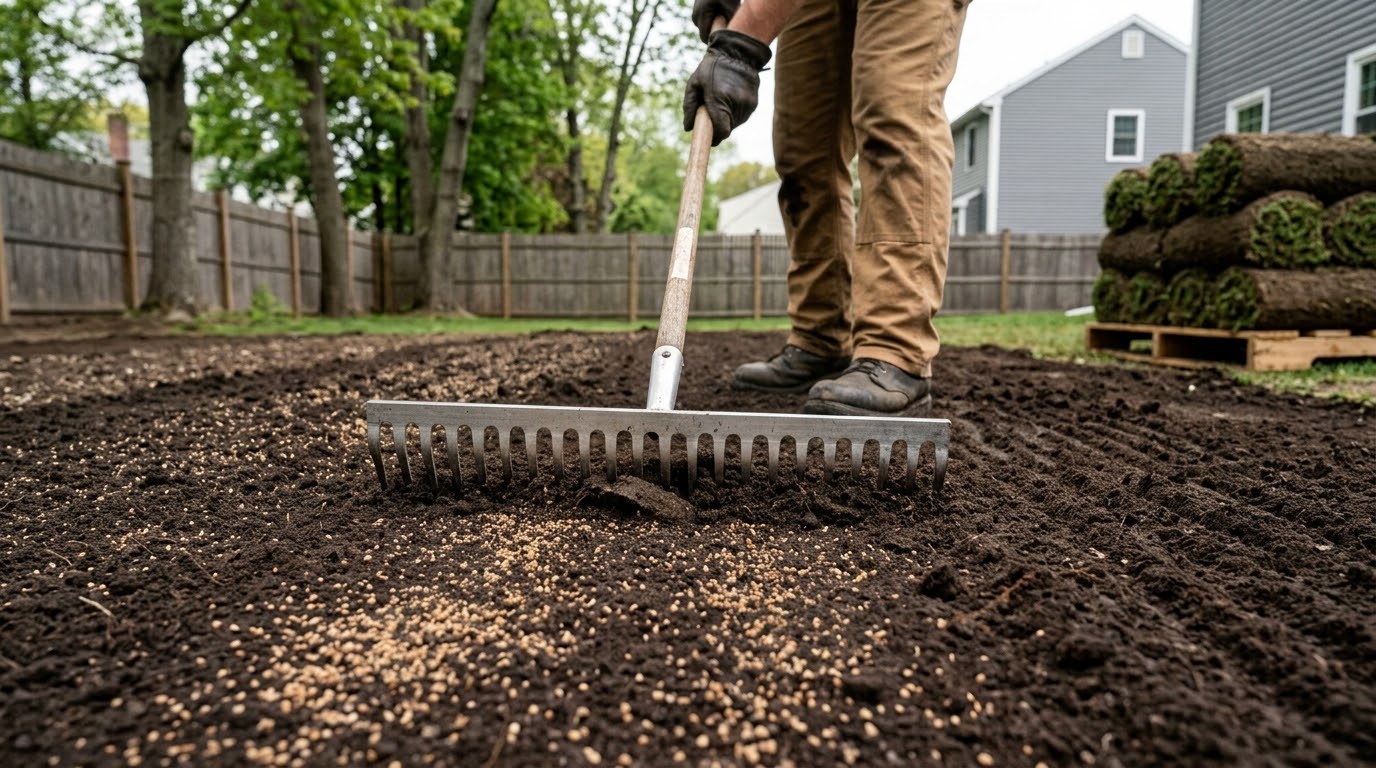
On a new-construction lot, fix the base before you think about the bag: break the compaction 4 to 6 inches deep, place 4 to 6 inches of real topsoil, then test that topsoil. The test will usually come back low in phosphorus and often off in pH, which is the opposite of an established lawn. On a low test, a starter or straight phosphate at the report's rate goes in, tilled into the top 4 to 6 inches, once, and every state's phosphorus law allows it on a new lawn. Scraped and stockpiled soil has also lost most of its mycorrhizal inoculum, and it takes years to come back on its own, which is why the bag that goes under the sod carries the fungi and keeps phosphorus low enough that the plant will accept them. The 4-2-5 with no iron and four species of mycorrhizae, one 25-pound bag per pallet of sod (500 square feet), which is 50 pounds per 1,000 square feet, blended into the top 4 to 6 inches, is Under Sod 4-2-5; the 8-0-6 with 2 percent non-staining iron, one 25-pound bag per four pallets at 30 days, is Over Sod 8-0-6.
This is part of a series: read your soil test → do you need a starter → what goes under the sod → the 30-day feeding.
What a builder's yard actually is
The University of Georgia's lawn establishment bulletin describes the starting condition without softening it: "On new construction sites, topsoil is sometimes stripped and stockpiled (or hauled away)." A Georgia extension agent's version for homeowners is blunter: a new home site "will have highly compacted soil, the consistency of concrete, which is good for the foundation of a home" and "very difficult to grow anything in," and in most cases "the topsoil around a newly constructed home has been removed." Clemson's fact sheet says the compacted subsurface produced by rough grading "must be broken up," with a spring-tooth harrow for light compaction and a rototiller for heavy.
Three things follow from that description, and they are the three things a soil test on the fill will show:
- Phosphorus is often genuinely low. Kansas State's turf nutrient guide: "Soil phosphorus levels are frequently low in new housing developments before turf has been established." This is the one situation where the high-phosphorus starter that we tell most homeowners to skip is the right tool, and every state phosphorus law has a new-lawn exemption written for exactly this case.
- pH can be off in either direction. In Georgia the exposed subsoil is "very acidic." In the Northeast the more common problem is the opposite: concrete, mortar, and lime rock left in the fill push pH up near the foundation, the walks, and the driveway. University of Florida extension has "often seen landscapes where the soil pH changed dramatically near the street, sidewalk, or home foundation" from those materials, and the University of Maryland notes that iron chlorosis in plants "placed too close to cement foundations or walkways" comes from calcium carbonate raising the pH. Turf iron is locked up above about 7.5. You cannot fix that with iron in a bag; you fix it with the pH, and the test tells you which way.
- The biology is gone or dormant. Topsoil is where the mycorrhizal fungi and the bacteria that feed a root system live. Strip it, stockpile it, or bury it under fill and the inoculum drops. The research on that is below.
| Factor | Established lot, old lawn stripped | New-construction lot | What it changes |
|---|---|---|---|
| Phosphorus | Usually optimum or high; Cornell found at least 80% of lawn samples had enough | Frequently low (Kansas State) | Starter is usually wrong on the first and often right on the second; the test decides |
| pH | Whatever the lawn's history left; test | Often high near foundations and walks from concrete and mortar; acidic exposed subsoil in some regions | Lime or sulfur per the report, incorporated, before the sod |
| Organic matter | Present in the old topsoil | Near zero in fill; 2–3 cu yd per 1,000 sq ft tilled in (Kentucky) | Water holding and root depth |
| Compaction | Surface, from foot traffic | Deep, from months of equipment; "the consistency of concrete" (Georgia) | Harrow or till 4–6 in before topsoil (Clemson); compost-and-till on the worst sites (Kentucky standard) |
| Mycorrhizal inoculum | Present | Reduced by stripping and stockpiling; years to recover on its own (Jasper et al.; Warner) | The under-sod bag carries it, and keeps phosphate low so the plant accepts it |
| Topsoil | Existing, 4 in or more | Placed: 4–6 in settled, ordered at +15% | The calculator below |
| Under the sod | Low-phosphorus incorporated bag | Phosphate at the report's rate plus the incorporated bag, counted together | Both mixed into the top 4–6 in, once |
There is a fourth thing the test will not show and a shovel will: how deep the topsoil really is. The new-build lawns we get called about in the second summer usually have two to four inches of topsoil sitting on packed fill. Sod roots into that layer in the first season because it arrives with its own roots, looks fine at closing, and then declines when the roots reach the floor and the lawn becomes dependent on daily water. That is our field observation, not a study, and it is consistent every time. The fix is not fertilizer. It is depth.
Fix the base before the bag
Everything under this heading is extension guidance, and none of it is optional on a scraped lot.
1. Clear it. Rocks, stumps, construction debris, and buried lumber. Georgia: stumps and debris left in the ground "eventually decay and leave deep depressions in the lawn several years later." 2. Break the compaction. Clemson: harrow for light compaction, rototill for heavy, after rough grading. The University of Kentucky's landscape standard for construction sites with removed topsoil and compacted subsoil goes further, spreading compost to a 4-inch depth over the compacted subsoil and tilling it 6 inches before topsoil is replaced. Do not work the soil wet; Kentucky extension: "the soil will compact more, thus losing the benefits of the organic matter." 3. Place real topsoil, 4 to 6 inches settled. UNH Extension: on poor soils, "adding four inches of loam and/or organic matter can make the difference between a healthy low maintenance lawn and a thin or weed infested lawn." Our own minimum for an install is 4 inches of quality topsoil over a prepared base; on a scraped lot we would rather see 6. Settled depth, not dumped depth: topsoil loses volume as it firms, and the calculator below adds 15 percent to the order for that. 4. Add organic matter if the topsoil is thin on it. Kentucky extension: 2 to 3 cubic yards per 1,000 square feet, tilled into the upper 6 inches, for soil that is too sandy, too heavy in clay, or compacted. 5. Now test. Georgia: after the site is prepared and leveled, "collect a soil sample to obtain soil fertilizer recommendations." Test the topsoil you placed, not the fill under it, 10 to 20 cores about 4 inches deep. The four Northeast labs, what their reports mean, and what to write on the form are in the soil test post. 6. Correct pH per the report. Lime for low pH, incorporated into the top 4 to 6 inches (Michigan State, Rutgers). Sulfur for high pH, in the amounts on the report and no more. If you suspect buried concrete or mortar, North Dakota State's kitchen test works anywhere: a tablespoon of soil in two tablespoons of vinegar; if it fizzes, there is lime in the soil, and lowering pH will be slow. 7. Then the bag, then the grade, then the sod, the same day.
Sod on top of packed fill with two inches of screened topsoil skips steps 2 through 6. That is the yard that fails in year two.
Phosphorus on a new build: the one time the starter is right
For most established lots we say the same thing the land-grant labs say: phosphorus only if the test is low, and it usually is not. A new build is the exception the labs and the laws both anticipated. Penn State's soil-test report for a home lawn to be planted says to "thoroughly mix recommended phosphate (P2O5) and/or potash (K2O) into a four to six inch soil depth," and defines the starter it means as 0.5 to 1.0 pound of P2O5 per 1,000 square feet. Connecticut, New York, Massachusetts, New Jersey, Pennsylvania, Maryland, Minnesota, Wisconsin, Michigan, and Washington all exempt a new lawn from their phosphorus restrictions, and New Hampshire allows it at a capped rate. The full fifteen-state table is in Do You Need Starter Fertilizer for Sod?.
So on a low test: phosphate at the report's rate, tilled in with the topsoil, once. The Under Sod 4-2-5 label delivers 1 pound of P2O5 per 1,000 square feet on its own, the top of Penn State's starter range, so on a test that is a little low it may cover the number by itself; on a test that is badly low, the additional phosphate comes from a starter or straight superphosphate at the report's rate, mixed in at the same time, and you count both. The rate, the label math on the common starters, and the don't-double-up rule are in the starter post.
On a test that comes back optimum or high, which happens when the placed topsoil was good, treat it like any other lawn: no starter, the incorporated low-phosphorus bag.
The biology: what scraping and stockpiling do to it
This is the part of a new build that no fertilizer analysis on a bag addresses, and the research on it is older and more consistent than most people expect.
Jasper, Robson, and Abbott, working on disturbed sites in Australia, found that "topsoil disturbance decreased the number of spores or the number of spore types that could be isolated from the soil, and reduced or delayed formation of VA mycorrhizas," that "both disturbance and a period of storage without plant growth contributed to the loss in infectivity," and that infective propagules were restored to undisturbed levels only "after 4–5 years of revegetation." Gould and Liberta documented the same loss from topsoil storage during surface mining in 1981. Warner, at Rothamsted, found twelve years of topsoil storage at a Hertfordshire gravel pit "reduced the indigenous population of vesicular-arbuscular mycorrhizal fungi substantially," with re-establishment after restoration taking 8 to 20 months. Wiseman and Wells, summarizing the field in Arboriculture and Urban Forestry, put it in one sentence: disturbance of native soils "has been shown to reduce AMF propagule abundance and infectivity."
Wiseman and Wells also supply the caveat, and it argues for the bag's design more than against it. In their study of red maples on newly developed lots next to native forest, the landscape trees had far lower mycorrhizal colonization than the forest trees, 3 percent versus 22 percent, yet soil-and-sand mixtures made from the landscape soils held greater inoculum potential than mixtures made from the forest soils, 10 percent versus 4. The difference tracked soil chemistry: the forest soils "were more acidic and possessed less extractable P than landscape soils," and the trees on the developed lots declined the partnership. Their conclusion: "not all disturbed landscape soils are deficient in AMF propagules." Two lessons for a sod job. First, inoculant matters most where the topsoil was actually removed or stockpiled, which describes most new builds. Second, inoculant only works if phosphorus in the contact zone is low enough that the plant will let the fungi in, which is why the bag built to carry fungi holds its phosphate at 2 percent, and why a high-phosphorus starter on soil that does not need it undoes the biology you paid for.
One more honest note on the research: the disturbed-soil studies above are from mine sites in Australia and the American West and a gravel pit in England. A Wisconsin study of reclaimed taconite tailings found mycorrhizal propagules re-establishing within weeks of reclamation, faster than the semi-arid sites, because wetter sites grow host plants faster. A Northeast lawn recovers faster than a mine, and it recovers from a lower start than an undisturbed lawn. Both things are true.
The University of Minnesota's turf program review lists Kentucky bluegrass, the fescues, and perennial ryegrass among the grasses that form these associations, and cites Pelletier and Dionne's 2004 finding of faster establishment with Glomus intraradices, now named Rhizophagus irregularis, one of the four species on the Under Sod 4-2-5 label. Turfgrass results vary with the grass, the fungus, and the soil; we label that honestly. But the direction on a scraped lot is not in doubt: the soil has less of this than a lawn that was never disturbed, and it takes years to recover on its own.
pH, iron, and why the under-sod bag has no iron
Iron chlorosis, yellow leaf with green veins, is common on new builds near foundations, walks, and driveways, for the reason above: construction lime and concrete washout push pH up, and iron becomes unavailable to the plant even when the soil has plenty of it. Kansas State adds a second cause that lands on the same lawns: "excessive phosphorus can interfere with iron uptake by turfgrass roots and lead to an iron deficiency." A high-phosphorus starter on a fill soil that did not need it, next to a foundation that raised the pH, is how a new lawn goes yellow in June.
The fix for a pH problem is the pH, per the report. Iron in the bag under the sod would green the leaf for a few weeks and change nothing below it, which is why the under-sod bag has none. At day 30, when the lawn is rooted, Over Sod 8-0-6 carries 2 percent non-staining iron for color while a pH correction takes its time; the day-30 bag is the right place for iron, and it is the only place we put it.
On a builder's schedule
We do this work on construction sites, and the schedule is the constraint that decides whether the base gets done. Turner Construction called us on a Tuesday with a Monday ribbon cutting at Central Middle School in Greenwich; the crew had 11,000 square feet installed and watered by Friday. That job worked because the base was ready when the trucks arrived. The 17,000-square-foot Shelton install around a new pool is the residential version: pool contractor out, base prepared, sod in a day.
For a builder, that means the topsoil order, the tilling, and the soil test happen a week before sod, not the morning of. The test takes about a week to come back. Sod cut to order takes 2 to 7 days. Sequence them and the lot is sodded the week the punch list closes; skip the test and you are guessing at phosphorus and pH on the one soil where guessing is most likely to be wrong. Builders: prep, grading, and topsoil are quoted with the sod, 1,200 square feet minimum, up to 30,000 square feet a day. (203) 806-4086.
Run the lot:
New-construction lawn: what to order
Topsoil, pallets, and the two bags for a scraped or filled lot. Topsoil depth is the settled depth; the order adds 15 percent for settling.
2,000 sq ft is 4 pallets of sod at 500 sq ft each.
Topsoil at a settled 4 inches: 24.7 cubic yards placed, order about 28.4 cubic yards to allow for settling and compaction (our 15 percent allowance).
Phosphorus optimum or high: Under Sod 4-2-5 at one 25-pound bag per pallet of sod (500 square feet), which is 50 pounds per 1,000 square feet, blended into the top 4 to 6 inches, once. 4 bags for this area.
Day 30, after the tug test: one 25-lb bag of Over Sod 8-0-6 per four pallets. 1 bag for this area. Nothing on top before then.
Follow your soil test report where it gives a number; the report governs phosphate, lime, and sulfur.
The procedure for a new-construction lot
1. Clear debris, stumps, and construction trash. Correct drainage with rough grade. 2. Break the compaction 4 to 6 inches deep after rough grading. Harrow for light compaction, rototill for heavy. Never wet. 3. Place quality topsoil to a settled 4 to 6 inches. Order 15 percent more than the math. 4. Till in 2 to 3 cubic yards of organic matter per 1,000 square feet if the topsoil is thin on it. 5. Test the placed topsoil: 10 to 20 cores, about 4 inches deep, one lab. 6. Lime or sulfur per the report, incorporated. 7. Phosphorus low: starter or phosphate at the report's rate, plus Under Sod 4-2-5 at one 25-pound bag per pallet of sod (500 square feet), which is 50 pounds per 1,000 square feet, blended into the top 4 to 6 inches, counted together, tilled into the top 4 to 6 inches. Phosphorus optimum or high: Under Sod 4-2-5 alone. 8. Finish grade. Lay the sod the day it arrives. Roll. Water. 9. Nothing on top for 30 days. Water every day for two weeks. 10. Day 30, tug test, then one 25-pound bag of Over Sod 8-0-6 per four pallets, inside your state's dates.
What we are not claiming
The mycorrhizal research above is on disturbed and mined soils and on landscape trees, not on sodded lawns; Wiseman and Wells found that not every disturbed landscape soil is short on propagules, and Johnson and McGraw found recovery is faster on wet sites than the mine studies suggest. The 15 percent topsoil settling allowance is our field number, not an extension figure. New Hampshire caps phosphate in retail turf fertilizer for new lawns at 0.25 pounds per 1,000 square feet per application, below the planned rate, and New Jersey and Pennsylvania cap nitrogen per application; those are label and registration questions for those states, addressed in the starter post and not resolved here.
Sources
- University of Georgia Extension, Bulletin 1533-2, Lawns in Georgia: Establishment. Topsoil stripped and stockpiled or hauled away on new construction sites; test after preparation; incorporate starter and lime. https://secure.caes.uga.edu/extension/publications/files/pdf/B%201533-2_2.PDF
- University of Georgia Extension, Bartow County. New home sites: compacted soil "the consistency of concrete," topsoil removed. https://site.extension.uga.edu/bartow/wp-json/wp/v2/posts/862
- Clemson Cooperative Extension, HGIC, Lawn Establishment. Compacted subsurface from rough grading must be broken up; harrow or rototiller. https://hgic.clemson.edu/factsheet/lawn-establishment/
- UNH Extension, Seeding a New Lawn. Four inches of loam and/or organic matter on poor soils. https://extension.unh.edu/resource/seeding-new-lawn-video
- University of Kentucky Extension, Daviess County, Establishing a New Lawn. Two to three cubic yards of organic matter per 1,000 sq ft tilled into the upper 6 inches; do not work wet soil. https://daviess.ca.uky.edu/sites/daviess.ca.uky.edu/files/20240727%20%20Establishing%20a%20new%20lawn.pdf
- University of Kentucky Design and Construction Standards, Soil Profile Rebuilding. Compost over compacted subsoil, tilled 6 inches, before topsoil replacement. https://facilities.uky.edu/sites/default/files/standards/329113s01_soil_profile_rebuilding_.pdf
- Kansas State Research and Extension, MF2311. Phosphorus frequently low in new developments; excess phosphorus and iron uptake. https://bookstore.ksre.ksu.edu/pubs/MF2311.pdf
- Penn State Agricultural Analytical Services Laboratory, sample soil test report for a home lawn to plant. Starter definition; incorporate 4 to 6 inches. https://agsci.psu.edu/aasl/soil-testing/fertility/handbooks/turf/forms/sample-soil-test-report-for-home-lawn-to-plant
- UF/IFAS Extension, Duval County, Why Soil pH Matters. Concrete, mortar, and lime rock raise pH near streets, sidewalks, and foundations. https://blogs.ifas.ufl.edu/duvalco/2021/11/30/why-soil-ph-matters/
- University of Maryland Extension. Iron chlorosis near cement foundations and walkways from calcium carbonate. https://extension.umd.edu/resource/azaleas-and-rhododendrons-identify-and-manage-problems
- North Dakota State University Extension, Iron Chlorosis. The vinegar test for lime in soil; pH above 7.5. https://www.ndsu.edu/agriculture/node/2102
- Jasper, D. A., Robson, A. D., and Abbott, L. K. 1987. The effect of surface mining on the infectivity of vesicular-arbuscular mycorrhizal fungi. Australian Journal of Botany 35:641–652. https://publish.csiro.au/BT/BT9870641
- Warner, A. 1983. Re-establishment of indigenous vesicular-arbuscular mycorrhizal fungi after topsoil storage. Plant and Soil 73(3):387–394. https://link.springer.com/article/10.1007/BF02184315
- Johnson, N. C., and McGraw, A. C. 1988. Vesicular-arbuscular mycorrhizae in taconite tailings. I. Incidence and spread of endogonaceous fungi following reclamation. Agriculture, Ecosystems and Environment. Faster re-establishment on mesic sites. https://experts.nau.edu/en/publications/vesicular-arbuscular-mycorrhizae-in-taconite-tailings-i-incidence/
- Wiseman, P. E., and Wells, C. E. 2005. Soil inoculum potential and arbuscular mycorrhizal fungal colonization of Acer rubrum in forested and developed landscapes. Arboriculture and Urban Forestry 31(6):296. https://auf.isa-arbor.com/content/31/6/296
- University of Minnesota Turfgrass Science, Sessoms 2020. AMF and their interactions with turfgrass species. https://turf.umn.edu/news/arbuscular-mycorrhizal-fungi-amf-and-their-interactions-turfgrass-species
- Michigan State University Extension, E2911, Nine Steps for Establishing a New Lawn Using Sod. Incorporation depth. https://sanweb.lib.msu.edu/DMC/extension_publications/e2911/E2911-2004.PDF
Ready To Order?
Fresh-Cut Sod Delivered
CT Sod delivers Kentucky Bluegrass, Tall Fescue & RTF sod across CT, MA, NY, NJ, RI, NH, VT & ME.
From The Field
