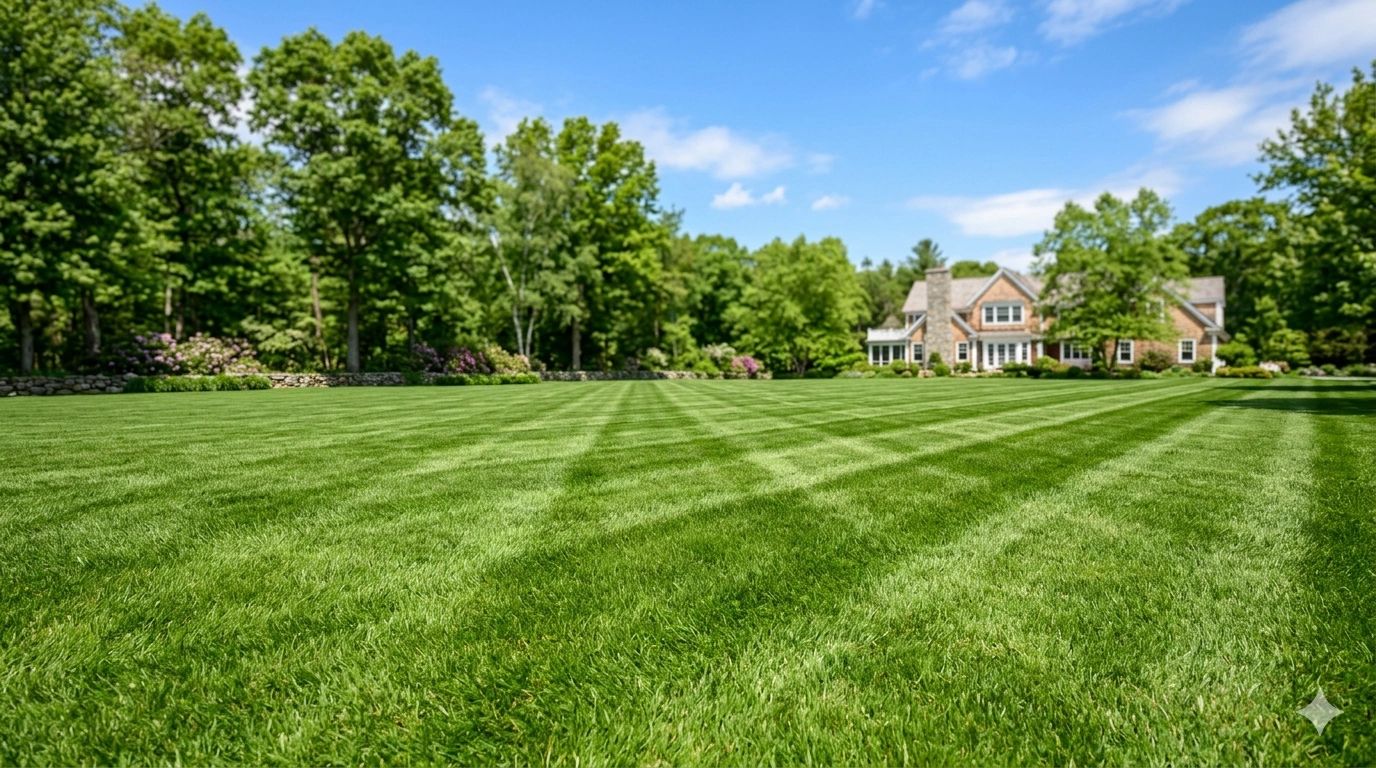
Best Sod Varieties for Sunny Lawns: A Complete Guide to Full-Sun Cool-Season Sod for Northeast Properties
Full sun is the easy condition for cool-season grasses — the question isn't which variety tolerates sun, but which variety performs reliably given the property's specific irrigation, use patterns, and exposure. This guide covers the four primary full-sun varieties — tall fescue, Kentucky Bluegrass, RTF, and perennial ryegrass — and matches each to the property conditions where it actually wins. It's the companion to our guide to shade-tolerant sod varieties. Skim the Quick Answer Guide below for the short version, or read the full sections for the deeper variety landscape.
Quick Answer Guide: The Short Version
Best sod for coastal Northeast properties with full sun and salt exposure? Tall fescue or RTF with salt-tolerant cultivars. See our guides for the Hamptons, Westport, and Cape Cod.
Will Kentucky Bluegrass survive a Northeast summer without irrigation? It usually goes summer-dormant — turns tan, growth stops — and recovers when fall rain returns. Survives, but the showcase aesthetic disappears for the months you most want it. See our Kentucky Bluegrass diseases guide for the management considerations.
Does the cultivar matter, or is "tall fescue" just "tall fescue"? Cultivar matters substantially. Premium NTEP-tested cultivars from regional growers outperform generic sod meaningfully across heat tolerance, drought tolerance, disease resistance, and aesthetic. Our cluster covers Kentucky Bluegrass cultivars and tall fescue cultivars in detail, plus deep dives on Midnight and Merion Kentucky Bluegrass.
The full variety landscape, property condition matching, common mistakes, and establishment guidance follow below.
Why Full Sun Is the Easy Condition Biologically
Cool-season grasses evolved primarily as full-sun species. Photosynthesis — the process by which grass blades convert sunlight into chemical energy that fuels root growth, blade growth, and overall plant health — requires substantial direct light. Standard Kentucky Bluegrass performs optimally with 6 to 8 hours of direct sunlight daily. Most tall fescue varieties perform optimally with 4 to 6 hours of direct sun. Perennial ryegrass performs optimally with 6 to 8 hours of direct sun. Full sun conditions provide more than adequate light for any of these species to perform their photosynthetic functions and produce dense, healthy turf.Adequate light is rarely the limiting factor for full-sun lawn performance. The limiting factors are almost always the secondary stresses that accompany full sun on residential properties: heat stress during summer, moisture stress during dry periods, soil temperature extremes, wear pressure from active use, and the concentrated stresses that develop on south-facing and west-facing exposures during peak summer conditions.
Cool-season grasses photosynthesize most efficiently between approximately 60°F and 75°F. Above approximately 85°F, photosynthetic efficiency declines, and cool-season grasses begin transitioning toward heat-protective dormancy mechanisms. The combination of full sun, high air temperatures, intense soil temperatures from solar gain, and elevated transpiration rates during summer creates stress conditions that determine whether full-sun lawns thrive or struggle through the most demanding months of the year.
The variety landscape for full-sun lawns organizes around the secondary stress profile of the property, not around basic light tolerance. Properties with reliable irrigation can support varieties with shallower roots and lower drought tolerance because the irrigation infrastructure compensates for those limitations. Properties without irrigation must select varieties with deep roots and strong drought tolerance because the lawn must survive on natural rainfall and stored soil moisture during summer dry periods. Properties with substantial wear pressure must select varieties with strong wear tolerance and recovery capability regardless of their irrigation situation.
The fundamental full-sun variety principle: match the variety choice to the actual stress profile of the specific property. Don't specify Kentucky Bluegrass for properties without irrigation expecting it to handle summer drought — it will go dormant. Don't specify perennial ryegrass for properties on south-facing slopes without irrigation — it lacks the heat and drought tolerance to handle that combination. Don't specify standard tall fescue for properties with kids playing soccer five days a week — the wear pressure exceeds tall fescue's recovery capability without the rhizomatous self-repair of RTF. Each variety has a specific performance envelope.
Full Sun Conditions Defined
Practical full-sun variety selection requires understanding what level of sun and stress actually exists on the specific lawn area being addressed. Full sun isn't a binary condition any more than shade is. There are multiple meaningfully different full-sun conditions, each with different variety implications.Standard full sun (6 or more hours of direct daily sun) on a typical residential property. The most common condition across Northeast residential properties — open lawn areas without substantial canopy obstruction, suburban corridors with average tree cover, estate properties with formal lawn zones designed around full sun. All cool-season varieties perform reasonably under standard full sun. Variety selection comes down to irrigation infrastructure, use patterns, and aesthetic priorities rather than light tolerance.
Intense full sun (8 or more hours of direct daily sun) without irrigation. Common on open suburban lots without substantial tree cover, on cleared estate lawn zones, on lake estate properties with cleared waterfront lawn areas, on coastal properties with limited tree cover. The combination of extended daily sun exposure plus lack of irrigation creates demanding moisture-management conditions that favor tall fescue and RTF over Kentucky Bluegrass and perennial ryegrass.
South-facing exposure with afternoon sun. Lawn areas with south-facing aspect receive the most concentrated solar exposure during peak summer conditions. South-facing slopes and lawn areas immediately south of buildings face the highest summer heat stress, the highest soil temperatures, the highest evapotranspiration rates, and the most demanding drought conditions. Tall fescue and RTF handle south-facing exposures more reliably than Kentucky Bluegrass or perennial ryegrass.
West-facing exposure with intense afternoon sun. West-facing lawn areas receive the most stressful daily light condition for cool-season grasses — high-angle afternoon sun coinciding with peak daily temperatures. The combination produces the most demanding heat stress profile of any common residential exposure. West-facing lawn areas often show heat stress symptoms during summer despite receiving total sun hours similar to other orientations, because the timing of the peak sun exposure compounds the heat stress on cool-season turf.
Reflective heat exposure adjacent to hardscape. Lawn areas immediately adjacent to concrete driveways, stone patios, pool decks, asphalt surfaces, stucco walls, or south-facing brick walls face localized heat stress from reflected solar energy. Hardscape surfaces absorb solar energy during the day and reradiate it as heat, producing surface temperatures meaningfully higher than open lawn areas. The reflective heat zone typically extends 4 to 8 feet from the hardscape edge depending on the surface material, color, and orientation. Tall fescue and RTF handle reflective heat better than Kentucky Bluegrass or perennial ryegrass.
Sandy or fast-draining soils under full sun. Sandy soils drain quickly and retain less moisture and fewer nutrients than loamy soils. Under full-sun conditions, the limited soil moisture-holding capacity compounds summer drought stress. Coastal properties with sandy soils, properties on glacial outwash deposits common across portions of the Northeast, and properties with imported sandy fill materials face conditions that favor deep-rooted tall fescue or RTF over shallow-rooted varieties. Our guide to amending sandy soil with compost covers the soil preparation considerations.
Heavy clay soils under full sun. Clay soils retain moisture longer than sandy soils but become hard and crusted during summer dry periods, producing root zone conditions that limit oxygen availability and restrict deep root development. Heavy clay soils favor varieties tolerant of imperfect soil conditions — tall fescue particularly handles a wide range of soil types better than Kentucky Bluegrass.
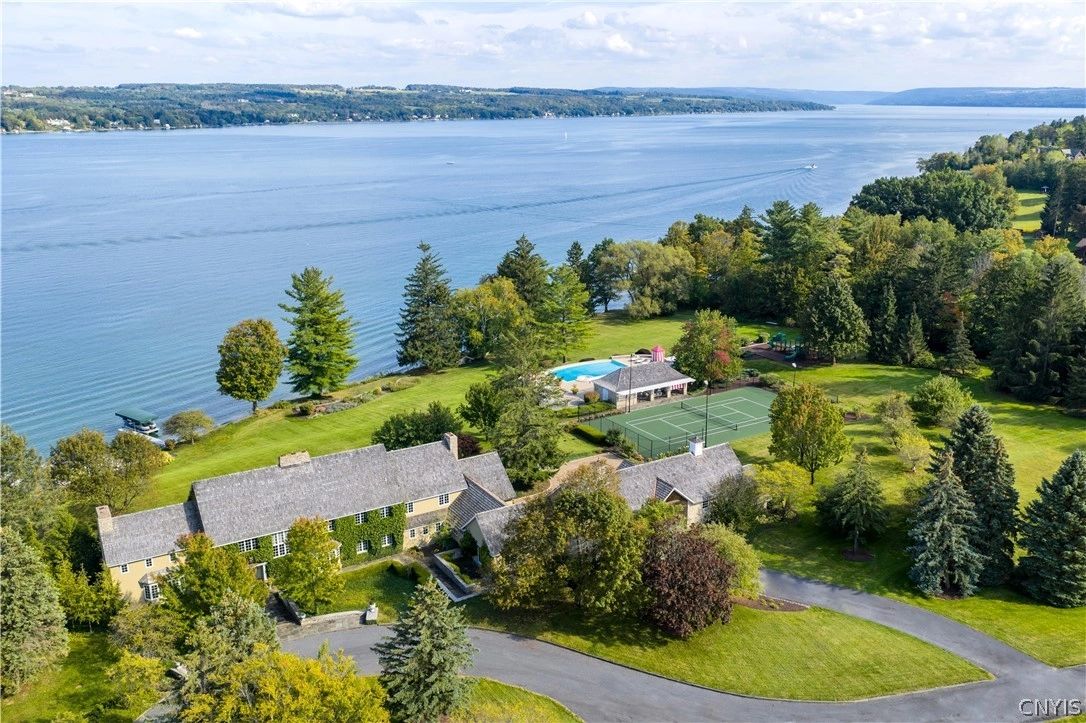
Northeast lake estate properties with cleared waterfront lawn zones. Lake estate corridors throughout the Northeast — Pocono lakes, Adirondack lakes, the Hudson Valley and Catskills corridor, Lake Winnipesaukee region, Squam Lake, Lake Champlain corridor, and the Maine lake estate market — frequently feature cleared waterfront lawn zones with full sun exposure between the residence and the water. These zones often combine full sun with sandy or rocky soils, lake-effect wind exposure, and seasonal use patterns that affect variety choice.
Coastal estate properties with full sun and salt exposure. The Hamptons estate corridor, Cape Cod estate properties, Newport coastal estates, Westport and the Connecticut shoreline estates, and the broader Northeast coastal estate market feature substantial full-sun lawn zones with salt spray and salt-laden coastal winds. Coastal full-sun conditions favor tall fescue, RTF, and select salt-tolerant cultivars within other species.
Top Full-Sun Sod Varieties
The variety landscape for full-sun lawns centers on four primary species with distinct performance profiles — tall fescue as the practical workhorse, Kentucky Bluegrass as the showcase aesthetic, RTF as the durability upgrade, and perennial ryegrass as the wear tolerance specialist. Each species has specific applications where it outperforms the alternatives, and each species has limitations that disqualify it from certain property conditions.:::diagram type=roots title="Mature Root Depth by Variety (inches)" caption="Typical mature root depth under proper Northeast establishment." Kentucky Bluegrass|6 Perennial Ryegrass|8 Fine Fescue Blends|10 Tall Fescue|30 RTF|36 :::
| Variety | Sun Need | Root Depth | Irrigation Need | Wear Tolerance | Aesthetic |
|---|---|---|---|---|---|
| Tall Fescue | 6+ hrs | 2–3 ft | Low | Moderate–High | Refined modern |
| Kentucky Bluegrass | 6+ hrs | 6–8 in | High | Moderate (self-repairs) | Premium estate |
| RTF | 6+ hrs | 2–3 ft | Low | High (rhizomatous repair) | Refined modern |
| Perennial Ryegrass | 6+ hrs | 6–10 in | Moderate–High | Highest (sports-grade) | Fine, glossy |
| KBG / Rye Blend | 6+ hrs | 6–10 in | High | High | Premium with quick-fill |
| Three-Way Blend | 6+ hrs | 10–24 in | Moderate | High | Balanced |
Tall Fescue — The Practical Full-Sun Workhorse
Tall fescue is the most reliable practical full-sun choice for Northeast residential properties — strong full-sun performance, deep root system that handles drought and heat stress without daily irrigation, moderate to good wear tolerance, refined aesthetic with modern turf-type cultivars, broad adaptability across soil types and growing conditions. Our tall fescue variety guide and tall fescue vs Kentucky Bluegrass comparison cover the variety in detail.
Tall fescue's full-sun performance is strong across the variety landscape. Tall fescue performs optimally with 4 to 6 hours of daily direct sun and handles intense full-sun conditions including 8 or more hours of daily exposure without difficulty. The variety's broad sun tolerance makes it the most adaptable cool-season choice across varied property conditions.
Tall fescue's heat tolerance is the strongest among the major cool-season residential varieties. Tall fescue handles Northeast summer heat stress more reliably than Kentucky Bluegrass or perennial ryegrass, particularly during the peak July and August stress periods. Properties facing intense summer heat — south-facing exposures, hardscape-adjacent zones, west-facing slopes — benefit from tall fescue's heat tolerance.
Tall fescue's drought tolerance is driven by its deep root system. Tall fescue roots typically reach 2 to 3 feet deep in mature lawns under typical conditions — substantially deeper than Kentucky Bluegrass or perennial ryegrass — allowing tall fescue to access moisture deeper in the soil profile during dry periods. Properties without irrigation infrastructure benefit substantially from tall fescue's drought tolerance.
Tall fescue's wear tolerance is moderate to good. Standard tall fescue handles normal residential foot traffic, kids' play, and moderate dog activity reasonably well but lacks the rhizomatous self-repair that allows RTF or Kentucky Bluegrass to recover from concentrated wear damage. Properties with substantial wear pressure benefit from RTF rather than standard tall fescue.
Tall fescue's fertility requirements are moderate. Tall fescue performs well on 2 to 4 pounds of nitrogen per 1,000 square feet annually — less than Kentucky Bluegrass requirements (3 to 5 pounds annually) and more than fine fescue requirements (1 to 2 pounds annually). The moderate fertility profile makes tall fescue more forgiving of management variation than higher-fertility varieties. Our best fertilizer for new sod guide covers the fertility considerations.
Tall fescue performs best at higher mowing heights. The recommended mowing height for tall fescue is 3 to 4 inches during summer and 2.5 to 3 inches during spring and fall. Higher mowing heights support deeper root development, improve drought tolerance, and reduce summer heat stress. Tall fescue should never be mowed at the low golf-course-style heights that work for Kentucky Bluegrass.
Tall fescue's aesthetic has improved dramatically with modern turf-type cultivars. The older Kentucky-31 pasture-type tall fescue produced the coarse, clumpy appearance that gave tall fescue a poor reputation through the mid-20th century. Modern turf-type tall fescue cultivars released since the 1980s — Falcon, Rebel, Olympic, and many subsequent NTEP-tested varieties — produce fine-textured dense turf with deep green color comparable to Kentucky Bluegrass. The aesthetic gap between premium tall fescue and Kentucky Bluegrass has narrowed substantially.
Tall fescue's establishment characteristics are strong. Tall fescue sod establishes reliably under proper conditions. The deep root system develops quickly during the first establishment season, producing the drought tolerance and stress resilience that make tall fescue the practical choice for most full-sun residential applications. Our 12-month sod rooting timeline covers the establishment trajectory in detail.
For Northeast residential properties facing full-sun conditions without reliable irrigation infrastructure, on south-facing or west-facing exposures, on sandy or fast-draining soils, or simply seeking the most adaptable practical full-sun specification, tall fescue is typically the appropriate variety choice. The combination of strong performance, broad adaptability, deep root system, and refined modern aesthetic makes tall fescue the workhorse of the Northeast cool-season variety landscape.
Kentucky Bluegrass — The Showcase Estate Aesthetic
Kentucky Bluegrass produces the most refined showcase aesthetic in the cool-season variety landscape — fine texture, deep blue-green color, dense canopy, the elegant refined appearance that defines premium Northeast estate lawns. When irrigation is reliable and management is appropriate, premium Kentucky Bluegrass varieties produce results that no other cool-season variety quite matches. Our Kentucky Bluegrass variety guide, Midnight Kentucky Bluegrass deep dive, Merion Kentucky Bluegrass history, and origin and rise of Kentucky Bluegrass cover the variety in depth.
Kentucky Bluegrass requires consistent summer irrigation to maintain quality. Standard Kentucky Bluegrass varieties go into summer dormancy during extended dry periods without irrigation. The lawn turns tan or brown, growth stops, and the showcase aesthetic disappears during the months when the lawn is most visible. Properties with reliable irrigation infrastructure can support premium Kentucky Bluegrass specifications. Properties without irrigation, with summer water restrictions, or with unreliable irrigation through summer should specify tall fescue, RTF, or drought-tolerant Kentucky Bluegrass cultivars rather than premium Kentucky Bluegrass.
Kentucky Bluegrass's full-sun performance is optimal with 6 to 8 hours of daily direct sun. Performance declines meaningfully below 4 to 5 hours of daily direct sun, which is the threshold where shade-tolerant Kentucky Bluegrass cultivars or fine fescue blends become more appropriate variety choices. For full-sun applications, Kentucky Bluegrass is in its biological element.
Kentucky Bluegrass spreads through rhizomes — underground stems that produce new shoots. This rhizomatous spreading habit gives Kentucky Bluegrass its self-repair characteristic. When the lawn experiences wear damage, divots, or thin spots, the rhizomatous spread fills in the damaged areas naturally over time without overseeding or sod patching. This self-repair capability is the key structural advantage of Kentucky Bluegrass over bunch-forming varieties like tall fescue and perennial ryegrass.
Kentucky Bluegrass's heat tolerance varies significantly by cultivar. Older Kentucky Bluegrass cultivars struggle in extended heat. Newer cultivars bred for improved heat tolerance — including HGT (Heat & Grow Technology) varieties, Bewitched, Full Moon, and various TWCA-certified water-efficient cultivars — handle Northeast summer heat substantially better than older varieties. Premium Kentucky Bluegrass sod typically uses modern cultivars with improved heat tolerance.
Kentucky Bluegrass's wear tolerance is good when the lawn is mature and properly managed. Newly installed Kentucky Bluegrass sod has limited wear tolerance during the first establishment season. Mature Kentucky Bluegrass lawns handle normal residential wear well, with the rhizomatous self-repair allowing recovery from concentrated wear damage. For active family use with kids and dogs, Kentucky Bluegrass performs reasonably but RTF typically performs better.
Kentucky Bluegrass's fertility requirements are higher than tall fescue or fine fescue. Premium Kentucky Bluegrass lawns typically require 3 to 5 pounds of nitrogen per 1,000 square feet annually, applied across multiple feedings through the growing season. The higher fertility requirements support the dense growth and deep color that produce the showcase aesthetic but require ongoing management investment to maintain. Our Kentucky Bluegrass watering guide covers the establishment watering protocols.
Kentucky Bluegrass's disease pressure includes several common issues. Summer patch, dollar spot, leaf spot, rust, and various other fungal diseases affect Kentucky Bluegrass lawns under stress conditions. Modern cultivars have improved disease resistance, but disease management remains a more substantial concern with Kentucky Bluegrass than with tall fescue. Our Kentucky Bluegrass diseases guide covers the major disease categories and prevention approaches.
Kentucky Bluegrass's establishment is slower than tall fescue or perennial ryegrass. Kentucky Bluegrass seed germinates in 14 to 21 days under ideal conditions — roughly three times the germination time of perennial ryegrass. Kentucky Bluegrass sod, by contrast, establishes immediately because the rooting and grass establishment happens at the sod farm before delivery. Our how to lay Kentucky Bluegrass sod guide covers the installation considerations specifically.
For Northeast properties with reliable irrigation infrastructure, formal estate lawn zones designed around showcase aesthetics, and the management capacity to support Kentucky Bluegrass's higher fertility and disease management requirements, premium Kentucky Bluegrass produces the refined estate aesthetic that defines the Northeast premium residential market. Properties without those supporting conditions should specify tall fescue, RTF, or KBG blends with strong drought-tolerant cultivars rather than pure premium Kentucky Bluegrass.
RTF (Rhizomatous Tall Fescue) — The Durability Upgrade
RTF is the appropriate full-sun specification for properties with substantial wear pressure — kids playing daily, dogs running and digging, active family use, sports and recreation activities, or any combination of conditions that exceeds the comfortable performance envelope of standard tall fescue. Our RTF complete guide, most dog-resistant sod guide explaining why RTF wins for dogs, and Bermudagrass vs RTF comparison cover RTF performance in active-use applications.
RTF combines tall fescue's structural advantages with rhizomatous self-repair characteristics. Standard tall fescue is a bunch-forming grass — it grows in clumps without horizontal spreading capability, meaning damaged areas don't repair themselves. RTF cultivars have been specifically bred to produce limited rhizomatous spread alongside the tall fescue root structure and stress tolerance. The result is a tall fescue with self-repair capability — better wear recovery than standard tall fescue, comparable drought and heat tolerance, similar deep root structure.
RTF's full-sun performance matches standard tall fescue. Same optimal sun exposure (4 to 6 hours daily, broader tolerance), same heat tolerance, same drought tolerance, same broad soil adaptability. The RTF advantage over standard tall fescue is the wear recovery, not the basic full-sun performance.
RTF's wear tolerance and recovery is meaningfully stronger than standard tall fescue. Properties with daily kids' play, multiple dogs, sports and recreation use, or any concentrated wear pressure benefit substantially from RTF. The self-repair characteristic allows RTF to recover from concentrated damage that would leave permanent thin or bare spots in standard tall fescue. For dog-specific damage management, see our dog urine spot prevention guide and dog potty area training guide.
RTF's drought tolerance and deep root system match tall fescue. RTF roots reach the same 2 to 3 feet deep typical of tall fescue under good conditions, providing the same drought tolerance and heat resilience that makes tall fescue the practical full-sun choice for Northeast properties without reliable irrigation.
RTF's aesthetic is comparable to premium tall fescue. Modern RTF cultivars produce fine-textured dense turf with deep green color suitable for premium residential applications. The aesthetic difference between RTF and standard tall fescue is minimal — RTF buyers are paying for the wear recovery characteristic, not for an aesthetic upgrade.
RTF costs more per pallet than standard tall fescue. The price premium reflects the more limited supply of RTF cultivar sod and the breeding investment required to produce rhizomatous tall fescue varieties. For properties with substantial wear pressure, the cost upgrade is justified by the meaningfully better long-term performance. For properties without substantial wear pressure, standard tall fescue typically delivers adequate performance at lower cost.
RTF's establishment characteristics are similar to standard tall fescue. RTF sod establishes reliably under proper conditions with the same deep-rooting trajectory as standard tall fescue. The first establishment season produces the same drought tolerance and stress resilience that makes the tall fescue family the practical full-sun choice.
For Northeast properties with active family use, kids playing daily, multiple dogs, sports and recreation activities, or any substantial wear pressure on full-sun lawn areas, RTF is the appropriate variety upgrade. The wear recovery characteristic produces meaningfully better long-term performance than standard tall fescue under demanding use conditions.
Perennial Ryegrass — The Wear Tolerance Specialist
Perennial ryegrass has the highest wear tolerance of any cool-season grass species — meaningfully stronger than tall fescue, RTF, or Kentucky Bluegrass under concentrated wear conditions. The variety's wear performance is the reason it dominates athletic and sports field applications globally, including the Wimbledon courts that have been sown with 100% perennial ryegrass since 2001 specifically to handle the wear demands of modern professional tennis.
Perennial ryegrass establishes faster than any other common cool-season grass. Perennial ryegrass germinates in 5 to 10 days under ideal conditions, compared to 14 to 21 days for Kentucky Bluegrass and 7 to 14 days for tall fescue. The fast establishment makes perennial ryegrass valuable as a quick-cover component in seed mixes and as the dominant species in applications where rapid turf establishment matters more than long-term resilience.
Perennial ryegrass is a bunch-forming grass without rhizomatous spread. Like tall fescue, perennial ryegrass spreads through tillers (vertical shoots from the base of the plant) rather than through rhizomes. The bunch-forming habit means perennial ryegrass lacks self-repair capability — damaged areas don't fill in naturally over time the way Kentucky Bluegrass or RTF damaged areas recover. Athletic field applications compensate for this limitation through aggressive overseeding programs that maintain density despite the lack of rhizomatous spread.
Perennial ryegrass's full-sun performance is optimal with 6 to 8 hours of daily direct sun. The variety's full-sun requirement is similar to Kentucky Bluegrass — meaningfully more demanding than tall fescue's 4 to 6 hour optimal range. Perennial ryegrass should not be specified for partial-shade conditions where tall fescue, fine fescue blends, or shade-tolerant cultivars perform better.
Perennial ryegrass has shallower roots than tall fescue or Kentucky Bluegrass. The shallower root system limits drought tolerance and produces meaningful summer stress on perennial ryegrass lawns during extended dry periods. Properties with reliable irrigation can support perennial ryegrass through summer. Properties without irrigation or with summer water restrictions should specify tall fescue or RTF rather than perennial ryegrass for primary lawn coverage.
Perennial ryegrass's heat tolerance is weaker than tall fescue or Kentucky Bluegrass. Day temperatures above approximately 86°F and night temperatures above approximately 77°F produce meaningful stress on perennial ryegrass, with photosynthetic decline, reduced growth, and increased disease susceptibility under extended hot conditions. Northeast summer heat conditions stress perennial ryegrass more than the other major full-sun varieties.
Perennial ryegrass faces specific disease pressure under stress conditions. Gray leaf spot, dollar spot, red thread, brown patch, and various other fungal diseases affect perennial ryegrass particularly under hot, humid summer conditions. Modern cultivars have improved disease resistance, but disease management is a more substantial concern with perennial ryegrass than with tall fescue or properly managed Kentucky Bluegrass.
Perennial ryegrass's cold tolerance is weaker than Kentucky Bluegrass or tall fescue. Properties in the upper Northeast — northern Vermont, Maine, upstate New York, northern New Hampshire — face winter conditions that test perennial ryegrass's cold tolerance more than southern Northeast conditions. Most Northeast perennial ryegrass applications are in the southern portion of the region or at lower elevations where winter cold stress is more moderate.
Perennial ryegrass's aesthetic is fine-textured with glossy leaf undersides that produce subtle sheen in sunlight. The variety's fine texture and dark green color produce refined turf appearance suitable for premium residential applications. The aesthetic is comparable to Kentucky Bluegrass at a glance, though the bunch-forming growth habit produces slightly different overall lawn texture than the rhizomatous spread of Kentucky Bluegrass.
For Northeast properties with sports field, athletic, or extreme-wear residential applications — sports practice areas, kids playing daily soccer or lacrosse, properties with multiple large dogs running and playing constantly, or any condition where wear tolerance trumps drought and heat resilience — perennial ryegrass is the appropriate variety choice. The trade-off is acceptance of perennial ryegrass's heat sensitivity, shallower roots, and higher disease pressure compared to tall fescue or RTF. Most Northeast residential properties without extreme wear demands perform better with tall fescue or RTF as the primary specification, with perennial ryegrass appearing as a blend component rather than as the dominant species.
KBG-Perennial Ryegrass Blends
Sod blends combining Kentucky Bluegrass with perennial ryegrass produce broader environmental adaptation than either species alone. The standard commercial residential blend in the Northeast is 80% Kentucky Bluegrass / 20% perennial ryegrass — a multi-purpose specification suitable for residential lawns, light commercial applications, and properties seeking the Kentucky Bluegrass aesthetic with enhanced wear tolerance and faster establishment.
The 80/20 blend's biological dynamic combines both species' strengths. Perennial ryegrass establishes quickly during the first weeks after installation, providing fast cover and immediate wear tolerance. Kentucky Bluegrass establishes more slowly but eventually fills in through rhizomatous spread, producing the dense aesthetic and self-repair capability that defines mature Kentucky Bluegrass lawns. The blend produces stronger early-establishment performance than pure Kentucky Bluegrass plus stronger long-term aesthetic and self-repair than pure perennial ryegrass.
The 80/20 blend is positioned as a multi-purpose residential specification, not as the elite sports field standard. Premium athletic and sports field applications typically specify perennial ryegrass-dominant blends or pure perennial ryegrass for the wear surface specifically. The 80/20 KBG-PR blend is a residential and light-commercial specification — a strong general-purpose sod with enhanced wear tolerance compared to pure Kentucky Bluegrass, but not the specification used for the most demanding athletic applications.
The 80/20 blend's full-sun performance is strong with reliable irrigation. The Kentucky Bluegrass component requires consistent summer irrigation to maintain quality, the same as pure Kentucky Bluegrass. Properties without reliable irrigation should specify tall fescue or RTF rather than KBG-dominant blends.
Three-Way Blends (KBG, Tall Fescue, Perennial Ryegrass)
Sod blends combining Kentucky Bluegrass, tall fescue, and perennial ryegrass produce broad environmental resilience by drawing on multiple species' strengths. Three-way blends are useful for properties with highly varied conditions — full sun in some areas, partial shade in others, varied use patterns across the property, mixed irrigation reliability across different lawn zones.
The three-way blend's species diversity allows different components to thrive in different microconditions across the same lawn. Kentucky Bluegrass dominates in the well-irrigated full-sun areas where it produces the showcase aesthetic. Tall fescue dominates in the drier, less irrigated zones and partial-shade transition areas where its broader adaptability supports performance. Perennial ryegrass provides establishment speed and wear tolerance throughout the lawn during the early establishment period. The blend produces more uniform overall performance than any single-variety specification could deliver across the same varied conditions.
Property Conditions That Drive Full-Sun Variety Choice
Full-sun conditions vary substantially across Northeast residential properties depending on the specific landscape characteristics. Understanding the property conditions that drive variety selection helps inform the practical decision-making process.Property conditions that drive full-sun variety choice
Open suburban lots without substantial tree cover. The most common full-sun condition across Northeast residential markets — open lawn areas with limited mature canopy, moderate to substantial daily sun exposure, varied use patterns from passive aesthetic to active family use. Variety selection for open suburban lots comes down to irrigation infrastructure and use patterns rather than light availability.
Premium estate properties with formal lawn zones. Estate properties typically include both formal lawn zones (designed around showcase aesthetics, often with reliable irrigation) and informal lawn zones (transitional areas, perimeter zones, lake or coastal frontage). Formal estate lawn zones favor Kentucky Bluegrass with reliable irrigation. Informal estate zones often favor tall fescue or RTF for their broader adaptability and lower management requirements. See our location guides for Litchfield County, Westchester and Greenwich, Long Island and the Hamptons, Northern New Jersey, and Trumbull for region-specific variety considerations.
Lake estate properties with cleared waterfront lawn zones. Lake estate corridors throughout the Northeast — Pocono lakes, Adirondack lakes, the Hudson Valley and Catskills corridor, Lake Winnipesaukee region, Squam Lake, Lake Champlain corridor, the Maine lake estate market, and the Saratoga Springs and Capital Region — feature cleared waterfront lawn zones with full sun exposure between the residence and the water. These zones often combine full sun with sandy or rocky soils, lake-effect wind exposure, and seasonal use patterns. Tall fescue and RTF are typically appropriate for waterfront lawn zones.
Coastal estate properties with full sun and salt exposure. The Hamptons estate corridor, Cape Cod estate properties, Newport coastal estates, Westport and the Connecticut shoreline estates, and the broader Northeast coastal estate market feature full-sun lawn zones with salt spray, salt-laden coastal winds, and sandy coastal soils. Coastal full-sun conditions favor tall fescue, RTF, and select salt-tolerant cultivars.
Properties with active family use, kids, and dogs. Full-sun residential properties with substantial wear pressure favor RTF over standard tall fescue. The rhizomatous self-repair characteristic of RTF supports recovery from concentrated wear damage that would leave permanent thin or bare spots in standard tall fescue. The cost upgrade from standard tall fescue to RTF is justified for properties with substantial wear pressure. Our guides on dog urine spot prevention, dog urine spot repair, and dog potty area training cover the active dog management considerations.
Properties on south-facing or west-facing slopes. South-facing and west-facing slopes face the most demanding heat and drought stress profiles in the Northeast residential market. Tall fescue and RTF handle these exposures more reliably than Kentucky Bluegrass or perennial ryegrass, particularly without reliable irrigation infrastructure.
Properties with substantial hardscape adjacent to lawn areas. Concrete driveways, stone patios, pool decks, and asphalt surfaces produce reflective heat zones that compound summer stress on adjacent lawn areas. Tall fescue and RTF handle reflective heat better than Kentucky Bluegrass or perennial ryegrass. See our pool-area Kentucky Bluegrass installation case study for an example of premium variety specification adjacent to hardscape.
Properties on sandy or fast-draining soils. Sandy soils compound summer drought stress under full-sun conditions. Tall fescue's deep root system reaches moisture deeper in the soil profile than shallow-rooted varieties can access. Sandy-soil properties benefit from tall fescue or RTF specifications combined with substantial soil amendment during installation.
Properties without reliable irrigation infrastructure. The single most important condition shaping full-sun variety choice. Properties without irrigation should default to tall fescue or RTF rather than Kentucky Bluegrass or perennial ryegrass. The drought tolerance differential between deep-rooted tall fescue and shallow-rooted Kentucky Bluegrass or perennial ryegrass is substantial.
Common Full-Sun Lawn Mistakes
Several common mistakes consistently produce poor full-sun lawn performance across Northeast residential properties.Specifying Kentucky Bluegrass for properties without reliable irrigation. The most common full-sun lawn mistake. Standard Kentucky Bluegrass goes into summer dormancy without consistent irrigation, turning tan or brown during the months when the lawn is most visible. The aesthetic concern is the summer appearance, not lawn survival, but properties that cannot accept summer dormancy appearance should specify tall fescue or RTF rather than Kentucky Bluegrass. The variety mismatch is the cause of the disappointing summer appearance, not management failure.
Watering too frequently and too shallowly. Daily light watering encourages shallow root development, producing lawns that depend on the daily watering and cannot survive any irrigation interruption. The correct approach is deep, infrequent watering — typically once or twice weekly with substantial water depth — that encourages deep root development and produces lawns with genuine drought tolerance. Tall fescue and RTF particularly benefit from deep, infrequent watering that supports their natural deep root development trajectory. Our first 14 days aftercare guide covers establishment watering principles.
Mowing too short during summer. Cool-season grasses under summer heat stress benefit from higher mowing heights that maximize leaf surface area for photosynthesis and reduce soil temperature through canopy shade on the soil surface. Mowing at the lower spring heights during summer compounds heat stress and reduces overall lawn quality. Summer mowing heights should be raised to 3 to 4 inches for tall fescue, RTF, and Kentucky Bluegrass.
Excessive nitrogen fertilization during summer. Nitrogen fertilization stimulates top growth, which increases water demand and produces succulent tissue more susceptible to disease and heat stress. Heavy summer fertilization weakens cool-season lawns at the most stressful time of year. The bulk of fertilization should occur during fall, with light spring applications and minimal summer applications.
Ignoring hardscape reflective heat zones. Lawn areas immediately adjacent to driveways, patios, and pool decks face localized heat stress meaningfully beyond ambient conditions. Specifying Kentucky Bluegrass or perennial ryegrass in hardscape-adjacent zones often produces declining turf in those specific areas while the rest of the lawn performs reasonably. Tall fescue or RTF performs more reliably in reflective heat zones.
Mowing height too low for the variety. Tall fescue mowed at 2 inches develops shallow roots, weak stress tolerance, and limited drought resilience. Each variety has an optimal mowing height range that supports its natural growth pattern. Tall fescue: 3 to 4 inches. Kentucky Bluegrass: 2.5 to 3.5 inches. Perennial ryegrass: 2.5 to 3 inches. Mowing height is one of the most important management variables affecting full-sun lawn performance.
Insufficient soil preparation before sod installation. Full-sun lawn performance starts with the soil. Compacted soils, soils without adequate organic matter, soils with poor drainage, and soils with inappropriate pH all limit lawn performance regardless of variety choice. Substantial soil preparation during installation — soil testing, amendment based on test results, organic matter incorporation, addressing drainage issues — produces meaningfully better long-term lawn performance. Our best topsoil for sod guide, soil pH guide, and soil biology guide cover the soil preparation considerations that affect full-sun lawn performance.
Skipping starter fertilization at installation. New sod benefits substantially from appropriate starter fertilizer at installation. The starter feeding supports root development during the critical establishment period and produces stronger long-term lawn performance. Our best fertilizer for new sod guide, biologically active starter fertilizer guide, and what fertilizer to use on new sod guide cover the starter fertility considerations in detail.
Ignoring soil biology during installation. Healthy soil biology — beneficial fungi, bacteria, and microorganisms — supports root development, nutrient cycling, and overall lawn health. Most residential soils are biologically depleted, particularly soils that have been subject to construction disturbance, herbicide application, or extended turf cultivation under synthetic-only fertility programs. Mycorrhizal inoculation at installation supports beneficial soil biology development and produces meaningfully better long-term lawn performance. Our mycorrhizal fungi guide, humic acid guide, and glomalin soil protein guide cover the soil biology considerations.
Full-Sun Lawn Establishment Considerations
Successful full-sun lawn establishment requires attention to several factors beyond simple variety selection.Soil preparation matters substantially for full-sun installations. Compost amendment at 2 to 4 cubic yards per 1,000 square feet improves moisture retention, supports beneficial soil biology, and produces stronger long-term lawn performance. Soil testing and pH adjustment based on test results produces appropriate nutrient availability for the specified variety. Drainage assessment and improvement where needed prevents the standing water and saturated soil conditions that produce establishment failure. Our yard prep guide for sod covers the preparation sequence in detail.
Watering protocols during establishment determine first-year performance. Newly installed sod requires careful watering that supports establishment without producing the overwatered conditions that promote disease. Initial establishment watering should be deep enough to penetrate the sod and reach the underlying soil, with frequency appropriate to local weather conditions. Our first 14 days aftercare guide and first 30 days post-installation guide cover establishment watering principles in detail.
Initial fertility supports root development during the critical establishment period. Newly installed sod benefits from appropriate starter fertilizer with biological soil amendments. Mycorrhizal inoculation at installation supports root system development and improves long-term performance. Tall fescue, RTF, and Kentucky Bluegrass all respond well to biological fertility programs that support soil biology alongside delivering nutrients.
Mowing during establishment should support, not stress, the developing lawn. Newly installed sod should be allowed to root before first mowing — typically 10 to 14 days post-installation. First mowing should be at the appropriate variety height with sharp blades that cut cleanly without tearing the sod. Subsequent mowing follows variety-appropriate height and frequency through the first establishment season.
Year-one management determines long-term performance trajectory. The first year of full-sun lawn establishment determines whether the lawn develops the deep root system, beneficial soil biology, and stress resilience that support long-term performance. Conservative fertility, appropriate watering, variety-appropriate mowing heights, and patient establishment support produce full-sun lawns that perform reliably for many years. Aggressive management during establishment frequently produces problems that reduce long-term lawn quality. Our 12-month sod rooting timeline covers the year-one development trajectory in detail.
Frequently Asked Questions
What's the best sod for a typical Northeast suburban full-sun lawn?Tall fescue is the most reliable practical choice for typical Northeast suburban full-sun lawns — strong full-sun performance, deep root system that handles drought without daily irrigation, moderate to good wear tolerance, refined aesthetic with modern cultivars, broad adaptability across soil types and conditions. Properties with reliable irrigation and modest wear pressure can specify Kentucky Bluegrass for the showcase aesthetic. Properties with substantial wear pressure benefit from RTF.
Will tall fescue go dormant during summer drought?
Mature tall fescue with established deep root systems typically maintains green color and reasonable density through Northeast summer dry periods that would force Kentucky Bluegrass into dormancy. During extended severe drought, tall fescue can show heat stress symptoms with some color decline, but full dormancy is less common than in Kentucky Bluegrass. The deep root system reaches moisture deeper in the soil profile than shallow-rooted varieties can access.
How much sun does Kentucky Bluegrass need?
Standard Kentucky Bluegrass varieties perform optimally with 6 to 8 hours of direct daily sun. Performance declines meaningfully below 4 to 5 hours daily, which is the threshold where tall fescue, fine fescue blends, or shade-tolerant Kentucky Bluegrass cultivars become more appropriate variety choices.
What's the difference between tall fescue and RTF?
Tall fescue is a bunch-forming grass without horizontal spreading capability. RTF (Rhizomatous Tall Fescue) is tall fescue specifically bred with limited rhizomatous spreading capability that supports self-repair from wear damage. Both varieties have similar full-sun performance, drought tolerance, and deep root systems. The RTF advantage is wear recovery, justified for properties with substantial wear pressure — read more about why RTF is the best sod for dogs and high-traffic homes.
Is perennial ryegrass good for residential lawns?
Perennial ryegrass works well for residential applications with sports field, athletic, or extreme-wear demands where wear tolerance trumps drought and heat resilience. For typical Northeast residential applications without extreme wear demands, tall fescue or RTF performs more reliably than perennial ryegrass through Northeast summer conditions. Perennial ryegrass appears most often as a minor blend component in Kentucky Bluegrass-dominant residential sod rather than as a primary variety choice.
What's the best sod blend for full-sun residential lawns?
The 80/20 Kentucky Bluegrass / perennial ryegrass blend is the standard commercial residential blend in the Northeast — strong general-purpose specification with the Kentucky Bluegrass aesthetic, enhanced wear tolerance from the perennial ryegrass component, and faster establishment than pure Kentucky Bluegrass. Properties without reliable irrigation should specify tall fescue or RTF rather than KBG-dominant blends.
Can I have a full-sun lawn without an irrigation system?
Yes, with appropriate variety choice. Tall fescue and RTF are specifically the right choices for full-sun residential properties without irrigation infrastructure. The deep root system handles Northeast summer drought through stored soil moisture and natural rainfall without requiring daily watering. Kentucky Bluegrass and perennial ryegrass need consistent irrigation to maintain quality through summer.
How do south-facing and west-facing exposures affect variety choice?
South-facing and west-facing exposures face the most demanding heat and drought stress profiles in the Northeast residential market. Tall fescue and RTF handle these exposures more reliably than Kentucky Bluegrass or perennial ryegrass. Properties with south-facing or west-facing slopes should default to tall fescue or RTF specifications regardless of irrigation status.
What's the best fertility program for full-sun lawns?
The bulk of fertilization should occur during fall, with light spring applications and minimal summer applications. Fall fertilization supports root development and stress recovery through the critical late-season growth period. Heavy summer fertilization weakens cool-season lawns at the most stressful time of year. Tall fescue performs well on 2 to 4 pounds of nitrogen per 1,000 square feet annually. Kentucky Bluegrass typically requires 3 to 5 pounds annually. Perennial ryegrass requirements are similar to Kentucky Bluegrass. Our when to fertilize new sod guide covers the seasonal timing.
Will my full-sun lawn need different maintenance than a shaded lawn?
Yes. Full-sun lawns typically need more irrigation than shaded lawns (full-sun areas lose moisture faster), variety-appropriate mowing heights (typically 2.5 to 4 inches depending on variety), more attention to summer heat stress management, more aggressive fall fertility programs, and more attention to wear management on actively used areas. The maintenance approach for full-sun lawns is meaningfully different from shaded lawns even on the same property.
Full sun is the easy biological condition for cool-season grass — every major residential variety performs reasonably here. The decision is not about what survives; it is about which combination of aesthetic, irrigation cost, wear tolerance, and management willingness fits the specific property.
A Final Note on Full-Sun Lawn Variety Selection
The variety landscape for full-sun lawns centers on four primary species — tall fescue as the practical workhorse, Kentucky Bluegrass as the showcase aesthetic, RTF as the durability upgrade, and perennial ryegrass as the wear tolerance specialist. Property location, irrigation infrastructure, use patterns, exposure characteristics, soil conditions, aesthetic priorities, and integration with surrounding landscape character all shape the optimal variety choice for any specific property.For most Northeast homeowners and estate property owners with full-sun lawn conditions, the practical decision tree starts with irrigation infrastructure and use patterns. Properties without reliable irrigation should default to tall fescue (or RTF if wear pressure is substantial). Properties with reliable irrigation and the management capacity to support it can specify Kentucky Bluegrass for the showcase aesthetic. Properties with kids, dogs, and active family use should specify RTF regardless of irrigation status. Properties with sports field or extreme-wear residential applications should specify perennial ryegrass-dominant blends. Properties with mixed conditions across the property typically benefit from variety zoning — premium specifications in formal lawn zones, practical specifications in transitional and high-wear zones.
The right specification for any specific full-sun property is the one that aligns variety choice with actual property conditions, irrigation infrastructure, use patterns, and aesthetic priorities — not the variety that produces the showcase aesthetic on properties with different conditions, and not generic full-sun variety advice that ignores the meaningful differences between properties.
For shaded lawn conditions on the same property, see our companion guide to shade-tolerant sod varieties . Most Northeast residential properties have both full-sun and shaded conditions present, and matching variety choice to actual conditions across the property — variety zoning rather than single-variety specification — is what produces lawns that perform reliably for many years.
Based on more than 30 years of hands-on sod, soil, and landscape experience across the Northeast.
Ready To Order?
Fresh-Cut Sod Delivered
CT Sod delivers Kentucky Bluegrass, Tall Fescue & RTF sod across CT, MA, NY, NJ, RI, NH, VT & ME.
Keep Reading
Amending Sandy Soil with Compost for Sod Installation CT, NY, MA
August 25, 2025
Best Drought-Tolerant Sod Varieties: Northeast Guide
April 30, 2026
Best Sod for Connecticut Lawns: Complete Regional Guide
April 28, 2026
Best Sod for Finger Lakes Properties: Regional Guide
April 29, 2026