How to Train Your Dog to Use a Designated Potty Area: The Complete Lawn Protection Strategy for Cool-Season Climates
If your lawn is being destroyed by your dog, training a designated potty area is the single highest-impact intervention available — higher than any grass selection, any repair routine, any product purchase. A dog trained to consistently use one specific area concentrates the chemical and physical pressure into a zone you've designed to handle it, leaving the rest of the lawn essentially undamaged. The math is straightforward: zero urine on the main lawn equals zero urine spots on the main lawn.
The catch is that designated-area training requires actual training. Dogs don't naturally choose one corner of the yard over another — they choose based on scent patterns, surface preference, habit, convenience, and territorial behavior. Redirecting all of that into a specific area takes consistent reinforcement over weeks, not hours. Most homeowners who attempt it give up within the first 2-3 weeks because the early-stage results don't match their expectations. The homeowners who push through to month two end up with trained dogs and protected lawns; the homeowners who quit early end up with the same lawn damage they started with.
This guide walks through how dogs actually develop urination location preferences, the proven training methodology that works, the equipment and setup that makes training easier, the timeline to expect, the common reasons training fails and how to avoid them, what to do with multiple-dog households or trained-but-stubborn adult dogs, and how training fits with the broader lawn protection strategy alongside grass selection, repair routines, and yard design.
Everything in this guide applies to cool-season climate dog households across the Northeast, Upper Midwest, Pacific Northwest, transition zone northern regions, and mountain climates.
Why Designated-Area Training Is the Highest-Impact Lawn Protection
A 70-pound dog produces approximately 700-1,000 ml of urine per day distributed across 4-8 urination events. Two dogs produce roughly double that. Three dogs roughly triple. Every milliliter of that urine has to go somewhere, and where it goes determines whether your lawn survives.
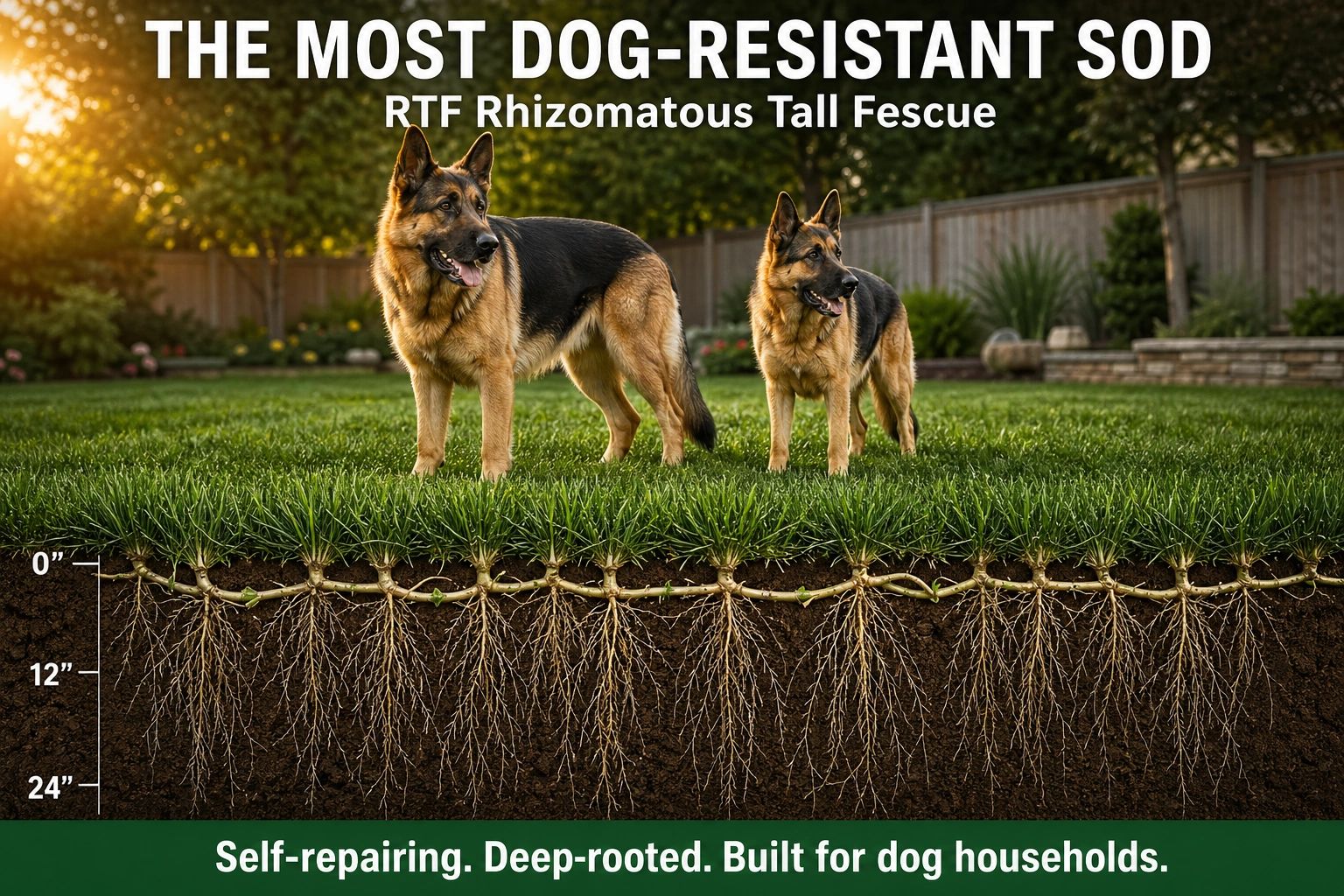
Distributed across a typical residential lawn, the volume is meaningful — even with the most dog-resistant grass available, repeated daily urination across a lawn surface eventually produces visible damage. RTF (Rhizomatous Tall Fescue) handles this pressure better than any cool-season alternative, but no grass is invulnerable to indefinite concentrated nitrogen exposure. The full breakdown on grass-level urine tolerance is in the dog-friendly RTF guide.
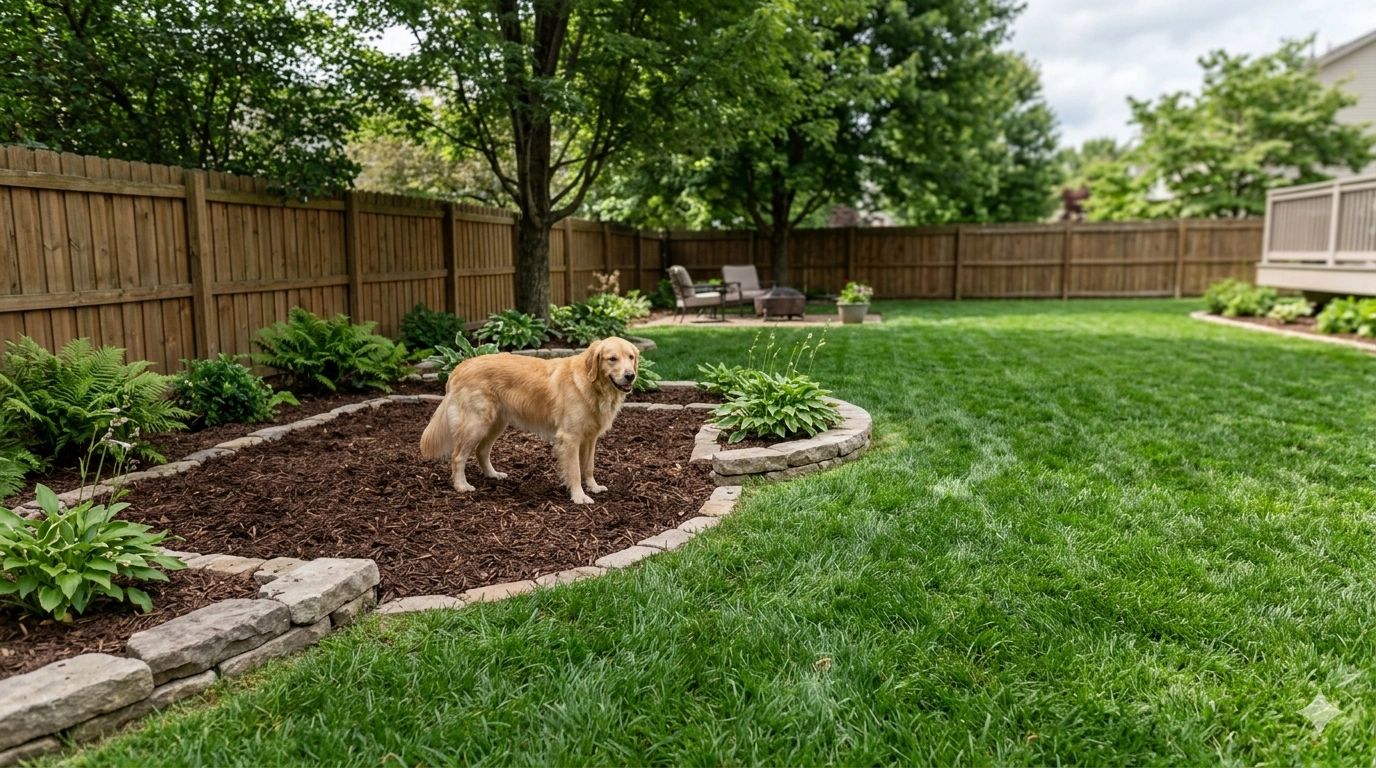
Concentrated into a single designated area, that same urine volume is contained. The designated area takes the full chemical load, but you've designed the area to handle it — mulch, gravel, decomposed granite, artificial turf, or dog-tolerant ground cover doesn't suffer from urine the way grass does. The rest of the lawn becomes essentially damage-free because dogs are no longer using it as their primary urination zone.
The mathematics of this are dramatic. A dog household that successfully trains to a 200 square foot designated area protects 95% or more of the surrounding lawn from urine damage. Compare that to a household relying on grass selection alone — even RTF in active dog conditions sees ongoing spot damage requiring 5-15 spot repairs per year. With designated-area training plus RTF, the spot repair load drops to 1-2 per year, and the visible lawn appearance improves dramatically.
This is why training matters more than any product or grass selection: it's the only intervention that addresses the source of the damage rather than the symptoms. Other interventions help the lawn handle pressure better; training reduces the pressure itself.
How Dogs Actually Choose Where to Urinate
Understanding why dogs urinate where they do is essential to redirecting that behavior. Dog urination location preference is driven by several factors:
Scent reinforcement. Dogs are strongly drawn to urinate where they or other dogs have urinated before. The previous urine creates a scent marker that signals "this is an appropriate urination location." Once a spot has been used 5-10 times, it becomes a strongly preferred location, and the dog will return there reliably. This is the single most powerful behavioral mechanism affecting urination location.
Surface preference. Dogs have surface preferences for urination, often established in puppyhood or early in their adult life with the household. Some dogs strongly prefer grass; others prefer dirt, mulch, or gravel; others have minimal preference. Surface preference can be modified through consistent training but works against you if you're trying to redirect a grass-preferring dog to a non-grass designated area.
Territorial behavior. Dogs urinate strategically along property boundaries to establish territorial markers. This is more pronounced in intact (non-neutered) male dogs but occurs to some degree in all dogs. Territorial urination is concentrated along fence lines, gates, property edges, and locations dogs perceive as boundary points. Designated areas should account for this — placing the designated area near a fence line or boundary uses the territorial instinct rather than fighting it.
Convenience and routine. Dogs urinate based on routine and convenience patterns. The first spot they encounter when going outside in the morning, the spot near the door they exit through, the spot they pass on their regular yard route — these become preferred locations through pure repetition. This is why dogs often urinate within 10-20 feet of the door they exit, and why redirecting that behavior requires either physically moving the dog to the designated area or changing the door routine.
Time pressure. Dogs needing to urinate urgently (after a long indoor period, after eating or drinking, immediately after waking) will use the first appropriate location they reach rather than walking to a preferred location. This is why morning urination is the hardest urination event to redirect — the dog has held urine overnight and needs to relieve itself immediately upon going outside, not after walking to a designated area.
Anxiety or stress urination. Some dogs urinate as a stress response to environmental stimuli (visitors, other dogs, unusual sounds). Stress urination is harder to direct and may occur in unpredictable locations regardless of training.
The implication for training: successful designated-area training works with these behavioral mechanisms rather than against them. The right setup uses scent reinforcement, accounts for surface preference, leverages territorial instinct, accommodates convenience routines, plans for time pressure situations, and acknowledges that some urination events (stress urination especially) won't be fully controlled.
The Designated-Area Training Methodology
Successful designated-area training follows a consistent methodology that's been refined across decades of dog behavior research and practical experience. The core process is straightforward, but execution requires consistency over weeks.
Phase 1: Setup (before training begins)
Before any training takes place, the designated area itself needs to be established. The setup determines how successful training will be — a poorly chosen or poorly designed designated area makes training harder; a well-designed area makes it easier.
Location selection. The designated area should be:
- Close enough to the door that the dog can reach it quickly when needing to urinate urgently
- Out of the main view from the house if possible (most homeowners don't want to look at the designated area from their kitchen window)
- Near a property boundary or fence line if territorial-marking dogs are involved (uses territorial instinct constructively)
- Away from areas where children play, where guests gather, or where you spend time outdoors
- Sized appropriately for the dog(s) — minimum 50 sq ft for one dog, 100+ sq ft for multiple dogs
- Mulch (Sweet Peet, hardwood mulch, or pine bark mulch): Good choice. Drains well, handles urine without persistent odor when refreshed periodically, comfortable for dogs to use. Requires annual refreshing. Most natural-looking option.
- Pea gravel or decomposed granite: Good choice. Excellent drainage, no visible damage from urine, durable for years. Can be uncomfortable for some dogs who prefer softer surfaces. Requires occasional rinsing during dry periods.
- Artificial turf: Good choice if installed correctly with proper drainage. Provides a grass-like surface dogs accept easily. Lower-quality installations develop persistent urine odor; quality installations with antimicrobial treatment and proper drainage work well for years.
- Dog-tolerant ground cover plants: Mixed results. Some plants tolerate dog urine reasonably well (sedum, ornamental grasses with deep roots) but no plant material handles the concentrated load that mulch or gravel handles. Generally not recommended as the primary designated area surface.
- Bare dirt: Acceptable but messy. Becomes muddy when wet, tracks into the house, and produces dust when dry. Most homeowners find mulch or gravel preferable.
Boundary definition. The designated area should be visually defined so dogs and humans both recognize where it begins and ends. Edging stones, low garden borders, or simple visual transitions (mulch surrounded by lawn) all work. Clear boundaries help dogs learn the area's edges and help humans consistently direct dogs to the right location.
Phase 2: Initial Training (Weeks 1-4)
The initial training phase is where most homeowners give up because results are inconsistent and the dog seems to ignore the designated area. The reality is that you're rewriting weeks or months of established behavioral patterns, and consistency matters more than any specific technique.
Take the dog directly to the designated area for every urination event. This means leashing the dog when going outside (yes, even in your own fenced yard), walking the dog directly to the designated area, and waiting until the dog urinates there. No detours, no allowing the dog to choose its own spot, no exceptions. Every single time.
Use a consistent verbal cue. Choose a phrase ("go potty," "do your business," "use your spot," whatever works for you) and use it every single time the dog is in the designated area before urination. Eventually the cue becomes associated with the act, and you can use it to prompt urination on command. This cue is also useful later for reinforcing the designated area when the dog drifts.
Reward immediately after urination in the designated area. Praise enthusiastically, give a small treat, or both. The reward must come within seconds of completed urination — dogs associate consequences with whatever they were doing immediately before, so a delayed reward attaches to whatever they did next, not to the urination itself.
Do not punish urination outside the designated area. Punishment doesn't work for urination location preferences and often backfires by making the dog anxious about urinating at all. If the dog urinates in the wrong location, simply clean it up without comment and continue training. The reward for correct location is the only effective behavioral lever.
Frequency. Take the dog to the designated area immediately after every wake-up, after every meal, after every drink of water, after every prolonged indoor period (over 2-3 hours), and any time the dog shows signs of needing to urinate. Frequent successful urinations in the designated area accelerate the scent-reinforcement effect and build the habit faster.
Handle accidents calmly. Accidents during the first 4 weeks are normal and don't indicate training failure. When they happen, clean the area thoroughly with an enzymatic cleaner (regular cleaners don't fully remove urine scent and the residual scent encourages return urination at the same spot). Continue with the training routine without modification.
Phase 3: Consolidation (Weeks 4-8)
After 3-4 weeks of consistent initial training, most dogs will start to use the designated area when prompted but may still default to other locations when going outside without direction. The consolidation phase reinforces the habit until it becomes self-directed.
Begin transitioning off-leash trips. Continue leashing the dog for the first urination of each outdoor session, but allow off-leash time after the urination occurs. The leashed first-trip ensures the designated area is used; the off-leash time afterward maintains the dog's normal yard enjoyment.
Watch for self-directed designated area use. Around weeks 4-6, most dogs begin walking toward the designated area on their own when needing to urinate, even without leash direction. This is the breakthrough moment — when self-directed use begins, the habit is forming.
Maintain reward consistency. Even as the dog begins using the area on their own, continue the reward routine for the first few weeks of self-directed use. The reward continues to reinforce the behavior and prevents regression.
Address regression promptly. Some dogs will slip back to old patterns occasionally, particularly during weather changes, household disruptions, or after illness. Treat regressions like the initial training phase — leash the dog, walk to the designated area, reward correct use. Most regressions resolve within a few days with renewed consistency.
Phase 4: Maintenance (Week 8 onward)
After 8 weeks of consistent training, most dogs are reliably using the designated area without supervision. The maintenance phase is about preserving the habit long-term.
Keep the designated area appealing. Refresh mulch annually, rinse gravel during dry periods, maintain artificial turf according to manufacturer recommendations, and ensure the area remains accessible and comfortable for the dog. A designated area that becomes neglected, smelly, or uncomfortable will be abandoned by the dog regardless of prior training.
Reinforce occasionally. Periodic verbal reinforcement and occasional treats maintain the habit. You don't need to maintain every-time rewards forever, but completely eliminating positive reinforcement weakens the habit over time.
Monitor for new patterns. Dogs occasionally develop new preferences (a new favorite spot in the lawn, a new urination routine after household changes). Catching these early and redirecting to the designated area prevents them from becoming established alternative locations.
Equipment and Setup That Makes Training Easier
The right equipment doesn't replace consistent training but does make consistency easier to maintain.
Leash and lead system. A standard 6-foot leash works for most yards; longer training leads (15-20 feet) work for larger yards or for transitioning to off-leash. The leash is the most important training tool because it's how you ensure the dog reaches the designated area before urinating.
Outdoor-accessible treat container. A weatherproof container near the door with training treats removes the friction of needing to grab treats before going outside. Treats need to be small (training-treat sized, not full meal portions) and easy to deliver quickly.
Enzymatic cleaner. For cleaning accidents in the wrong locations. Regular cleaners leave residual urine scent that encourages return urination at the same spot. Enzymatic cleaners (Nature's Miracle, Rocco & Roxie, similar) break down the scent compounds completely.
Visible designated area markers. Whether stones, edging, low borders, or simple visual transitions, clear boundaries help everyone in the household consistently direct the dog to the right location.
Outdoor lighting. For households where dogs go out at night or early morning, motion-activated or always-on lighting at the designated area makes it easier to confirm successful use and clean up if needed.
Optional: pheromone or scent attractants. Commercial products that mimic dog urine scent can be applied to the designated area to encourage initial use. Some homeowners find these helpful in the first week of training; others find them unnecessary. Effective for some dogs, less effective for others.
Why Training Fails: The Common Mistakes
Designated-area training has a high failure rate among homeowners who attempt it, but the failures are almost always traceable to specific mistakes in execution. Understanding the common failure modes helps avoid them.
Mistake 1: Inconsistency. The single most common failure is occasional rather than constant adherence to the training routine. "I'll just let the dog out without leashing this once" becomes a daily exception within two weeks, and the dog never establishes the designated area as the primary urination spot. Training requires every-trip consistency for at least the first month. Households where multiple family members handle the dog often fail because not everyone follows the routine consistently.
Mistake 2: Designated area too far from the door. If the dog has to walk more than 30-50 feet from the exit door to reach the designated area, time pressure urinations (immediately after waking, after long indoor periods) will happen before the dog reaches the area. The designated area should be the closest acceptable urination location to the door dogs use most.
Mistake 3: Insufficient time in the designated area. Some homeowners take dogs to the designated area but leave too quickly when the dog doesn't urinate immediately. Dogs sometimes need 5-10 minutes of standing/walking around in the area before urinating. Patience during this time is essential — leaving the area too early teaches the dog that the designated area is just a brief stop on the way to the real urination location.
Mistake 4: Reward timing errors. Rewards delivered more than a few seconds after urination don't reinforce the urination behavior — they reinforce whatever the dog did most recently. Treats must come immediately after the dog finishes urinating in the correct location. Praise should come during the urination if possible.
Mistake 5: Using the designated area for play or attention. If the designated area becomes associated with positive attention beyond the urination reward, dogs may go to the area for reasons other than urination, which dilutes the habit's specificity. The area should be associated with one thing: urination followed by reward and return to normal yard activity.
Mistake 6: Assuming training transfers across dogs. Each dog in a household needs individual training to the designated area. A trained dog teaching an untrained dog through observation is unreliable — the new dog needs to go through the full training process. Multi-dog households often fail when the trained dog's habit is assumed to transfer to new additions.
Mistake 7: Giving up too early. The first 2-3 weeks of training typically show inconsistent results. Many homeowners conclude the training isn't working and abandon the routine. The behavioral shift to self-directed designated area use usually happens between weeks 4-8 — exactly when most homeowners have already quit. Pushing through the inconsistent early phase is the difference between successful training and failed training.
Mistake 8: Punishment-based approaches. Punishing urination in the wrong location doesn't work and often makes things worse. Dogs respond to reward-based reinforcement for urination behaviors; punishment creates anxiety that can cause general urination problems including indoor accidents.
When Training Won't Work: Realistic Expectations
Designated-area training works for most dogs with consistent execution, but some situations make training difficult or impossible. Recognizing these helps homeowners decide whether training is the right approach or whether other strategies (grass selection, yard design, professional behavioral consultation) are better matches.
Older dogs with established habits. Dogs over 8-10 years old who have been urinating throughout the yard for their entire lives are more difficult to retrain than younger dogs. Training is still possible but takes longer (3-6 months instead of 6-8 weeks) and may never reach full reliability. For senior dog households, RTF combined with regular spot repair often produces better outcomes than attempting full retraining.
Dogs with cognitive decline or dementia. Senior dogs experiencing cognitive issues may not be able to learn new behavioral patterns. Trying to train a cognitively impaired dog creates frustration without progress. For these dogs, accommodating the existing urination patterns through grass selection and design is the realistic strategy.
Anxiety-driven urination. Dogs who urinate as a stress response (during thunderstorms, when visitors arrive, during separation) can't be trained to use a designated area for those specific events because the urination is involuntary stress-related. Stress urination requires veterinary or behavioral consultation rather than designated-area training.
Multi-dog households without consistent supervision. Households with 3+ dogs where supervision can't be consistent often struggle with designated-area training because dogs reinforce each other's existing patterns and individual training is difficult to maintain. These households may need to combine partial training with grass selection and design to manage damage.
Dogs with medical conditions affecting urination. Diabetes, kidney issues, urinary tract infections, and several other medical conditions affect urination frequency and urgency in ways that make designated-area training impractical. Address medical issues first; training can resume once the medical condition is stable.
Dogs with established preference for specific surfaces or locations. Some dogs develop strong preferences (always urinating on grass specifically, always urinating in one specific corner) that resist redirection. Training is still possible but takes longer and may require accepting partial rather than complete redirection.
Households without consistent training commitment. Designated-area training requires daily consistency from everyone interacting with the dog for at least 6-8 weeks. Households where multiple family members can't maintain the routine, or where the primary trainer travels frequently during the training period, often see training fail.
Multi-Dog Households: Specific Considerations
Households with multiple dogs face additional complications that single-dog training doesn't.
Train each dog individually. Each dog needs to go through the full training process individually, even if other dogs in the household are already trained. Don't assume observation transfers the behavior — it usually doesn't, and assuming transfer leads to dogs that use the designated area inconsistently.
Sequential vs. simultaneous training. Most professionals recommend training one dog at a time when possible. Training multiple dogs simultaneously divides supervision and reinforcement, slowing progress for all dogs involved. If sequential training isn't practical, ensure each dog gets focused individual training time daily even if all dogs are using the yard together.
Account for territorial dynamics. Multi-dog households often have territorial dynamics where one dog's urination patterns influence the others. The dominant dog's preferred locations become preferred locations for the rest of the pack. Training the dominant dog first often makes training the other dogs easier.
Sized designated area appropriately. A 50 sq ft designated area sized for one dog may be inadequate for three dogs producing three times the volume in the same space. Multi-dog households need larger designated areas (100-300 sq ft depending on dog count and size) to handle the cumulative load.
Increased designated area maintenance. Multi-dog designated areas need more frequent refreshing of mulch, more frequent rinsing of gravel, or more aggressive maintenance of artificial turf. The chemical and physical load is multiplied; the maintenance requirements multiply correspondingly.
Consider multiple designated areas. For households with 3+ dogs or for very large yards, two or three designated areas can work better than a single area. Each dog may develop preference for a specific area, distributing the load and preventing any single location from becoming overwhelmed.
Training Plus Grass Selection Plus Design: The Integrated Approach
Designated-area training is the highest-impact single intervention for lawn protection, but it's not the only intervention, and the best outcomes come from integrating training with grass selection, yard design, and ongoing maintenance.
Training + Grass Selection. Even with successful training, occasional accidents and stress urinations will occur on the main lawn. The grass type determines how those occasional events affect the lawn. RTF in the main lawn handles the occasional incident with minimal visible damage; KBG in the same situation produces visible spots that persist for weeks. Training reduces the frequency of damage events; grass selection reduces the visibility and severity of the events that do occur.
Training + Yard Design. Yard design supports training by making the right behavior easier and the wrong behavior harder. The designated area should be conveniently located; main lawn areas should be designed for the dogs to enjoy without urinating (shade for resting, water for drinking, toys for play). Some homeowners use temporary fencing during early training to physically prevent access to non-designated areas; this accelerates training but isn't necessary for most dogs.
Training + Repair Routine. Even successful training plus optimal grass selection won't produce a 100% damage-free lawn in active dog households. The remaining occasional damage requires routine spot repair to maintain coherent lawn appearance. The full breakdown on damage repair is in the urine spot repair guide (link forthcoming once published).
Training + Soil Health. Lawns under any dog pressure benefit from active soil biology investment. Compost topdressing, mycorrhizal inoculation, and biologically-active fertilizers support the lawn's natural recovery capacity. The deeper background is in the mycorrhizal fungi guide and glomalin and soil structure pillar.
The integrated math:
- Training alone (no grass change): 70-90% reduction in lawn damage
- RTF alone (no training): 60-80% reduction in lawn damage compared to KBG
- Training + RTF: 90-95%+ reduction in lawn damage
- Training + RTF + design + repair routine: visually damage-free lawn most of the year
Designated Area Surface Considerations
The designated area surface choice deserves more detail because it significantly affects training success and long-term performance.
Mulch (Sweet Peet, hardwood, pine bark, or cedar). The most popular choice for designated areas in residential settings. Provides comfortable surface for dogs, drains well, accepts urine without persistent odor when refreshed periodically, and integrates visually with typical residential landscaping. Sweet Peet specifically — a composted forest product — is often preferred for its softer texture and natural appearance. Annual refreshing with 2-3 inches of new mulch maintains the area's appeal and absorption capacity.
Pea gravel. Excellent drainage and durability. Doesn't show urine damage visually. Lasts for years with minimal maintenance. Can be uncomfortable for dogs with sensitive paws, particularly puppies and small breeds. Best for medium-large breed dogs that don't have paw sensitivities.
Decomposed granite. Similar to pea gravel but with smaller particle size and more uniform appearance. Compacts slightly under use, which some dogs prefer. Drains well, doesn't show damage, durable. Slightly more expensive than mulch or pea gravel but produces a more refined appearance.
Artificial turf with drainage system. Provides a grass-like surface that dogs accept readily and that doesn't damage from urine when properly drained and maintained. Quality matters significantly — quality turf with proper subsurface drainage and antimicrobial treatment performs for 10+ years; lower-quality turf develops persistent odor within 1-3 years. Higher upfront cost than mulch or gravel but lower long-term maintenance.
Crushed stone or stonedust. Very durable, drains well, lasts indefinitely. Less comfortable than mulch but acceptable for most dogs. Industrial appearance limits residential aesthetic appeal but works well for utility areas of the yard.
Bark chunks or large bark mulch. Less common but acceptable. Drains well and absorbs urine reasonably. Larger pieces may be uncomfortable for some dogs and may scatter when dogs scratch the surface.
Avoid for designated areas:
- Concrete or paver surfaces (pools urine, persistent odor, no drainage)
- Sand (becomes saturated, tracks everywhere)
- Bare dirt (mud problems, dust, paw tracking)
- Live plants as primary surface (don't handle the chemical load)
Frequently Asked Questions
How long does designated-area training take?
Most dogs reach reliable self-directed use of the designated area within 6-8 weeks of consistent training. Initial breakthrough (dog walks toward designated area on their own) typically occurs around weeks 4-6. Full habit consolidation takes 8-12 weeks. Older dogs and dogs with strong existing habits may take 3-6 months.
Can I train an older dog to use a designated area?
Yes, but expect longer training timelines and possibly less than full reliability. Senior dogs with established lifetime urination patterns are harder to retrain than younger dogs. Some senior dog households find that 70-80% reliability is achievable but 100% isn't, in which case combining partial training with RTF grass selection and routine spot repair produces the best lawn outcomes.
What size designated area do I need?
Minimum 50 sq ft for one small-to-medium dog. 75-100 sq ft for one large dog. 100-200 sq ft for two dogs. 200+ sq ft for three or more dogs. Larger areas handle the chemical load better and accommodate dogs who prefer to walk around before urinating.
Where should the designated area be located?
Within 30-50 feet of the door dogs use most. Out of main view from primary living areas if possible. Near a property boundary or fence line if territorial-marking dogs are involved. Away from areas where children play or guests gather.
Will my dog use the designated area in winter or rain?
Yes, with consistent training. Some dogs initially resist using designated areas in inclement weather, particularly snow-covered areas. Clearing snow from the designated area and ensuring the surface remains accessible helps maintain winter use. Training that has reached the consolidation phase (8+ weeks) typically holds through weather variations.
My dog goes to the designated area but won't urinate there. What do I do?
Patience. Dogs sometimes need 5-10 minutes in the designated area before urinating, especially in the early training phase. Wait. Don't leave the area until the dog urinates. If the dog seems uncomfortable urinating in the area, check that the surface is appropriate for your dog's preferences (some dogs strongly prefer grass and resist non-grass surfaces) and consider whether a different surface choice would help.
Can I train multiple dogs at the same time?
It's harder. Sequential training (one dog at a time) usually produces better results. If training simultaneously, ensure each dog gets focused individual training time and that the designated area is sized for cumulative load.
What if my dog still has accidents on the lawn after training?
Some accidents are normal even after training. Stress urination, urgency situations, weather-related disruptions, and household changes can all produce occasional incidents. Combine training with RTF grass selection and routine spot repair to handle the residual damage that any active dog household produces.
Should I use a fence or barriers to keep my dog in the designated area?
Generally no. Forcing the dog to stay in the designated area through physical restraint doesn't produce voluntary use of the area. The training methodology relies on the dog choosing the designated area based on positive reinforcement, not on physical restriction. Temporary fencing during early training is acceptable for some homeowners but isn't necessary for most dogs.
My dog was trained but has started using the lawn again. What happened?
Common causes of regression: reduced consistency in the family routine, changes in household structure (new baby, new pet, household members moving), changes in the designated area (new surface, new location, neglect of maintenance), seasonal weather changes, illness affecting urination patterns. Identify the change and address it. Most regressions resolve within 1-2 weeks with renewed training consistency.
What surface is best for the designated area?
Depends on your priorities. Mulch (especially Sweet Peet) is most popular for residential settings — natural appearance, comfortable for dogs, drains well, requires annual refreshing. Pea gravel or decomposed granite is most durable with lowest maintenance. Quality artificial turf with proper drainage produces the most grass-like experience for dogs but has highest upfront cost. Match the choice to your aesthetic preferences, dog's surface preferences, and maintenance tolerance.
How much does setting up a designated area cost?
Varies by size and material choice. A 100 sq ft mulch designated area with edging requires roughly 1-2 cubic yards of mulch ([Estimated] $50-150 from regional landscape suppliers depending on material) plus edging materials ($50-200 depending on choice). Total typical cost $100-400 for DIY installation. Pea gravel or decomposed granite costs slightly more in materials. Quality artificial turf installations run significantly higher ($1,500-5,000 for typical residential designated areas) due to drainage system requirements. The investment is recovered through reduced lawn damage and replacement sod savings over 1-3 years.
Does training work for puppies?
Yes, and puppy households often have the easiest time training because puppies haven't developed strong existing patterns. Start designated-area training as soon as the puppy is reliably housetrained (typically 4-6 months old). Puppies learn the designated area faster than adults and develop the habit as part of their normal yard routine.
Will training stop my dog from marking territory along the fence?
Partially. Territorial marking is a separate behavioral pattern from regular urination, and fully eliminating it through training is difficult, particularly for intact male dogs. Designated-area training redirects most regular urination to the designated area, but occasional fence-line marking may continue. The volume involved in marking is typically low and produces less lawn damage than concentrated regular urination.
Can I combine designated-area training with leaving the dog out unsupervised?
After training is fully consolidated (8-12+ weeks), most dogs use the designated area reliably even when unsupervised. During the training phase, supervision is essential — unsupervised yard time during training reinforces old patterns and slows progress.
Ready To Order?
Fresh-Cut Sod Delivered
CT Sod delivers Kentucky Bluegrass, Tall Fescue & RTF sod across CT, MA, NY, NJ, RI, NH, VT & ME.
Keep Reading
Bermudagrass vs RTF Sod: Which Is Better for Dogs?
April 26, 2026
🐾 How to Prevent and Fix Dog Urine Spots on New Sod
May 24, 2025
How to Repair Dog Urine Spots in Cool Season Grass
April 25, 2026
The Most Dog-Resistant Sod: Why RTF Is the Best for Dogs
April 25, 2026