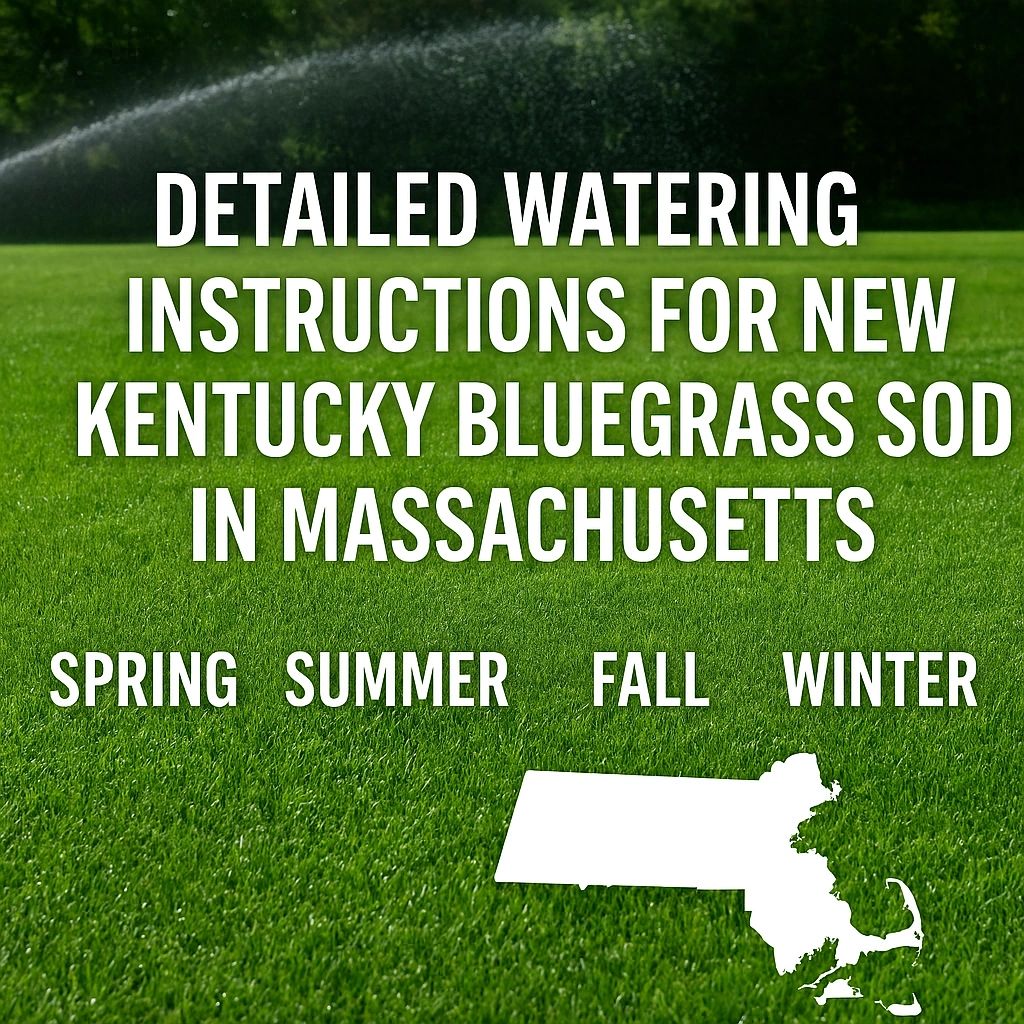
Proper watering is the single most important step in establishing a healthy Kentucky bluegrass lawn. Massachusetts homeowners often ask us how much—and how often—they should water after a new sod installation. The answer depends not only on the season, but also on your specific region of the state. From the cooler Berkshires to the warmer Cape Cod shoreline, climate differences across Massachusetts can greatly impact sod establishment.
At CT Sod, we deliver and install premium Kentucky bluegrass sod throughout Massachusetts. Below, you’ll find detailed watering instructions tailored to each season, along with zone-by-zone output guidelines and a simple test you can perform to measure your sprinklers.
General Rules for Watering New Kentucky Bluegrass Sod
- Water immediately after installation – Sod must be soaked within 30 minutes of being laid.
- Soak deeply – The soil beneath should be moist to a depth of at least 6 inches.
- No dry edges – Pay close attention to corners and seams; they dry out first.
- Morning watering is best – Early watering reduces evaporation and helps prevent disease.
- Measure output by zone – Every sprinkler zone delivers water differently. Don’t guess—test.
The “Tuna Can Test” – Measuring Water Output
Different sprinkler systems (and even different zones in the same yard) deliver water at very different rates. A rotor head in the back yard may take twice as long as spray heads in the front. To know exactly how long to run each zone:
1. Place empty tuna cans (or any short, flat-bottomed container) across a zone. 2. Run sprinklers for 15 minutes. 3. Measure how much water collected.
- If you have ¼ inch in 15 minutes, you’ll know it takes 1 hour to get 1 inch of water. - If you have ½ inch in 15 minutes, it only takes 30 minutes to get 1 inch.
1. Adjust each zone’s run time so your lawn consistently receives 1–1.5 inches of water per week once sod is established.
This simple test prevents overwatering, underwatering, and uneven growth.
Spring Watering in Massachusetts (March–May)
Spring is one of the best seasons to install sod in Massachusetts because of moderate temperatures and natural rainfall.
- First 2 weeks: Water each zone 2–3 times daily for 15–20 minutes (morning, midday, and late afternoon).
- Weeks 3–4: Reduce to once daily in the morning, with supplemental watering if it hasn’t rained.
- Regional tips:
- Boston & Eastern MA: Coastal breezes dry sod quickly—afternoon watering is often necessary. - Western MA/Berkshires: Cooler temps mean sod retains moisture longer; always check with the tuna can test before adding water.
Summer Watering in Massachusetts (June–August)
Summer heat and humidity are tough on new sod, especially Kentucky bluegrass.
- First 10 days: Water 3–4 times daily for 10–15 minutes per zone.
- After 2 weeks: Transition to once or twice daily, ensuring at least 1–1.5 inches of water per week (use the tuna can test to confirm).
- Regional tips:
- Cape Cod & South Shore: Sandy soils drain quickly—longer soakings are needed per zone. - Worcester & Central MA: Thunderstorms help, but don’t rely on them—measure soil moisture. - Berkshires: Cooler, but extended dry spells still require consistent watering.
Fall Watering in Massachusetts (September–November)
Fall is the ideal season for Kentucky bluegrass sod installation in Massachusetts.
- First 2 weeks: Water each zone twice daily (morning and late afternoon).
- Weeks 3–4: Reduce to once per day, then every other day as temps drop.
- Regional tips:
- Eastern MA: Warm “Indian Summer” stretches may require continued daily watering. - Western MA: Cooler nights help retain moisture—zones can be shortened sooner.
👉 Learn more in our guide to fall sod installation in New England.
Winter Watering in Massachusetts (December–February)
Yes, sod can even be installed in Massachusetts during warmer winters as long as the ground isn’t frozen. Kentucky bluegrass will go dormant, but roots still grow slowly underground.
- After installation: Give sod a deep soak to help settle roots.
- Ongoing: Water only if temperatures rise above 40°F for several days and the ground isn’t frozen. Typically, one deep watering every 10–14 days is enough.
- Regional tips:
- Boston & Coastal MA: Occasional winter watering may be required. - Inland & Worcester Hills: Snow cover often provides enough natural moisture.
Signs Your Sod Is Getting Enough Water
- Sod feels soft and spongy underfoot.
- Soil beneath is moist to 3–4 inches.
- Grass blades bounce back after being stepped on.
- Yellowing or browning at seams = not enough water.
Whether you’re in Boston, Worcester, Cape Cod, or the Berkshires, following these watering instructions will give your new Kentucky bluegrass sod the best start possible.
At CT Sod, we provide full-service sod delivery and installation throughout Massachusetts and beyond. Our team ensures your lawn gets the right care from day one—and we’ll guide you every step of the way.
📞 Ready for a lush, green lawn? Contact us today for a free quote on sod delivery and installation in Massachusetts.
Ready To Order?
Fresh-Cut Sod Delivered
CT Sod delivers Kentucky Bluegrass, Tall Fescue & RTF sod across CT, MA, NY, NJ, RI, NH, VT & ME.
Keep Reading
Best Drought-Tolerant Sod Varieties: Northeast Guide
April 30, 2026
Best Sod for Connecticut Lawns: Complete Regional Guide
April 28, 2026
Best Sod for Finger Lakes Properties: Regional Guide
April 29, 2026
Best For Sod Shelton, Newtown, Easton & Inland Fairfield, CT
May 2, 2026