How to Repair Dog Urine Spots in Cool-Season Grass: The Complete Science-Based Guide for Lawn Recovery and Prevention
If your cool-season lawn has yellow or brown circular spots ringed by unusually dark green grass, your dog is the cause — and the chemistry behind those spots is more specific than most homeowners realize. The damage isn't from acidity, despite what most general lawn care content claims. It isn't from anything pH-related at all. It's from concentrated nitrogen salts hitting grass crowns at levels that exceed what cool-season turfgrass can tolerate, and the repair process depends on understanding what's actually happening at the soil level.
This guide walks through the chemistry of dog urine damage in cool-season grasses, why some grass species and cultivars survive what others don't, the practical step-by-step process for repairing damaged spots, the products that work and the ones that don't, and how to set up a long-term lawn that handles dog traffic without turning into a permanent repair project. Everything in this guide applies to cool-season turfgrasses across the Northeast, Upper Midwest, Pacific Northwest, transition zone northern regions, and mountain climates.
What Actually Causes Dog Urine Spots: The Chemistry Most People Get Wrong
The conventional explanation for dog urine damage is that dog urine is acidic and the acid burns the grass. This is wrong. Dog urine pH typically ranges from 5.5 to 7.5 depending on diet and individual dog factors, which puts it well within what healthy turfgrass tolerates without damage. Cool-season lawns are routinely exposed to rainwater that's more acidic than dog urine without showing damage.
The actual cause is nitrogen salt toxicity. Dog urine contains highly concentrated urea — the nitrogen waste product from protein metabolism — at levels far higher than what occurs naturally in soil. When concentrated urea hits a small area of grass, the urea breaks down rapidly into ammonia and ammonium, which then convert to nitrate as soil bacteria process the nitrogen. The combined effect is a sudden, intense pulse of soluble nitrogen and accompanying salts that exceeds what the grass crowns and roots can absorb safely.
This is why dog urine damage looks the way it does. The dead center of the spot is where urine concentration was highest — too much nitrogen too fast, and the grass dies. The bright green ring around the dead center is where urine concentration was lower and the diluted nitrogen actually fertilized the surrounding grass. If you've ever wondered why dog spots have that distinctive halo appearance, that's the explanation: lethal nitrogen concentration in the center, beneficial nitrogen concentration at the edges.
Understanding this chemistry matters because it determines what works for repair and prevention. Treatments based on the wrong premise — pH-balancing products, gypsum applications without flushing, "neutralizing" sprays that don't address salt concentration — fail consistently because they don't address the actual problem. Treatments that address nitrogen salt concentration directly work reliably.
Why Female Dogs Cause More Damage Than Males
The size and severity of dog urine spots correlates strongly with how the dog urinates, not with breed, diet, or sex hormones directly. Female dogs and some male dogs (particularly puppies and senior males) squat and deliver their entire urination volume to a single concentrated spot. Adult male dogs typically lift a leg and deliver smaller volumes to vertical surfaces or distribute volume across multiple spots as they move.
The same dog volume of urine that creates a major dead spot when delivered in one location creates no visible damage when distributed across multiple smaller deposits. This is why female dog owners and owners of squat-urinating males see dramatic lawn damage while owners of leg-lifting males often see little to no damage from the same dog with the same diet on the same lawn.
This also explains why some households see worsening damage as a male dog ages. Older male dogs sometimes lose the muscle control or behavioral patterns that produced multi-stop leg-lift urination and revert to single-spot squat patterns. The lawn damage that wasn't there when the dog was 4 appears when the same dog is 11.
The practical implication: training a dog to use a designated potty area is the single most effective long-term solution to lawn damage, regardless of dog sex or urination style. Concentrating the chemistry in one area you've designed to handle it (mulch, gravel, artificial turf, dog-tolerant ground cover) eliminates the chemistry's impact on the rest of the lawn.
Cool-Season Grass Species Ranked by Urine Tolerance
Not all cool-season grasses respond to dog urine the same way. The differences are significant enough that grass species selection alone can reduce visible damage by 60-80% on otherwise identical lawns with identical dogs.
Most tolerant: Tall Fescue (including Turf-Type Tall Fescue and Rhizomatous Tall Fescue) Tall fescue has the deepest root system of common cool-season grasses (2-3 feet versus 4-8 inches for Kentucky bluegrass), which gives it more soil volume to dilute nitrogen concentrations and more root mass to absorb nitrogen pulses without crown damage. Tall fescue also has thicker leaf blades and a more robust crown structure that resists the cellular damage that kills more delicate grasses. Among tall fescues, RTF (Rhizomatous Tall Fescue) adds the recovery advantage of underground stems that fill in damaged areas naturally — see the complete RTF guide for the full breakdown of how RTF differs from standard tall fescue.
Second most tolerant: Perennial Ryegrass Perennial ryegrass has shallower roots than tall fescue but compensates with rapid recovery — damaged areas regrow from existing crown tissue faster than most cool-season alternatives. Perennial ryegrass is commonly included in fescue blends specifically for its quick recovery from spot damage, and it's the fastest-germinating cool-season grass for repair seeding when damage does occur.
Moderate tolerance: Fine Fescues (Creeping Red, Chewings, Hard Fescue, Sheep Fescue) Fine fescues handle urine moderately well, with creeping red fescue showing rhizomatous recovery similar to (though slower than) RTF. Fine fescues are the right choice for shaded dog yards where tall fescue and bluegrass struggle from sun limitation more than from urine pressure.
Lowest tolerance: Kentucky Bluegrass Kentucky bluegrass is the most urine-sensitive of common cool-season grasses. Its shallower root system (4-8 inches versus 2-3 feet for tall fescue) provides less soil volume to dilute nitrogen and less root mass to absorb pulses. Its finer leaf blades and crown structure are more vulnerable to cellular damage from concentrated nitrogen salts. KBG is also the slowest cool-season grass to recover from damage by germination — KBG seed germination takes 14-28 days versus 5-10 days for perennial ryegrass and 7-14 days for tall fescue.
The frequent recommendation of Kentucky bluegrass for dog households — common in older lawn care content and some retail nursery advice — is poorly aligned with the chemistry. KBG is genuinely beautiful turf with excellent self-repair through rhizomes, but those advantages don't compensate for the underlying urine sensitivity. KBG is best suited for low-traffic ornamental lawns, not active dog households.
For dog households specifically, the sod choice that combines maximum urine tolerance with maximum self-repair capability is RTF — the deep roots of tall fescue plus the rhizomatous recovery that bluegrass is known for, in a single grass type that doesn't compromise on either characteristic.
The Step-by-Step Repair Process for Existing Damage
Repairing established dog urine spots requires three distinct phases: flushing, soil rehabilitation, and reseeding or sodding. Skipping any phase leads to recurring damage in the same spot because the underlying soil conditions haven't been corrected.
Phase 1: Flush the affected area
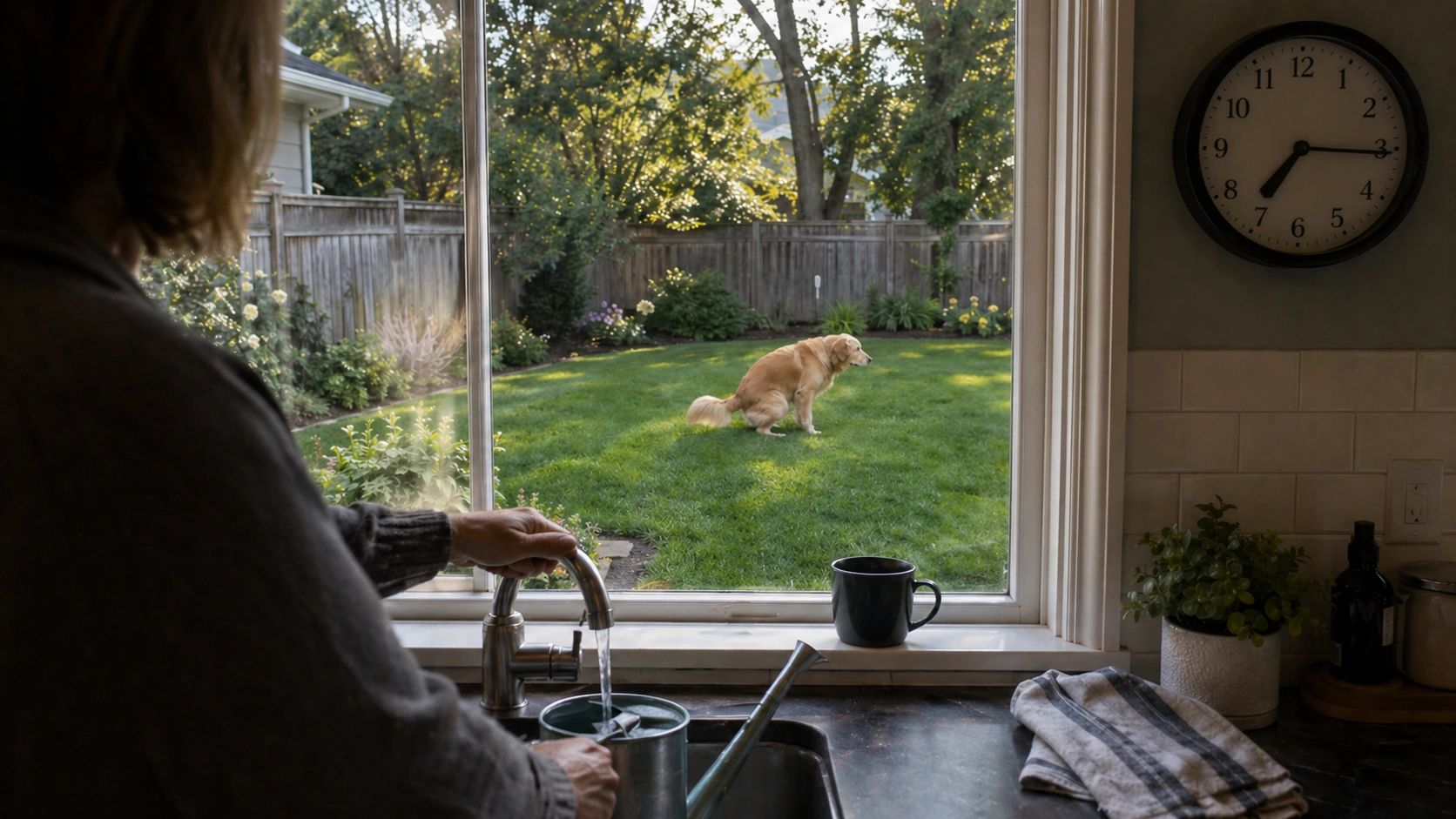
The first action on any dog urine spot — whether you noticed it yesterday or three weeks ago — is flushing the soil with water to dilute and move the residual nitrogen salts down past the root zone. Apply water at a rate equivalent to 0.5-1 inch over the affected area, which for a typical 6-inch diameter spot is roughly 1-2 gallons. Apply slowly enough that water soaks in rather than running off. A watering can with a rose attachment or a hose with a soft-spray setting works better than direct hose flow that displaces soil.
If the damage is fresh (urine deposited within the last 24-48 hours), flushing alone may be enough to prevent the spot from progressing to full damage. Many dog owners successfully prevent spots entirely by flushing immediately after observed urination — a 2-gallon dilution within 5-10 minutes effectively neutralizes the concentration before it reaches damaging levels.
For established spots where grass is already dead or dying, flushing is still the first step but cannot reverse damage that has already occurred. The flush is preparing the soil for rehabilitation, not rescuing the existing grass.
Phase 2: Rehabilitate the soil
Once the affected area has been flushed, the soil itself needs to be reset before new grass can establish. Dead grass crowns and root tissue should be raked out — use a stiff metal rake or a small dethatching tool to loosen and remove the dead material from the affected area. The goal is to expose fresh soil in the spot without digging more than necessary.
Add 1/4 to 1/2 inch of fresh topsoil or compost to the bare area. This serves multiple purposes: it covers any residual salt-affected soil that wasn't fully flushed, it provides a clean rooting environment for new grass, and it adds organic matter and microbiology that helps the soil recover its nitrogen-cycling balance. Compost is the better choice when available — the biological activity in healthy compost accelerates the soil's return to functional nutrient cycling.
Lightly work the topsoil or compost into the top inch of existing soil with the rake or a hand cultivator. Don't till deeply — disturbing the soil structure too much creates new problems. The objective is a smooth, slightly elevated patch of clean soil ready to accept seed or sod.
Phase 3: Reseed or patch with sod
For seed repair, choose a cool-season seed that matches your existing lawn type. The most common scenario is a tall fescue or fescue/bluegrass blend, which gives you a 7-14 day germination timeline and good integration with the surrounding lawn over the following 4-8 weeks.
Apply seed at 1.5 times the labeled overseeding rate for your chosen variety — heavier seeding compensates for the variable germination conditions in repair spots and accelerates coverage. After seeding, lightly rake the seed into the top 1/8 to 1/4 inch of soil contact, then cover with a thin layer of straw, peat moss, or seed starter mat to retain moisture and prevent bird predation.
Water lightly twice daily for the first 7-14 days, keeping the soil surface consistently moist but not saturated. Once germination is established, transition to deeper, less frequent watering — 1 inch per week, ideally in 1-2 applications — to encourage deep rooting.
For sod repair, cut a small piece of matching sod (most regional sod farms sell partial pieces or small rolls for repair work) and place it directly on the prepared soil. Press firmly to ensure soil contact, water thoroughly, and continue daily light watering for the first 7-10 days until the sod has rooted into the underlying soil. Sod repair is faster than seed repair (immediate visual result, full establishment in 14-21 days) and is the right choice for high-visibility spots or for households that can't tolerate the multi-week bare-spot phase that seed repair requires.
Products That Actually Work for Repair (And Common Products That Don't)
The dog-spot repair product category is full of products that don't work. Understanding which active ingredients address the actual chemistry — and which ones address the wrong problem — saves money and avoids wasted effort.
Products that work:
Plain water. The single most effective dog urine spot prevention is dilution within minutes of urination. Carrying a 2-gallon watering can or keeping a dedicated hose station near the dog's preferred areas allows real-time dilution that prevents most spots entirely. No commercial product outperforms immediate water dilution.
Compost or topsoil for soil rehabilitation. As covered in the repair process above, fresh organic matter on the affected area is essential for restoring the soil's biological function. Most commercial repair products skip this step or include only minimal amounts of biologically inert filler.
Seed starter mixes containing only seed and a moisture-retention component. Simple seed + mulch products work because they're addressing the actual need: getting new grass to germinate in repaired soil. Avoid products that include complex chemistry beyond seed and mulch.
Quality cool-season grass seed matched to your existing lawn. Choose seed that matches your lawn type — tall fescue blend for tall fescue lawns, fescue/bluegrass blend for mixed lawns, etc. Off-type repair seed creates visible color and texture differences that worsen the appearance even after the bare spot fills in.
Products that don't work:
pH-balancing or "urine neutralizing" sprays. These products address the wrong chemistry. Dog urine isn't damaging grass through pH effects, so neutralizing pH doesn't prevent damage. Products marketed as "urine neutralizers" typically contain agents that bind or modify nitrogen compounds, but the application timing required (within minutes of urination) is the same timing that makes plain water dilution work. The branded products don't outperform water at the timing they require.
Dog supplements marketed as "lawn-friendly" through urine modification. Products that claim to change the dog's urine chemistry through dietary supplementation — yucca extract products, pH-modifying supplements, etc. — have weak evidence behind their lawn-protective claims. Some of these products may have other dietary benefits, but the consistent finding across veterinary literature is that they don't measurably reduce lawn damage from healthy dogs urinating normally. [Verify with veterinarian before introducing any urinary supplement, particularly for dogs with kidney or urinary tract conditions.]
Gypsum applications. Gypsum (calcium sulfate) is sometimes recommended for dog spots based on its general role in salt-affected soil remediation. Gypsum can help in situations with persistent high-salt soil conditions, but for most cool-season lawns dealing with intermittent dog urine spots, gypsum doesn't address the immediate problem and can disrupt soil chemistry if applied without soil testing first.
Combination "spot repair" products with included fertilizer. These products often include synthetic nitrogen as part of the repair mix, which is exactly the wrong addition to soil that's already been damaged by excessive nitrogen. Adding more nitrogen to a salt-stressed area extends recovery rather than accelerating it.
The pattern: simple, water-based, and biologically-aligned approaches work. Complex chemical interventions don't outperform the simple approaches and sometimes make things worse.
The Critical First 48 Hours: When Spots Can Still Be Prevented
There's a narrow window after dog urination when the developing spot can still be prevented entirely. That window is approximately 0-24 hours, with effectiveness dropping sharply after the first few hours.
0-30 minutes after urination: Flushing with 1-2 gallons of water completely prevents most spots. The nitrogen hasn't yet broken down into the most damaging forms, and dilution moves the urine compounds past the root zone before damage occurs. Owners who can dilute within this window often have visually damage-free lawns despite multiple daily urinations.
30 minutes to 6 hours after urination: Flushing still significantly reduces damage but doesn't eliminate it. Some grass damage may still occur but spots are typically smaller and less severe than untreated spots.
6-24 hours after urination: Flushing reduces severity but most spots are visible by this point. The damage that's going to happen has largely happened, and flushing is preventing additional damage rather than reversing existing damage.
24+ hours after urination: The spot has formed. Flushing is now part of the repair process rather than prevention.
For households where real-time flushing isn't practical, the practical approach is morning and evening yard sweeps — walking the lawn twice daily and flushing any visible spots from the previous shift. A 12-hour delay still allows some prevention, particularly for spots from the previous overnight period.
A simple equipment setup for households serious about prevention: a 5-gallon watering can kept by the door dogs use to enter the yard, a hose with quick-disconnect at a convenient location, or a portable battery-powered pump sprayer dedicated to spot dilution. Whatever makes flushing fast and easy gets used. Whatever requires effort doesn't.
Why Repair Is Always Necessary in High-Pressure Households
Even with optimal grass selection (RTF) and aggressive prevention practices, households with multiple dogs or large dogs will see ongoing spot damage that requires periodic repair. This is not a sign of failure — it's a structural reality of running a lawn under high biological pressure.
A 70-pound dog produces approximately 700-1,000 ml of urine per day distributed across 4-8 urination events. A single 100-150 ml urination delivered in concentrated form to one spot delivers approximately 5-7 grams of urea nitrogen to that location. For comparison, professional lawn fertilization typically applies 0.5-1 gram of nitrogen per square foot per application, spread across the entire lawn over weeks. A single dog urination concentrates 5-10 times that amount in a 6-inch diameter circle in seconds.
No grass tolerates that concentration indefinitely. The more dogs, the larger the dogs, and the more concentrated the urination patterns, the more pressure the lawn is operating under. Healthy lawns in high-pressure households typically need 5-15 spot repairs per year even with good grass selection and reasonable prevention practices.
The right mental frame is treating spot repair as routine maintenance rather than fixing problems. Just as you'd mow regularly and apply fertilizer on a schedule, spot repair becomes part of the ongoing care rhythm. Sunday morning yard sweeps that include identifying, flushing, and reseeding spots from the previous week become 30-minute routines that keep the lawn looking healthy year-round.
Long-Term Lawn Strategy for Dog Households
Beyond individual spot repair, dog households benefit from broader lawn management approaches that reduce overall pressure on any single area and accelerate recovery when damage occurs.
Designated potty areas. Training dogs to use a specific corner of the yard concentrates damage in one location that's been designed for it. The designated area can be mulch, pea gravel, artificial turf, decomposed granite, or a dog-tolerant ground cover. The rest of the lawn becomes essentially damage-free because the dogs aren't using it as a primary urination area. Training requires consistent reinforcement for 4-8 weeks but the long-term lawn benefit is substantial.
Rotational access patterns. For yards where complete designation isn't practical, rotating dogs through different sections of the yard on different weeks allows damaged sections to recover while undamaged sections take the load. This works best in larger yards with dividers (fences, hedges, garden beds) that allow physical zoning.
Regular fertilization to mask the green halos. The bright green halos around dog spots are visually distracting because they contrast with the average color of the surrounding lawn. Maintaining a deep green color across the whole lawn through regular fertilization reduces the contrast and makes the halos less visually obvious. This doesn't reduce damage but reduces the visual impact of the damage that does occur. The standard cool-season fertilization schedule — see the first-year fertilizer schedule for new sod and the established-lawn schedule that follows — supports this color uniformity.
Soil biology investment. Lawns with active soil biology recover from damage faster than biologically depleted lawns. The mycorrhizal fungi and microbial networks that process nitrogen and support root health work continuously to rebalance the soil after disturbances. Annual compost topdressing (1/4 to 1/2 inch in spring or fall), reduced reliance on synthetic fertilizers in favor of biologically active alternatives, and protection of soil structure all contribute to faster recovery from spot damage. The deeper background on this is in the glomalin and soil structure pillar.
Strategic sod replacement. For lawns that have accumulated extensive damage over multiple years, partial or complete resodding with a more dog-tolerant variety (RTF instead of KBG, fescue blend instead of pure ryegrass) is sometimes the right answer. Spot repair becomes uneconomical when more than 10-15% of the lawn surface is in some stage of damage or recovery at any given time. At that point, starting fresh with the right grass type produces a better long-term outcome than continuous patching.
When to Resod vs. Continue Spot Repair
There's a tipping point where spot repair stops making sense and complete or partial resodding becomes the more economical choice. The signs that you've reached that point:
More than 15% of the lawn surface is damaged or recovering at any given time. At this density, spot repair becomes a continuous project with no clear completion point, and the lawn never reaches a coherent visual state.
The grass type is fundamentally wrong for the dog pressure. A KBG-dominant lawn in a multi-dog household will continue producing damaged spots faster than they can be repaired, regardless of repair effort. The right answer is grass replacement, not repeated repair.
Soil health has degraded across the entire lawn. When dog urine pressure has been high for years and soil rehabilitation hasn't kept up, the entire lawn surface may need biological reset rather than spot-by-spot repair. Compost topdressing combined with overseeding or partial resod with the right grass type is the path forward.
Repair attempts keep failing in the same spots. Spots that don't recover after proper repair indicate underlying soil problems that aren't being addressed by patch-level intervention. Either the soil rehabilitation step is being skipped, or the cumulative chemical exposure has exceeded what topical repair can fix.
For households reaching the resodding decision, the choice of replacement sod matters enormously for long-term outcomes. RTF is the recommended replacement for cool-season climates because it combines maximum urine tolerance with self-repair capability through rhizomes. Standard tall fescue is the second choice if RTF isn't available regionally. Fescue/bluegrass blends with high fescue content (70%+ fescue) work well as a middle ground. Pure Kentucky bluegrass should be avoided for dog households despite its aesthetic appeal.
Most regional sod farms sell partial loads for replacement projects (1-3 pallets), making partial resodding economically practical for problem areas without requiring whole-yard renovation. Complete renovation is sometimes the right answer for severely damaged lawns or for new dog households starting fresh.
Frequently Asked Questions
How long does it take for a dog urine spot to recover with proper repair?
With proper flushing, soil rehabilitation, and reseeding, expect 4-8 weeks from repair to fully integrated lawn appearance. The first 7-14 days see germination and early establishment. Weeks 2-4 see active growth and ground coverage. Weeks 4-8 see full color and texture matching with surrounding lawn. Sod repair is faster — visual recovery in 14-21 days.
Will the dark green ring around a dog spot eventually go away?
Yes, but slowly. The dark green halo is grass that received fertilizer-level nitrogen and grew faster and greener than surrounding grass. As the localized nitrogen depletes through normal grass uptake and rainfall flushing, the halo gradually fades to match surrounding grass color over 4-8 weeks. Regular mowing speeds this by removing the faster-growing tissue and reducing visual contrast.
Can I just throw grass seed on a dog spot without doing the soil work?
Sometimes, but with much lower success rates. Throwing seed on undisturbed dead grass and unflushed soil produces germination rates well below what proper soil prep achieves. The dead grass thatch prevents soil contact, residual salt levels inhibit germination, and the existing soil compaction works against root establishment. The 15 minutes of soil prep work makes the difference between 80%+ repair success and 30-40% repair success.
What's the best time of year to repair dog spots?
Spring and fall are optimal for cool-season grass repair. Spring repairs (March through May depending on region) take advantage of natural moisture and active grass growth season. Fall repairs (mid-August through early October) give new grass time to establish before winter while avoiding summer heat stress. Summer repairs are possible but require consistent watering and may struggle in heat above 85°F. Winter repairs are not practical for cool-season grasses.
Should I change my dog's diet to prevent lawn damage?
[Verify with veterinarian before changing dog diet for lawn-related reasons.] Dietary modifications to reduce urine nitrogen content or modify pH have weak evidence behind their lawn-protective claims and can have unintended health consequences. The protein content adjustments sometimes recommended affect urine nitrogen but also affect dog nutrition. The pH modifications sometimes recommended don't address the actual lawn damage mechanism. Most veterinary guidance favors maintaining standard healthy diets and managing lawn damage through grass selection, prevention practices, and repair routines rather than dietary intervention.
Are female dogs really worse for lawns than males?
In most cases yes, but the variable is urination pattern rather than sex per se. Squat-urinating dogs (most females, some males) deliver concentrated volumes to single spots, which creates spots. Leg-lifting dogs (most adult males) distribute volume across multiple smaller deposits or vertical surfaces, which doesn't create spots. The sex correlation is strong because urination pattern correlates with sex, but the underlying mechanism is volume concentration, not anything specific to female biology.
Can puppies cause as much damage as adult dogs?
Yes, sometimes more on a per-incident basis. Puppies have less urinary control and often deliver larger single-event volumes than adult dogs of the same eventual size. Female puppies and male puppies before they begin leg-lifting (typically 6-12 months of age) both contribute to lawn damage at adult-female levels. The lawn damage often improves when male puppies transition to leg-lifting urination as they mature.
Does artificial turf solve the problem?
Artificial turf eliminates grass damage but introduces other issues — urine doesn't drain through synthetic surfaces the way it does through soil, which means the urine compounds accumulate on or in the turf and require regular cleaning or rinsing to prevent odor and material degradation. Quality artificial turf installations include drainage systems and antimicrobial treatments specifically for pet urine. Lower-quality installations develop persistent odor and surface degradation within 1-3 years. Artificial turf is a legitimate solution for designated potty areas but is rarely the right choice for whole-yard installation in households that want lawn aesthetics.
What's the single most effective thing I can do to prevent dog urine spots?
Real-time water dilution. A 2-gallon water rinse within 5-10 minutes of observed urination prevents the vast majority of spots from forming. No grass selection, no repair product, no dietary intervention, and no soil amendment matches the effectiveness of immediate dilution. The challenge is operational consistency — making the dilution easy enough to actually do every time. Households that solve the operational problem (watering can by the door, hose at the corner of the yard, family routine of "flush after walks") have visually damage-free lawns. Households that intend to flush but don't follow through consistently see ongoing damage regardless of other interventions.
I have RTF sod and still see some dog spots. Is something wrong?
No. RTF is the most urine-tolerant common cool-season sod, but no grass is invulnerable to concentrated nitrogen pulses delivered repeatedly to the same areas. Expect significant reduction in spot frequency and severity compared to KBG or mixed lawns, but not complete elimination. RTF's rhizomatous self-repair means most spots will recover without manual repair effort, which is the practical advantage over alternatives. The right comparison isn't "no spots ever" — it's "60-80% fewer visible spots and faster automatic recovery on the spots that do occur."
Ready To Order?
Fresh-Cut Sod Delivered
CT Sod delivers Kentucky Bluegrass, Tall Fescue & RTF sod across CT, MA, NY, NJ, RI, NH, VT & ME.
Keep Reading
Amending Sandy Soil with Compost for Sod Installation CT, NY, MA
August 25, 2025
Bermudagrass vs RTF Sod: Which Is Better for Dogs?
April 26, 2026
Best Drought-Tolerant Sod Varieties: Northeast Guide
April 30, 2026
Best Sod for Connecticut Lawns: Complete Regional Guide
April 28, 2026