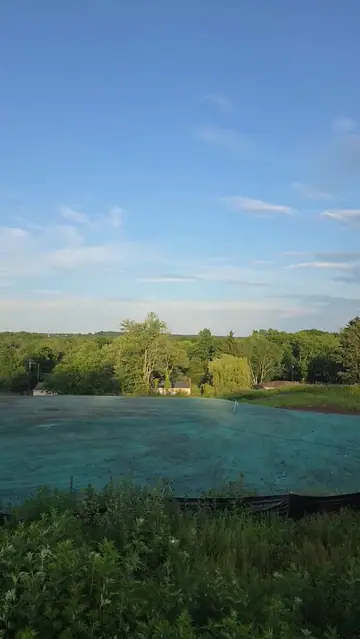
There are two honest ways to turn bare dirt into a real lawn: lay fresh sod and have a finished yard the same afternoon, or hydroseed and grow one in over a few weeks for a fraction of the price. Both end in thick, green grass — what really differs is how fast you get there and what you pay to skip the wait. Here's a straight, side-by-side comparison so you can pick the right one for your property.
What you're actually choosing between
Sod is mature grass, grown for a year or two on a farm, harvested into rolls, delivered fresh, and installed by hand over prepared soil. The moment the last roll goes down, you have a finished, deep-green lawn.
Hydroseeding sprays a slurry of grass seed, wood or paper mulch, starter fertilizer, and a tackifier — the glue that holds it all in place — evenly across prepped soil. It germinates and fills in over the following weeks. It's the budget-friendly way to establish a big new lawn or lock down a slope, and it's the core of our hydroseeding and lawn installation service. New to the process? Our complete guide to what hydroseeding is and how it works breaks down the slurry, the week-by-week timeline, and exactly what to expect.
The grass itself can be the same species. The real difference is speed, cost, and patience.
Instant results vs. the wait: a week-by-week timeline
Sod is finished the day it's installed. A hydroseeded lawn arrives as green-tinted soil and becomes a lawn on its own schedule. Here's how the two generally compare from install day forward.
| Timeline | Fresh sod | Hydroseed |
|---|---|---|
| Install day | Finished, deep-green lawn | Bare soil under a green mulch coat |
| Week 1–2 | Rooting in; keep foot traffic to a minimum | First seedlings emerge |
| Week 2–3 | Rooted and ready for normal use | Thin, uneven early fill-in |
| Week 6–8 | Fully established and thick | Finally starts to look like a lawn |
| First mow | About 2 weeks | About 4–6 weeks |
| Looks finished | Same day | 6–10 weeks |
| Full maturity | One season | One to two seasons |
If you need a usable, finished lawn on a deadline — selling a house, a summer party, kids and pets — that "same day" column is the whole argument for sod.
Cost: where hydroseeding wins
This is hydroseeding's home turf. On a comparable area, hydroseeding typically costs far less than a sod installation — commonly reported at roughly 50% to 80% less — and the gap widens as the area grows. You're spraying seed instead of buying turf that took a year to grow and then has to be harvested, freighted, and laid by hand. That's why hydroseed is the default for large lots, new construction, and open slopes. Published ranges vary, so treat that as a ballpark rather than a quote.
What sod's higher price actually buys you is time and certainty: a finished lawn today, virtually weed-free from the start, with no germination gamble. Both are quoted per project and depend on size, access, and prep, so the honest move is to get a free quote for your specific lot rather than guess from a number.
On a like-for-like area, hydroseeding usually costs a fraction of a comparable sod installation — often roughly half to a quarter (or less) — and the savings widen as the job gets bigger. Sod costs more because you're paying to skip the wait and remove the guesswork.
Pros and cons at a glance
A finished, deep-green lawn the same day. Usable in a couple of weeks, not a couple of seasons. It starts virtually weed-free from a clean, farm-grown mat. It holds a slope the moment it's pinned in place. And it installs in nearly any season the ground isn't frozen — even through summer heat with the right watering.
It costs more up front, because you're paying to skip the wait. You choose from the grower's available varieties rather than a fully custom blend. And it has to be laid promptly and watered hard the first two weeks, or it can dry out.
Far lower cost, especially across big areas. You can dial in a custom seed blend for sun, shade, or heavy traffic. The mulch and tackifier make it strong for erosion control, and the slurry coats slopes and odd contours evenly.
You wait weeks for a usable lawn and a full season or more for maturity. Watering has to be frequent and consistent or germination stalls. Open soil invites early weed competition. And it's tied to the cool-season windows — spring and, best of all, late summer into fall.
Which should you choose?
What they have in common
Neither method is a shortcut around the dirt. Both start with real site prep and grading — a smooth, firm, properly draining seedbed is what makes either one succeed. Both need water, though differently: sod hard and early, hydroseed little and often. Both can use the same grass species for your conditions. And with us, both are full-service, from clearing to aftercare.
We handle both, start to finish
The bottom line
Choose sod when you want an instant, certain, finished lawn and the schedule or the setting calls for it. Choose hydroseeding when you're covering a large area, watching the budget, or locking down a slope, and a few weeks of patience is fine. Same great lawn at the end — you're really just choosing speed or savings.
Related reading
Ready For A Finished Lawn?
Need it installed?
Sod-only crews, up to 30,000 sq ft a day across the Northeast.
From The Field