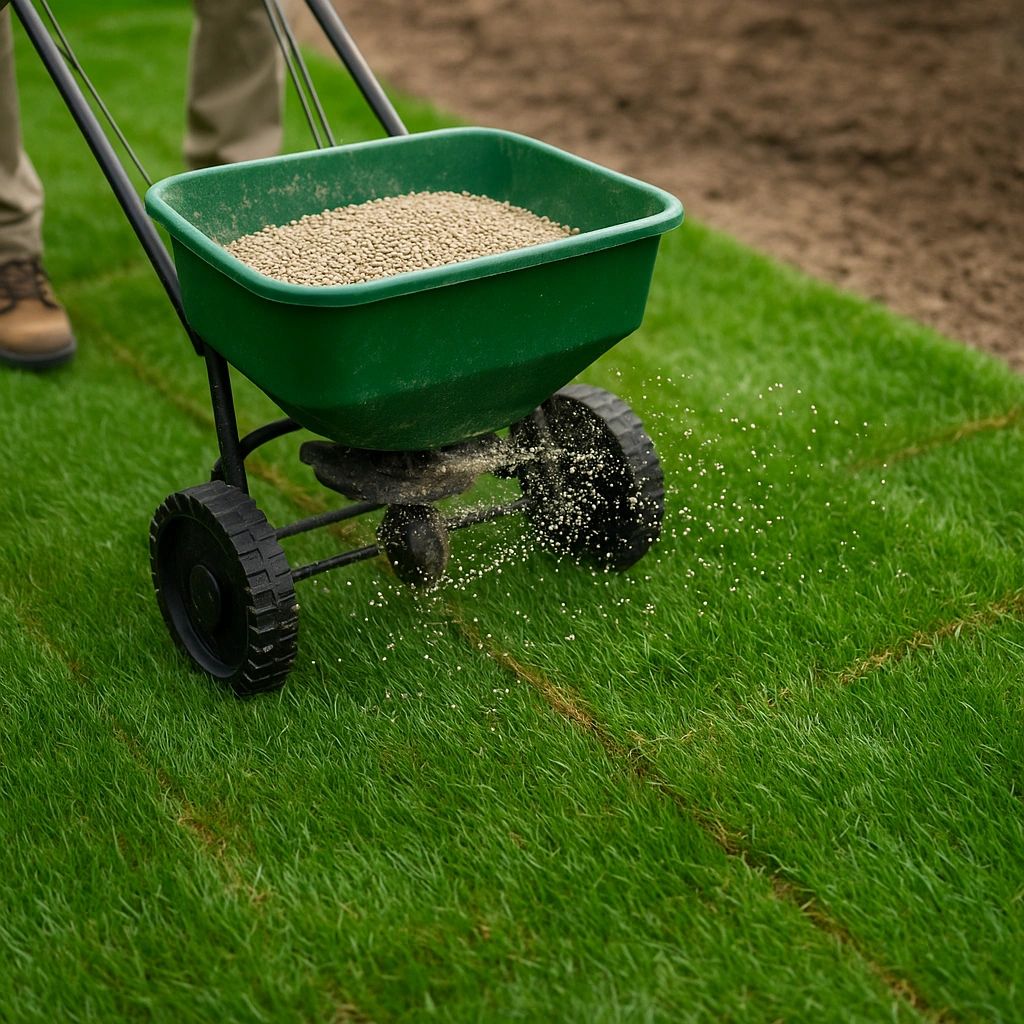

When to Fertilize New Sod in New England — A Complete Guide
After three decades of installing sod across Connecticut, Massachusetts, Rhode Island, and New York, we've watched more new lawns fail from bad fertilizer timing than from bad sod. The sod itself is rarely the problem. The problem is what homeowners do to it in the first six weeks.
This guide is the fertilization schedule we give our own full-service customers — including the specs we look for on the bag, not just the brands.
The First 3–4 Weeks: Don't Fertilize
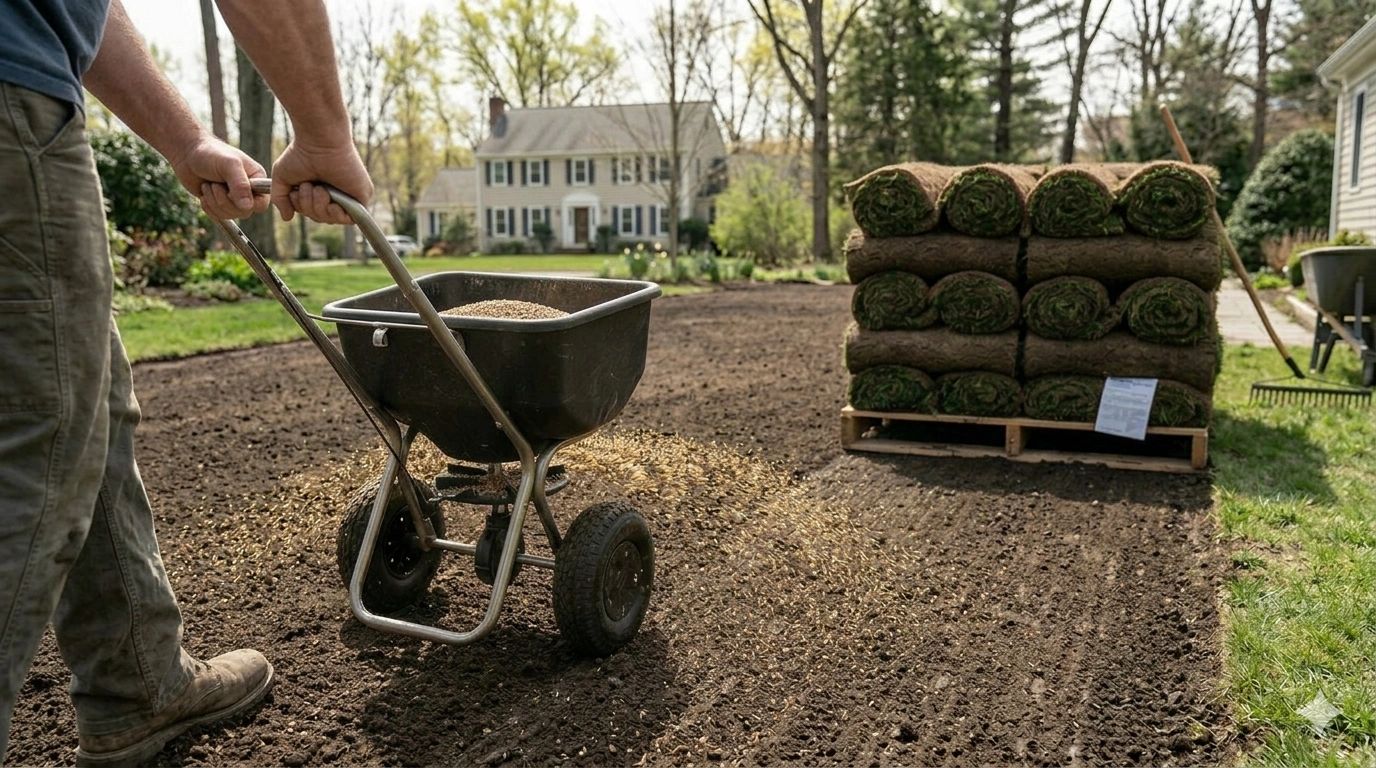
Fresh sod arrives with roots that are effectively cut off. For the first three to four weeks, that sod is pouring every calorie it has into growing new roots down into your soil. Hitting it with nitrogen during this window forces top growth before the root system can support it — and top growth the roots can't support is how you end up with yellow, stressed sod by week five.
What the first four weeks actually need:
- Consistent watering. Two to three short cycles per day for the first 10–14 days, tapering as roots establish.
- Zero foot traffic where possible.
- No mowing until the sod passes the tug test — you can't lift a corner by hand.
Week 4: The First Feeding
Once the sod has knit into the soil, it's ready for its first real feeding. Here's what to look for on the bag — this matters more than the brand name on the front.
NPK ratio: You want a balanced or slightly nitrogen-forward blend. A 10-10-10 works. A 16-16-16 works. A 20-5-10 works for established root systems. What you do not want is a heavy "weed and feed" product, which combines fertilizer with herbicide — herbicides will stress a four-week-old lawn that's still finding its feet. Always read the label for new-sod restrictions.
Slow-release nitrogen percentage: Look at the guaranteed analysis panel on the back of the bag. You want at least 30–50% of the nitrogen listed as "slow-release," "controlled-release," "stabilized," or "methylene urea." Cheap fertilizers are 100% quick-release urea, which gives you a two-week green-up and then nothing. Slow-release feeds for six to eight weeks and cuts your burn risk dramatically.
SGN (Size Guide Number): This one nobody talks about, and it matters. SGN is the particle size. A lower SGN (around 90–150) means smaller, more uniform granules that distribute evenly across the blade canopy. A high SGN (240+) is designed for golf course rough and tall grass — on a freshly laid residential lawn, those big prills fall between the blades unevenly and burn in clumps. If the bag doesn't list SGN, that's your answer: it's a commodity blend.
Biological additives: Premium products include mycorrhizae, humic acid, and seaweed extract. These aren't marketing fluff — mycorrhizae extend the effective root system, humic acid improves nutrient uptake in the clay-heavy soils that dominate Fairfield and New Haven counties, and seaweed extract is one of the more researched stress mitigators in turf.
Apply on a cool day. Avoid application in the 48 hours before a heat wave or during drought. Water in immediately — a quarter inch is enough to dissolve the prills and move the nutrients into the root zone.
Which Specific Product Should You Buy?
The specs above — balanced NPK, 30–50% slow-release nitrogen, low SGN, biological additives — will steer you toward the right shelf at any garden center or turf supplier. But "the right shelf" still leaves you staring at ten bags that all claim to be the best thing for your lawn.
We wrote a companion post that goes deeper on exactly that question — which brands and formulations we've actually seen perform on New England sod, and which ones to skip. If you've got a bag in your hand right now and you're trying to decide whether it's the right one, start there: What Fertilizer Should You Use on New Sod? (https://ctsod.com/everything-sod-blog/f/what-fertilizer-should-you-use-on-new-sod)
Then come back here for the timing.
The New England Seasonal Schedule
Once you're past the establishment phase, new sod joins the regular New England feeding calendar:
- Late April – early May: Slow-release nitrogen blend. This is the spring green-up feeding, timed to soil temperatures consistently above 55°F. Don't feed earlier — you'll push top growth before the soil warms enough for the roots to keep up.
- Mid-June: Balanced feeding with a heavier slow-release component. This is your summer stress insurance.
- Late August – early September: The most important feeding of the year. Cool-season grasses — Kentucky bluegrass, fine fescue, perennial rye, which is what our sod is blended from — do the majority of their annual root growth in September and October. A quality fall feeding is what separates a mediocre lawn from a great one.
- Late October – early November: Optional winterizer, higher in potassium, applied before the first hard frost.
- Fertilizing in the first two weeks. The most common and the most damaging.
- Applying right before a heat wave. Nitrogen plus 90°F plus drought-stressed turf equals dead stripes.
- Skipping the fall feeding because the lawn "looks fine." Fall feedings build next spring's lawn.
- Using last year's leftover bag. Slow-release coatings degrade; old fertilizer burns more unpredictably.
For the first month, leave new sod alone. At week four, feed with a balanced, slow-release product with good granulation — read the back of the bag, not the front. Then follow the New England seasonal schedule, with the fall feeding being the one you never skip.
If we delivered or installed your sod and you have questions about what to use on your specific lawn, call us at (203) 877-5070. We've seen what works on New England soil for thirty years, and we're happy to walk you through it.hen to Fertilize New Sod in New England — A Complete Guide
After three decades of installing sod across Connecticut, Massachusetts, Rhode Island, and New York, we've watched more new lawns fail from bad fertilizer timing than from bad sod. The sod itself is rarely the problem. The problem is what homeowners do to it in the first six weeks.
This guide is the fertilization schedule we give our own full-service customers — including the specs we look for on the bag, not just the brands.
The First 3–4 Weeks: Don't Fertilize
Fresh sod arrives with roots that are effectively cut off. For the first three to four weeks, that sod is pouring every calorie it has into growing new roots down into your soil. Hitting it with nitrogen during this window forces top growth before the root system can support it — and top growth the roots can't support is how you end up with yellow, stressed sod by week five.
What the first four weeks actually need:
- Consistent watering. Two to three short cycles per day for the first 10–14 days, tapering as roots establish.
- Zero foot traffic where possible.
- No mowing until the sod passes the tug test — you can't lift a corner by hand.
Week 4: The First Feeding
Once the sod has knit into the soil, it's ready for its first real feeding. Here's what to look for on the bag — this matters more than the brand name on the front.
NPK ratio: You want a balanced or slightly nitrogen-forward blend. A 10-10-10 works. A 16-16-16 works. A 20-5-10 works for established root systems. What you do not want is a heavy "weed and feed" product, which combines fertilizer with herbicide — herbicides will stress a four-week-old lawn that's still finding its feet. [Verify before acting — always read the label for new-sod restrictions.]
Slow-release nitrogen percentage: Look at the guaranteed analysis panel on the back of the bag. You want at least 30–50% of the nitrogen listed as "slow-release," "controlled-release," "stabilized," or "methylene urea." Cheap fertilizers are 100% quick-release urea, which gives you a two-week green-up and then nothing. Slow-release feeds for six to eight weeks and cuts your burn risk dramatically.
SGN (Size Guide Number): This one nobody talks about, and it matters. SGN is the particle size. A lower SGN (around 90–150) means smaller, more uniform granules that distribute evenly across the blade canopy. A high SGN (240+) is designed for golf course rough and tall grass — on a freshly laid residential lawn, those big prills fall between the blades unevenly and burn in clumps. If the bag doesn't list SGN, that's your answer: it's a commodity blend.
Biological additives: Premium products include mycorrhizae, humic acid, and seaweed extract. These aren't marketing fluff — mycorrhizae extend the effective root system, humic acid improves nutrient uptake in the clay-heavy soils that dominate Fairfield and New Haven counties, and seaweed extract is one of the more researched stress mitigators in turf. [Inference — these are standard claims in the turf trade; individual product results vary.]
Apply on a cool day. Avoid application in the 48 hours before a heat wave or during drought. Water in immediately — a quarter inch is enough to dissolve the prills and move the nutrients into the root zone.
The New England Seasonal Schedule
Once you're past the establishment phase, new sod joins the regular New England feeding calendar:
- Late April – early May: Slow-release nitrogen blend. This is the spring green-up feeding, timed to soil temperatures consistently above 55°F. Don't feed earlier — you'll push top growth before the soil warms enough for the roots to keep up.
- Mid-June: Balanced feeding with a heavier slow-release component. This is your summer stress insurance.
- Late August – early September: The most important feeding of the year. Cool-season grasses — Kentucky bluegrass, fine fescue, perennial rye, which is what our sod is blended from — do the majority of their annual root growth in September and October. A quality fall feeding is what separates a mediocre lawn from a great one.
- Late October – early November: Optional winterizer, higher in potassium, applied before the first hard frost.
- Fertilizing in the first two weeks. The most common and the most damaging.
- Applying right before a heat wave. Nitrogen plus 90°F plus drought-stressed turf equals dead stripes.
- Skipping the fall feeding because the lawn "looks fine." Fall feedings build next spring's lawn.
- Using last year's leftover bag. Slow-release coatings degrade; old fertilizer burns more unpredictably.
For the first month, leave new sod alone. At week four, feed with a balanced, slow-release product with good granulation — read the back of the bag, not the front. Then follow the New England seasonal schedule, with the fall feeding being the one you never skip.
If we delivered or installed your sod and you have questions about what to use on your specific lawn, call us at (203) 877-5070. We've seen what works on New England soil for thirty years, and we're happy to walk you through it.
Ready To Order?
Fresh-Cut Sod Delivered
CT Sod delivers Kentucky Bluegrass, Tall Fescue & RTF sod across CT, MA, NY, NJ, RI, NH, VT & ME.