Spring Pre-Emergent Timing in Massachusetts: 2026 Spring Update and Complete Homeowner's Guide
If you're in Massachusetts watching forsythia bloom and wondering whether you should apply pre-emergent now, you're thinking about lawn care at exactly the right time. The 2026 spring has been notably cold across Massachusetts, and forsythia has only started blooming in the past few days across most of the state. That timing has direct implications for your pre-emergent application window — it's opening right now rather than already in progress or closing, which means homeowners who haven't yet applied still have time to get it down properly.
This guide covers the current 2026 conditions across Massachusetts, when to apply pre-emergent in your specific region given this year's late spring, what to use, and how to handle the application window that's actively opening right now.
The 2026 Spring Reality in Massachusetts
This spring has run meaningfully colder than typical in Massachusetts. April temperatures have averaged below seasonal norms, soil warming has been delayed, and the visible spring indicators — forsythia blooming, daffodils opening, trees leafing out — are running 1-2 weeks behind a typical year.
For pre-emergent timing specifically, that delayed spring is genuinely good news for homeowners who haven't yet applied. The crabgrass germination window that typically opens in mid-April hasn't fully opened yet across most of Massachusetts. Soil temperatures at the 2-inch depth — the relevant measurement for crabgrass germination — are still below the 55°F threshold across most of the state.
That means if you're reading this in late April 2026 and haven't yet applied pre-emergent, the application window is opening now rather than closing. You have a window of opportunity that's actively present rather than rapidly disappearing.
The practical implication: this is the week to apply pre-emergent across most of Massachusetts. Forsythia just starting to bloom is the timing signal. Soil temperatures climbing into the 50°F range at the 2-inch depth indicates the herbicide will activate properly while still being in place before crabgrass seeds germinate.
Why Pre-Emergent Timing Matters
Crabgrass is an annual grass that germinates from seed each spring, establishes through summer, drops thousands of seeds in fall, and dies with the first hard frost. The seeds it drops sit dormant in soil through winter and germinate the following spring when soil conditions support it. Once crabgrass establishes in a lawn, it produces seeds for the next generation regardless of how aggressively you control it during the current season.
Pre-emergent herbicides work by creating a chemical barrier in the top inch of soil that prevents crabgrass seeds from successfully germinating. The barrier needs to be in place before crabgrass seeds start germinating, which means application timing has to anticipate germination rather than respond to it. Once you see crabgrass plants emerging, the pre-emergent window has closed for that season.
Crabgrass germinates when soil temperatures at the 0-2 inch depth reach roughly 55°F for several consecutive days. Eighty percent of crabgrass germination occurs when soil temperatures consistently reach 60-70°F. Pre-emergent applications need to be in place and watered into the soil before soil temperatures cross the 55°F threshold.
For 2026 specifically, that threshold is approaching across Massachusetts but hasn't been reached in most regions yet. The window is open right now.
Forsythia as Your Timing Signal This Year
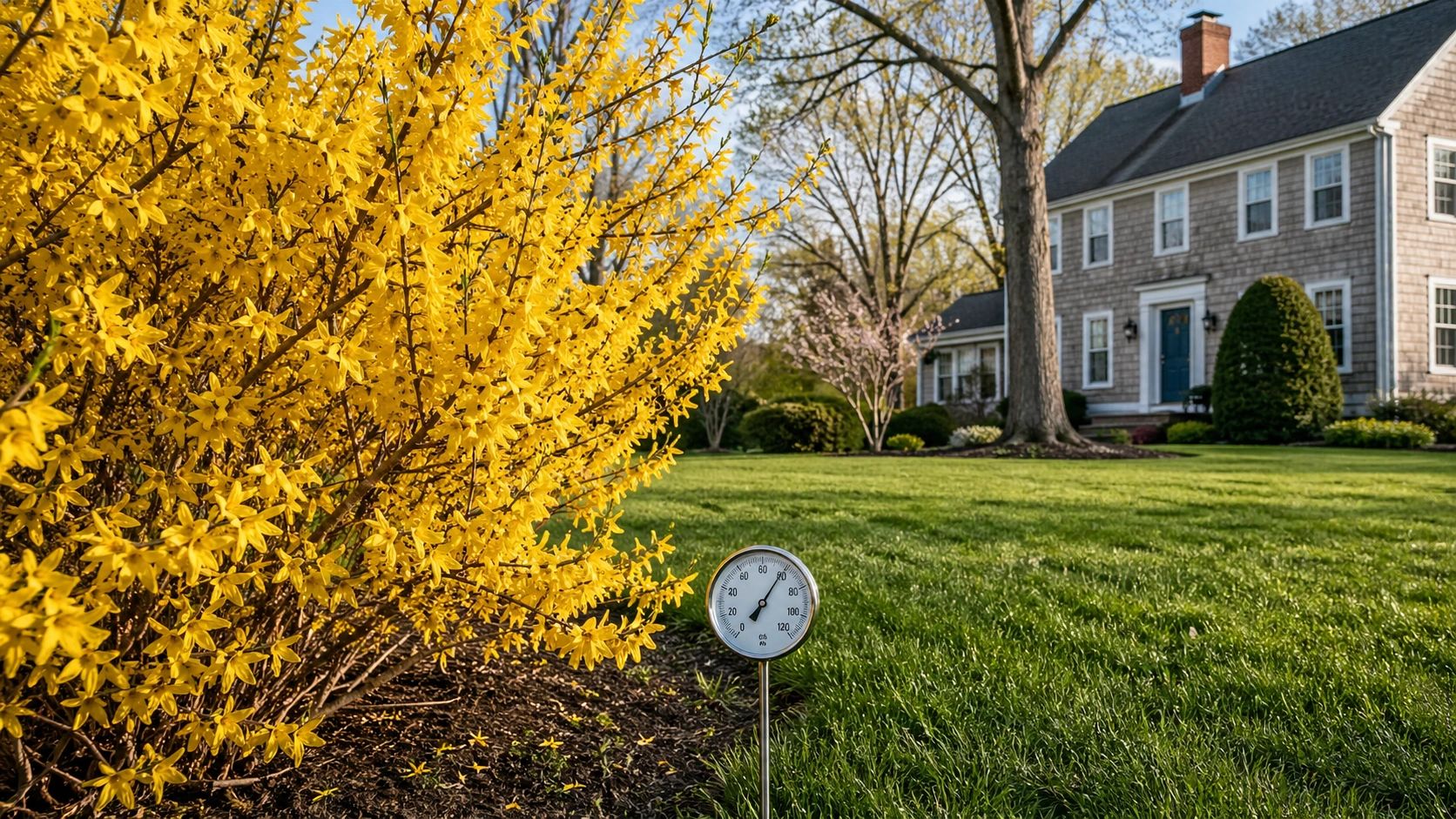
The traditional indicator plant for pre-emergent timing is forsythia, which begins blooming when soil temperatures reach roughly 50°F. Forsythia bloom timing aligns reasonably well with the pre-emergent application window because both forsythia and crabgrass respond to similar soil temperature conditions.
In 2026, forsythia has only started blooming in recent days across most of Massachusetts. That's the practical signal that says: apply pre-emergent now if you haven't already, and you're applying with appropriate timing rather than too early or too late.
The classic guidance is to apply pre-emergent when forsythia is in full bloom and the blooms are starting to drop. For 2026, that gives most Massachusetts homeowners roughly a 1-2 week window from now to complete application before the timing window starts closing.
If forsythia in your specific area has only just started blooming, applying within the next 7-10 days hits the optimal window. If forsythia in your area is already in full bloom, apply this week or early next week before the blooms start dropping.
Massachusetts Regional Timing for 2026
Massachusetts spans meaningfully different regional climates, and pre-emergent timing varies accordingly across the state. Given the cold 2026 spring, the regional differences are slightly more pronounced than typical years.
Eastern Massachusetts and Greater Boston
Boston metro, North Shore, and South Shore communities — Brookline, Newton, Wellesley, Concord, Lexington, Hingham, Cohasset, Marblehead, Beverly. Forsythia is just beginning to bloom or in early bloom across most of this region as of late April 2026. The application window is opening now and runs through approximately the first week of May this year. Apply within the next 7-10 days for optimal timing.
Central Massachusetts
Worcester County and the Pioneer Valley — Worcester, Northampton, Amherst, Hadley, Springfield. Inland conditions warm slightly faster than coastal areas, but the cold 2026 spring has compressed that difference. Forsythia bloom timing in this region is similar to eastern Massachusetts in the current spring, running 1-2 weeks behind a typical year. Apply within the next 7-10 days.
Western Massachusetts and the Berkshires
Pittsfield, Stockbridge, Lenox, Great Barrington, Williamstown. The Berkshires typically run later than the rest of the state in spring soil warming, and 2026's cold spring has extended that lag. Forsythia in higher elevation Berkshires properties may not yet be blooming as of late April. The application window in this region likely opens during the first week of May, with optimal timing potentially extending into the second week of May for the highest elevation properties. Track soil temperature and forsythia bloom in your specific location rather than relying on regional averages.
Cape Cod and the Islands
Cape Cod, Martha's Vineyard, Nantucket. Ocean-moderated spring conditions typically produce a slightly later application window than inland eastern Massachusetts. For 2026, the Cape and islands are seeing forsythia bloom in late April, similar to mainland eastern Massachusetts. Apply within the next 10-14 days for optimal timing on Cape and islands properties.
South Coast Massachusetts
Communities along Buzzards Bay and the South Coast — New Bedford, Fall River, Westport, Marion, Mattapoisett. Coastal influence moderates spring warming but less intensely than the Cape's full peninsular geography. Application window opening now, similar to eastern Massachusetts timing. Apply within the next 7-10 days.
What to Apply
The pre-emergent active ingredients available for residential use in Massachusetts include several effective options:
Prodiamine (Barricade and various branded products). Long-lasting pre-emergent providing season-long control with a single spring application when timed correctly. Effective on crabgrass, foxtail, goosegrass, and various other annual grassy weeds. Application window is more forgiving than some alternatives because the chemical persists longer in soil.
Dithiopyr (Dimension and various branded products). Pre-emergent with some early post-emergent activity, meaning it can still control crabgrass that has germinated but hasn't yet developed past the first leaf stage. The dual activity makes dithiopyr more forgiving for slightly late applications than pure pre-emergent products. For 2026 specifically, dithiopyr is a strong choice because the dual activity provides insurance if some crabgrass germinates before your application takes full effect.
Pendimethalin (Pendulum and various branded products). Effective pre-emergent commonly available in homeowner formulations. Generally requires application before crabgrass germination — has minimal post-emergent activity.
Mesotrione (Tenacity). Provides both pre-emergent and post-emergent control, plus effectiveness on broadleaf weeds. Can be used at the same time as overseeding new grass, which makes it useful for lawns being renovated alongside weed control.
Siduron (Tupersan). Specifically designed to be safe for new grass seedlings, making it the right choice for lawns being seeded or sodded in spring.
For most Massachusetts homeowners with established lawns this spring, prodiamine or dithiopyr products are the practical choices. Both are widely available at garden centers, home improvement stores, and lawn care suppliers in granular fertilizer-blended formulations that simplify application.
Application Mechanics
Pre-emergent application requires a few specific elements to work effectively.
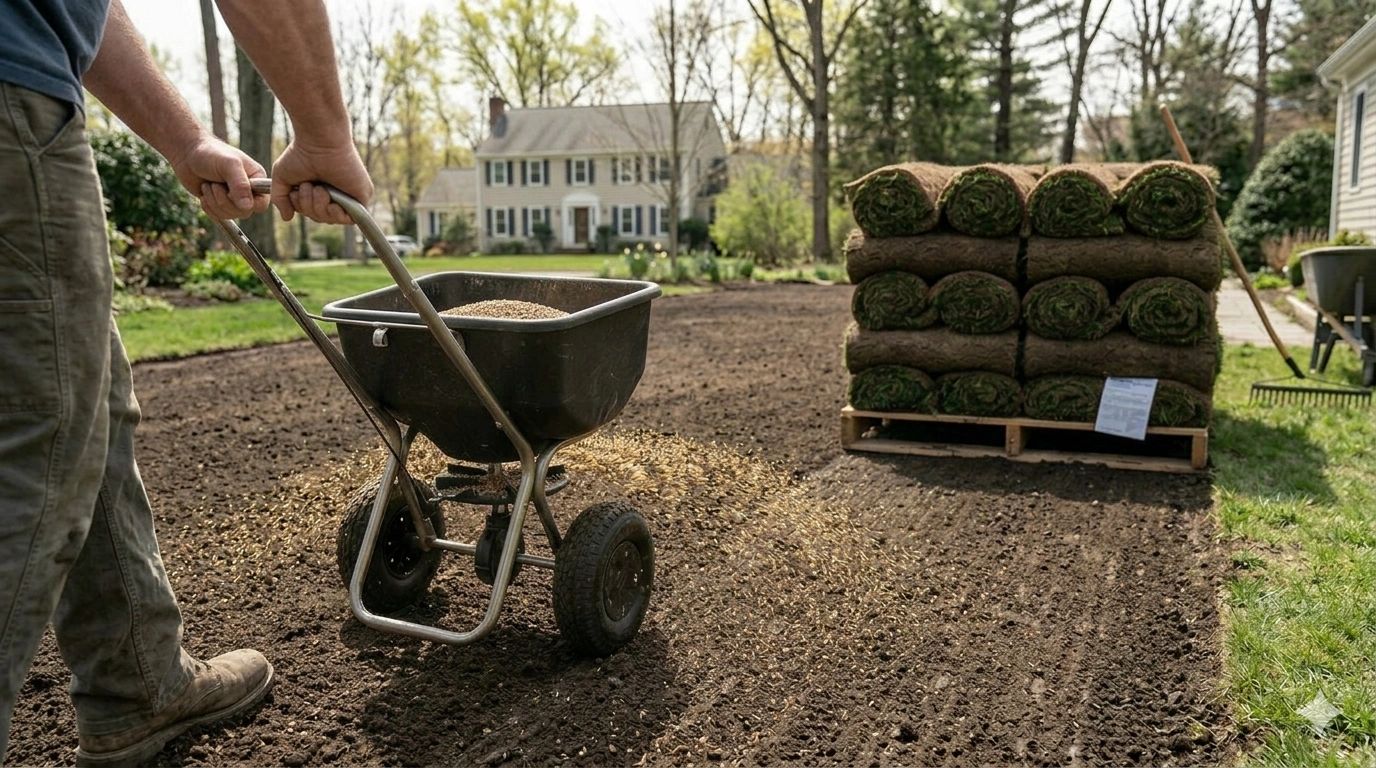
Even coverage across the lawn area. Pre-emergent works through chemical barrier formation in the soil, which means gaps in coverage produce gaps in protection. Rotary or drop spreaders set to manufacturer-recommended rates produce even coverage when applied in a grid pattern (apply in north-south passes, then east-west passes at half-rate each direction).
Watering in within 2-3 days. Pre-emergent needs to be moved into the top inch of soil to form the protective barrier. Rainfall of ¼ to ½ inch within 2-3 days of application accomplishes this naturally; if rainfall isn't available, irrigation or sprinkler watering provides the necessary activation.
Avoid application before heavy rainfall. Pre-emergent applied immediately before substantial rain (more than 1 inch within 24 hours) can wash off the lawn before establishing the soil barrier. Light to moderate rainfall is beneficial; heavy rainfall during the activation window can reduce effectiveness. Check the forecast before application.
Don't disturb the soil after application. Aerating, dethatching, or other soil disturbance after pre-emergent application breaks the chemical barrier and creates germination opportunities. Schedule any soil work for fall rather than after spring pre-emergent application.
Mow at proper height to support effectiveness. Mowing at 3 inches or higher produces denser turf that shades soil and reduces light penetration to germinating crabgrass seeds. Combining pre-emergent application with proper mowing height produces meaningfully better results than either practice alone.
What to Do If You've Missed the Window
For 2026 specifically, the cold spring means most Massachusetts homeowners haven't actually missed the window yet. But for properties where crabgrass is already emerging or for buyers reading this guide later in the season, a few practical options:
Apply dithiopyr products with early post-emergent activity. Dithiopyr can control crabgrass that has germinated but hasn't yet tillered (developed side shoots). If you can identify crabgrass at the 1-3 leaf stage, dithiopyr application can still produce control. Beyond the 3-leaf stage, dithiopyr's effectiveness drops significantly.
Apply post-emergent herbicide to existing crabgrass. Quinclorac products provide effective post-emergent crabgrass control on plants that have established. Application timing matters — control is most effective on younger crabgrass plants (under 4 leaves) and decreases as plants mature. Multiple applications may be needed for heavily-infested lawns.
Plan for fall renovation. If crabgrass has established significantly across the lawn, the most effective response may be accepting the current season and planning for fall renovation. Fall overseeding into a thinned lawn, combined with proper next-spring pre-emergent timing, produces meaningfully better long-term results than chasing established crabgrass through summer.
Focus on lawn density to limit spread. Even without chemical control, a thick dense lawn limits crabgrass establishment by shading the soil and outcompeting germinating seedlings. Proper mowing height (3-4 inches), adequate fertilization, and consistent watering produce dense turf that resists crabgrass naturally.
Why Pre-Emergent Matters for New Sod
Worth flagging specifically for properties planning sod installation: pre-emergent herbicides cannot be applied to newly installed sod or to soil being prepared for sod installation. Most pre-emergent products specify waiting periods of 4-12 weeks after application before seeding or sodding the area, depending on the active ingredient.
If you're planning sod installation this spring or summer, the pre-emergent timing question becomes whether to apply now (knowing it limits your window for any sod work) or skip pre-emergent this season (accepting some crabgrass risk in favor of installation flexibility).
For new sod installations specifically, the pre-emergent question is somewhat reduced because new sod creates a continuous turf cover that shades the soil and prevents crabgrass establishment naturally. Properly installed sod with adequate density typically resists crabgrass without chemical pre-emergent in the establishment year, particularly if installation timing avoids the peak germination window.
For lawns being maintained rather than renovated, pre-emergent timing remains the primary crabgrass prevention strategy and the application window matters significantly.
The Connection Between Healthy Soil and Crabgrass Resistance
Pre-emergent herbicides are one tool in crabgrass management, but they're not the only factor. Healthy lawns with dense turf, adequate fertilization, proper mowing height, and good soil biology resist crabgrass naturally regardless of chemical intervention.
Properties with ongoing crabgrass problems despite pre-emergent application typically have underlying issues that pre-emergent alone can't address — thin turf from compaction, inadequate soil fertility, mowing too short, irrigation problems, or soil conditions that favor crabgrass over desired grass species. Long-term crabgrass management often requires addressing these underlying conditions rather than relying on pre-emergent alone.
For Massachusetts properties dealing with chronic crabgrass issues, pre-emergent application this spring should be combined with longer-term planning for soil testing, possible aeration in fall, overseeding in fall to thicken thin areas, and adjusting maintenance practices to support dense turf development.
Frequently Asked Questions
Should I apply pre-emergent in Massachusetts right now in late April 2026?
Yes, for most of Massachusetts the application window is opening now given the cold 2026 spring. Forsythia just starting to bloom across most regions indicates the optimal application timing. Apply within the next 7-10 days for eastern, central, and South Coast Massachusetts. Cape Cod and the islands have a slightly later window extending 10-14 days from now. The Berkshires, particularly higher elevations, may have application windows opening during the first week of May.
Has the cold 2026 spring affected pre-emergent timing?
Yes — the cold spring has delayed the application window by 1-2 weeks compared to a typical year. That's actually beneficial for homeowners who haven't yet applied because the window is opening now rather than already closing. Track forsythia bloom in your specific area and soil temperature at the 2-inch depth to fine-tune your application timing.
When should I apply pre-emergent in Boston?
For Boston metro properties in 2026, apply within the next 7-10 days. Forsythia is just beginning to bloom or in early bloom across the region. The application window is opening now and runs through approximately the first week of May this year.
When should I apply pre-emergent on Cape Cod?
Cape Cod's ocean-moderated climate typically produces a slightly later application window. For 2026, apply within the next 10-14 days. Forsythia bloom timing on the Cape this year is similar to mainland eastern Massachusetts due to the broadly cold spring across the region.
When should I apply pre-emergent in the Berkshires?
Higher elevation Berkshires properties typically reach the application window later than the rest of the state, and 2026's cold spring has extended that lag. The application window for most Berkshires properties likely opens during the first week of May, with optimal timing potentially extending into the second week of May for the highest elevation properties. Track soil temperature directly rather than relying on regional averages.
Can I apply pre-emergent on new sod?
Generally no. Most pre-emergent products specify waiting periods of 4-12 weeks after application before sodding the area, and pre-emergent applied to newly installed sod can prevent the sod from rooting properly. New sod creates continuous turf cover that resists crabgrass naturally, which reduces the need for chemical pre-emergent in the establishment year.
What if I missed the pre-emergent window?
For 2026 specifically, most homeowners haven't actually missed it yet because the cold spring delayed everything. But for properties where crabgrass is already emerging, dithiopyr products with early post-emergent activity can still control crabgrass at the 1-3 leaf stage. Quinclorac products provide post-emergent control on more mature crabgrass.
How does pre-emergent affect overseeding?
Most pre-emergent products prevent grass seed germination as well as crabgrass germination. If you plan to overseed in spring, choose siduron (Tupersan) or mesotrione (Tenacity) products that are formulated to allow desired grass seedlings while controlling crabgrass. Standard pre-emergent products applied in spring typically prevent successful overseeding until the herbicide has fully degraded.
Do I need to apply pre-emergent every year?
For most Massachusetts lawns with crabgrass history, annual spring pre-emergent application is appropriate. Crabgrass seed banks in soil persist for several years, meaning even successful season-after-season control needs to continue for several years before seed pressure drops significantly. Skipping a year typically allows crabgrass to re-establish and rebuild the seed bank.
Can I apply pre-emergent and fertilizer at the same time?
Yes — many homeowner pre-emergent products are formulated as combined pre-emergent and fertilizer (often called "weed and feed" products). The combined application provides both crabgrass prevention and lawn fertilization in a single pass. Confirm the specific product is appropriate for your timing window and lawn conditions before application.
What's the difference between pre-emergent and post-emergent?
Pre-emergent herbicides prevent weed seeds from successfully germinating by creating a chemical barrier in the soil. Post-emergent herbicides kill weeds that have already emerged from the soil. Pre-emergent is preventive; post-emergent is corrective. Both have appropriate uses but require different timing and product choices.
Massachusetts Sod Installation Considerations
For homeowners thinking about both pre-emergent application and sod installation this season, the timing interaction matters. New sod typically can't follow pre-emergent application within 4-12 weeks depending on the herbicide used. If sod installation is planned for spring or early summer, skipping pre-emergent this season is often the practical choice because the sod's continuous turf cover provides natural crabgrass suppression during establishment.
CT Sod delivers and installs farm-fresh cool-season sod across Massachusetts including Boston metro, the South Shore, the North Shore, Cape Cod, and the Berkshires. We carry Kentucky Bluegrass, Rhizomatous Tall Fescue (RTF), Jonathan Green Black Beauty Tall Fescue, and Bluegrass-Fescue blends — the four cool-season varieties that perform across Massachusetts's varied conditions.
Standard delivery scheduling is 2-7 days from order. Call (203) 806-4086 or visit ctsod.com to discuss your project, or for guidance on whether pre-emergent or sod installation is the right approach for your specific lawn situation this spring.
Ready To Order?
Fresh-Cut Sod Delivered
CT Sod delivers Kentucky Bluegrass, Tall Fescue & RTF sod across CT, MA, NY, NJ, RI, NH, VT & ME.