Spring Pre-Emergent Timing in Connecticut: The Complete Homeowner's Guide to Stopping Crabgrass Before It Starts
If your forsythia is blooming or has just dropped its petals, you have roughly two weeks left to apply pre-emergent crabgrass control on your Connecticut lawn before the window closes for the season. This isn't a marketing claim — it's a soil temperature reality that every Connecticut homeowner faces every spring, and the homeowners who miss it spend the rest of the summer pulling crabgrass by hand or watching it take over the lawn they spent all spring trying to improve.
This guide walks through the science of why pre-emergent timing is so unforgiving in Connecticut, how to read your own yard for the right application window, what products actually work and which ones are wasting your money, the common mistakes that cause pre-emergent applications to fail, and how pre-emergent timing fits into the larger spring fertilizer schedule that keeps a Connecticut lawn healthy from April through October.
What Pre-Emergent Crabgrass Control Actually Does
Pre-emergent herbicides don't kill crabgrass plants. They prevent crabgrass seeds from germinating in the first place, which is why timing matters so much. Apply too early and the chemical barrier breaks down before the seeds wake up. Apply too late and the seeds have already germinated and the chemical has nothing to prevent.
The way pre-emergent works at the soil level is straightforward. The active ingredient — most commonly prodiamine, dithiopyr, pendimethalin, or mesotrione — forms a chemical barrier in the top inch of soil. When a crabgrass seed germinates and sends out its first root, the root contacts the chemical and the seedling dies before it ever breaks the soil surface. The barrier itself doesn't move much. It stays in roughly the layer where it was applied and slowly degrades over 6 to 12 weeks depending on the product, soil temperature, and rainfall.
This is why the timing window is so tight. The barrier needs to be in place before crabgrass seeds germinate, but not so far in advance that it has degraded by the time germination happens. In Connecticut, the practical window between "soil is warm enough that the chemical will activate properly" and "crabgrass has already germinated" is typically about 14 to 21 days. Miss that window in either direction and the application loses most of its value.
The Soil Temperature Science: Why 50-55°F Matters
Crabgrass seeds germinate when soil temperatures at a 4-inch depth hold at 55°F for 3 to 5 consecutive days. This is the single most important number in spring lawn care, and most Connecticut homeowners have never heard it.
In southern Connecticut — Fairfield, New Haven, and Middlesex counties — soil temperatures typically cross the 55°F threshold somewhere between late April and early May. In the Litchfield Hills and northern Connecticut, the threshold gets crossed about 7 to 14 days later. Coastal areas trend warmer than inland areas at the same latitude because Long Island Sound moderates temperature swings.
What this means in practical terms: a homeowner in Greenwich applying pre-emergent on April 25 has the timing roughly right. A homeowner in Litchfield applying on the same date is probably a week early — the chemical will start degrading before crabgrass actually germinates, reducing effectiveness later in the season when crabgrass pressure is highest. A homeowner in Stamford waiting until May 15 has probably already missed it. The crabgrass that's going to germinate has already done so, and the seedlings are below the soil surface but past the point where pre-emergent can stop them.
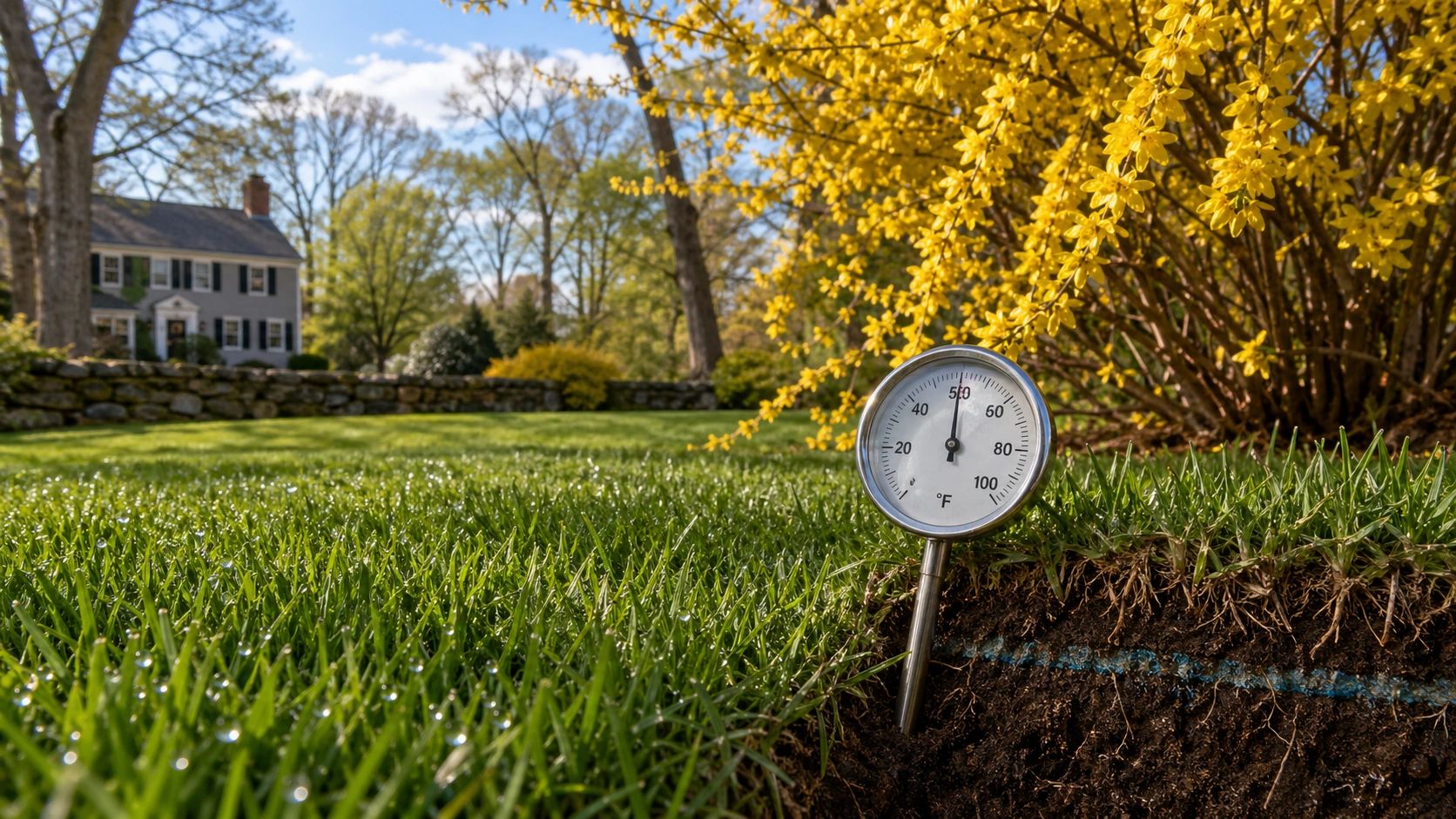
You can buy a soil thermometer for under $15 at any garden center, and it will give you a more precise read on your specific yard than any general timing guide. Push the probe 4 inches deep, leave it for 5 minutes, and read the temperature. Do this for several days in a row in the early morning before the sun warms the surface. When you've had 3 to 5 consecutive mornings at or above 55°F, the window is open and closing fast.
Forsythia: The Connecticut Homeowner's Free Soil Thermometer
For homeowners who don't want to track soil temperatures directly, forsythia bloom is the traditional Connecticut indicator for crabgrass pre-emergent timing. The relationship isn't magic — it's that forsythia and crabgrass both respond to similar accumulated soil warmth, so when forsythia hits full bloom, crabgrass germination is typically 7 to 14 days away. When forsythia drops its petals and starts to leaf out, you're at the trailing edge of the application window.
The rule of thumb that's worked for generations of Connecticut lawn care professionals: apply pre-emergent when forsythia is in full bloom or just starting to fade. If the forsythia has already dropped its petals and is showing green leaves, you're late but not too late — apply immediately and accept that effectiveness may be reduced. If the forsythia is leafed out fully and you're well into May, the window has closed for spring application.
This year — late April 2026 — most of southern Connecticut is at full forsythia bloom or just past peak. That's the visual cue that the application window is open. Homeowners who can see forsythia from their kitchen window have all the timing information they need.
[Inference] Forsythia blooms across Connecticut have historically tracked closely with crabgrass germination timing, but climate variability means individual years can shift the relationship by several days in either direction. Soil temperature monitoring remains more precise.
Choosing the Right Pre-Emergent Product for Your Situation
Not all pre-emergent products work the same way, and the right choice depends on what else you're trying to accomplish in your lawn this season. The four active ingredients homeowners are most likely to encounter:
Prodiamine is the workhorse professional pre-emergent. It provides 3 to 5 months of crabgrass control from a single spring application, which means one well-timed application in late April typically protects the lawn through the entire summer crabgrass pressure window. Prodiamine is the most cost-effective per square foot of coverage and the most forgiving on application timing, but it has a critical limitation for some homeowners: prodiamine prevents grass seed germination just as effectively as it prevents crabgrass germination. If you're planning to overseed, repair bare spots, or install seed this spring or summer, prodiamine is the wrong choice.
Dithiopyr is the most commonly recommended product for homeowners who need both pre-emergent and early-post-emergent control. Dithiopyr will stop crabgrass seeds from germinating and will also kill very young crabgrass seedlings (up to about 1-leaf stage) that have already germinated. This wider effective window is valuable for homeowners who realize they're slightly late on timing — dithiopyr can rescue an application that would have been useless with prodiamine. Dithiopyr also has a shorter soil residual than prodiamine, which means it interferes less with fall overseeding plans. For Connecticut homeowners wanting dithiopyr combined with spring fertilizer in a single application, Grillo Services in Milford carries 18-0-4 weed and feed with .164% Dimension dithiopyr crabgrass preventer in 40 lb bags.
Pendimethalin is widely available in homeowner products including the standard Scotts Step 1 lineup. It's effective but has a shorter residual than prodiamine, which means it may need a second application in midsummer to maintain control through August and September. For homeowners who follow the four-step Scotts schedule, pendimethalin is what they're getting and it works adequately within that program.
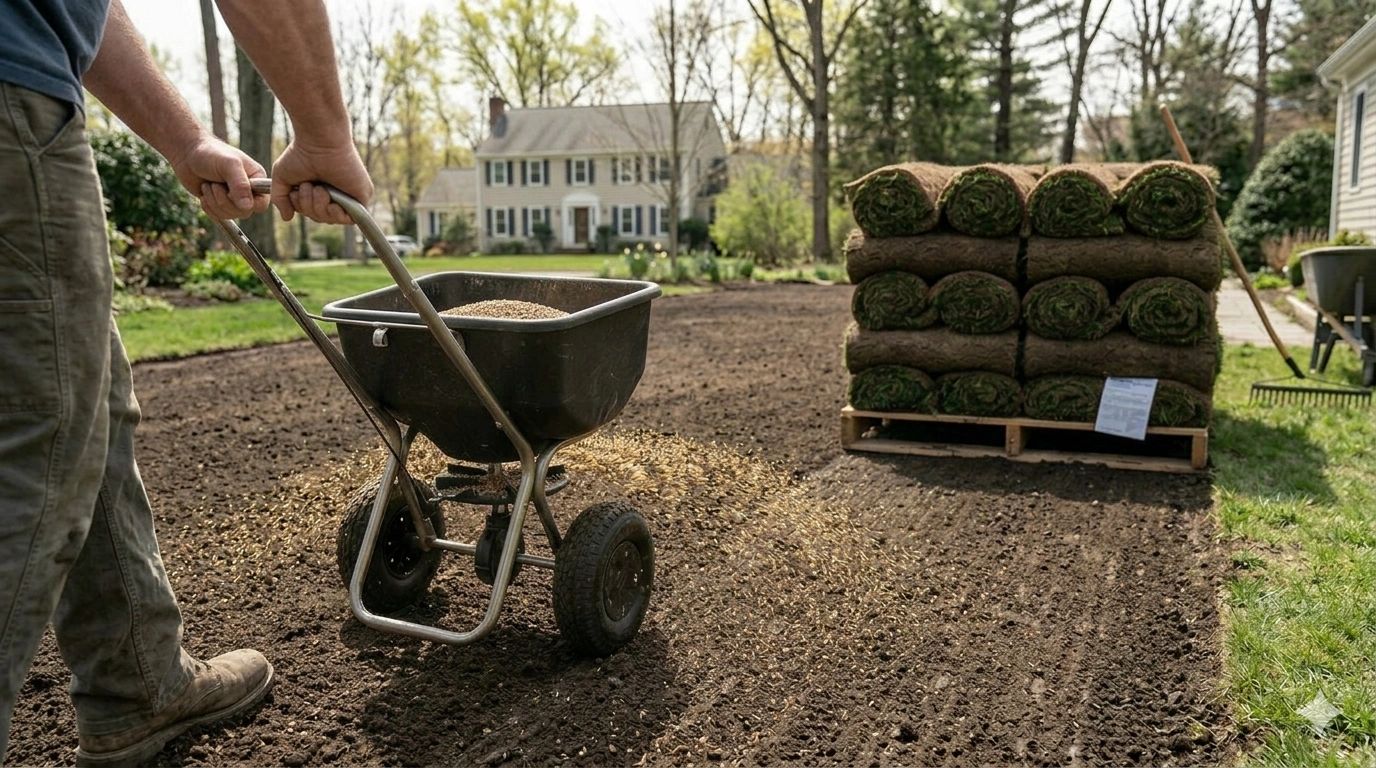
Mesotrione (sold as Tenacity in professional formulations and bundled into some homeowner products) is unusual because it can be applied at the same time as new grass seed without preventing seed germination of desirable cool-season grasses. This makes mesotrione the right choice for homeowners doing spring lawn renovation — seeding bare spots or overseeding thin areas while still providing some pre-emergent protection. Mesotrione's pre-emergent effect is shorter and somewhat less complete than prodiamine or dithiopyr, but for renovation scenarios it's the only option that doesn't force a choice between weed control and seeding. For Connecticut homeowners installing new sod or seeding this spring, Grillo Services carries a mesotrione-based starter fertilizer (21-22-4) with crabgrass preventer — the rare combination of high-phosphorus starter fertilizer with grass-seed-safe pre-emergent.
For a Connecticut homeowner with an established lawn and no plans to seed this spring, prodiamine or dithiopyr applied in late April is the highest-value choice. For a homeowner planning to fix bare spots or overseed thin areas, mesotrione is the only viable pre-emergent option. For a homeowner who realizes in early May that they're late on timing, dithiopyr is the rescue product.
Application Method: Why Most Pre-Emergent Failures Happen
The most common reason pre-emergent applications fail isn't the wrong product or the wrong timing — it's incorrect application technique. Pre-emergent only works if the chemical reaches the soil surface and gets activated by water. Three application errors account for most failures:
Insufficient watering after application. Pre-emergent products need to be watered in within 24 to 48 hours of application. The chemical needs to dissolve into the top inch of soil to form the barrier that stops germinating seeds. If the granules sit on the surface, they degrade in sunlight and never reach the soil. Most product labels specify 0.5 inches of water — either rainfall or irrigation — within 48 hours of application. If rain isn't in the forecast, irrigate.
Uneven application. Pre-emergent applied at half the labeled rate provides essentially zero crabgrass control. The chemical barrier only works at the labeled concentration, and underapplication leaves gaps that crabgrass exploits. Most homeowners who spread by hand or with a poorly-calibrated broadcast spreader end up with patchy coverage that fails in random spots across the lawn. Calibrate your spreader to the product label, and consider applying half the labeled rate going north-south and half going east-west to even out coverage.
Applying after disturbing the soil barrier. Pre-emergent forms a chemical barrier in the top inch of soil. Anything that disturbs that layer — aggressive raking, dethatching, aeration, edging, digging — breaks the barrier and creates open lanes for crabgrass to germinate. If you're planning to dethatch or aerate this spring, do it before applying pre-emergent, not after. Once the barrier is established, leave the soil surface undisturbed for the duration of the residual period.
A correctly-applied pre-emergent at the right timing with adequate water-in is one of the highest-value lawn investments a Connecticut homeowner can make. A poorly-applied pre-emergent at the wrong timing with no water-in is a waste of money and won't reduce crabgrass pressure measurably.
What Pre-Emergent Won't Do (And What You Need Other Products For)
Pre-emergent stops crabgrass and most other annual grassy weeds from germinating, but it's not a comprehensive weed control solution. Understanding what it doesn't do prevents the common homeowner mistake of assuming one product handles everything.
Pre-emergent won't kill existing weeds. Dandelions, plantain, clover, ground ivy, and other broadleaf weeds that are already established in your lawn will not be affected by crabgrass pre-emergent. These need post-emergent broadleaf herbicides (typically applied in fall for best effect, sometimes in spring as a secondary application). For Connecticut homeowners with active broadleaf weed pressure who want broadleaf control combined with spring fertilizer, Grillo Services carries 19-0-6 weed and feed with LockUp broadleaf herbicide as a separate application from crabgrass pre-emergent.
Pre-emergent won't stop perennial grassy weeds. Quackgrass, nimblewill, and other perennial grasses that come back from established root systems aren't affected by pre-emergent. These require selective herbicide treatment or spot-renovation.
Pre-emergent won't stop crabgrass that's already germinated. Once a crabgrass seedling has emerged, only post-emergent control will eliminate it. Quinclorac is the most common homeowner active ingredient for post-emergent crabgrass control, and it works best on young crabgrass (1-3 tiller stage). Mature crabgrass in late summer is much harder to kill and may need to be hand-pulled.
Pre-emergent won't compensate for thin or weak turf. Crabgrass thrives where desirable turf is thin, weak, or absent. The most effective long-term crabgrass control isn't pre-emergent — it's a thick, healthy lawn that physically excludes crabgrass seeds from reaching soil contact and germinating. Pre-emergent buys you a season; thick turf buys you a lifetime of reduced crabgrass pressure.
How Pre-Emergent Fits Into the Full Spring Fertilizer Schedule
Pre-emergent is one piece of the spring lawn care program, not the whole program. The Connecticut spring schedule that produces the best results across the season looks roughly like this:
Late April / early May (right now in 2026): First application — pre-emergent crabgrass control combined with or followed by a balanced spring fertilizer. The fertilizer feeds the active spring growth that's already happening, while the pre-emergent prevents the crabgrass seeds that are about to germinate. Many homeowner products combine both into a single bag (Scotts Step 1, Jonathan Green Crabgrass Preventer + Green-Up, Grillo Services 18-0-4 with Dimension, etc.). Soil temperature should be 50-55°F at 4 inches.
Mid to late May: Second application — broadleaf weed control if dandelions and other broadleaf weeds are present and visible. Apply when weeds are actively growing and not under heat stress. This is also the window for spot-treating any pre-emergent gaps where crabgrass is starting to appear.
Mid to late June: Third application — second feeding of slow-release nitrogen to maintain growth and color heading into summer stress. This feeding is lighter than the spring application — typically 0.5 to 0.75 lb of N per 1,000 sq ft rather than the 1 lb spring rate. For homeowners wanting straight nitrogen without herbicide for the summer feeding, Grillo Services 24-0-11 lawn fertilizer with XCU slow-release provides sustained feeding from a single application.
Early September: Fourth application — fall fertilizer with higher nitrogen content to push recovery from summer stress and rebuild root reserves. This is arguably the most important feeding of the entire year for cool-season turfgrass in Connecticut.
Late October / early November: Fifth application — winterizer with higher potassium and slow-release nitrogen for late-season root development and winter hardiness.
The first application — the pre-emergent + spring fertilizer combo — sets up everything that follows. A lawn that misses the spring pre-emergent window will fight crabgrass all summer, and the labor and cost of summer crabgrass control typically exceeds what spring pre-emergent would have cost by 5x to 10x.
For homeowners installing new sod this spring, the schedule is different — new sod has its own first-year fertilizer schedule that prioritizes establishment over weed control, and pre-emergent should not be applied to new sod for the first 60 to 90 days after installation.
Common Connecticut-Specific Pre-Emergent Mistakes
A few mistakes show up so consistently in Connecticut lawns that they're worth flagging directly:
Applying pre-emergent to areas you're going to seed this spring. This is the single most common renovation failure. Homeowners apply Scotts Step 1 across the whole lawn in April, then try to seed bare spots in May, and the seed never germinates because the pre-emergent is doing exactly what it's supposed to do. If you have bare spots to repair this spring, either skip pre-emergent entirely on those areas, use mesotrione (which doesn't prevent cool-season grass germination), or wait until fall for renovation work.
Assuming "weed and feed" handles everything. Most weed-and-feed products combine pre-emergent with fertilizer, which is fine for established lawns but creates problems in two scenarios: lawns with active broadleaf weeds (which need post-emergent, not pre-emergent) and lawns being seeded or renovated. Read the label, identify what active ingredients are actually in the bag, and match the product to the actual problem. A weed-and-feed with Dimension (dithiopyr) is for crabgrass prevention; a weed-and-feed with LockUp (broadleaf herbicide blend) is for active broadleaf weeds — they do different things and aren't interchangeable.
Skipping the soil test. Connecticut soils are typically acidic (pH 5.5 to 6.5 in most of the state), which limits nutrient availability and grass health regardless of how much fertilizer you apply. A $20 soil test through UConn Extension or a private lab tells you whether you need lime, what your phosphorus and potassium levels actually are, and whether your fertilizer program is matching your soil's needs. Most homeowners go their entire lives without testing soil, and most of those lawns underperform what they could be.
Applying right before heavy rain. Pre-emergent needs to be watered in within 24-48 hours, but heavy rain immediately after application can wash granules off the lawn entirely or concentrate them in low spots, both of which reduce effectiveness. Check the forecast — apply when light rain (or irrigation) is in the next 48 hours, not when a thunderstorm is hitting in the next 6 hours.
Treating pre-emergent as a one-time annual event. A single spring application of long-residual prodiamine (3-5 months) covers most of the crabgrass pressure season in Connecticut, but heavy crabgrass pressure in the previous year may justify a split application — half rate in late April, half rate in late June — to maintain the chemical barrier through August. Homeowners who lost the lawn to crabgrass last summer should consider the split-application approach this year.
Soil Biology and Fertilizer Timing: The Often-Missed Spring Opportunity
Spring isn't just when grass starts growing — it's when soil biology wakes up. Mycorrhizal fungi, which form symbiotic relationships with cool-season grass roots, become metabolically active when soil temperatures hold above 50°F. This is the window when biological inoculants and microbially-active fertilizers can actually colonize and establish, versus being applied to dormant soil where they sit inert.
For Connecticut homeowners interested in soil biology — whether for environmental reasons, for reduced fertilizer dependency over time, or for the deeper rooting and drought resistance that healthy soil biology supports — late April through May is the window when biological products do the most work. By July, soil temperatures push into the upper range where some beneficial fungi go semi-dormant; by September, the window reopens briefly before fall cooldown closes it for the year.
This is why the spring fertilizer + pre-emergent combo isn't just about killing crabgrass and feeding grass blades — it's also the moment when below-ground biology is most receptive to inputs. A spring program that combines pre-emergent crabgrass control, balanced fertilizer, and biological amendments (compost topdressing, mycorrhizal inoculants, or biologically-active organic fertilizers) sets up a lawn that performs better all season and gradually requires less synthetic input year over year.
For Connecticut homeowners building a biologically-focused spring program alongside their pre-emergent application, the practical approach is pairing an organic slow-release fertilizer like Organic Approach 9-0-4 — made from feather meal, soybean meal, cottonseed meal, alfalfa meal, and vegetative ash — with a microbial inoculant like Quantum Growth Organic Probiotics. Note that organic fertilizers should be applied separately from pre-emergent applications since most organic granular products don't combine with herbicide chemistries.
For more on how soil biology actually works under cool-season turfgrass, see the deep-dive on mycorrhizal fungi and lawn health and the related piece on glomalin and soil structure.
What To Do This Week
If you're a Connecticut homeowner reading this in late April 2026 and you haven't applied pre-emergent yet, here's the practical action sequence for the next 7-10 days:
Walk your yard and look at your forsythia. Full bloom or just-past-peak means the window is open right now. Fully leafed-out means you're late but not hopeless.
Decide whether you're seeding this spring. If yes, choose mesotrione-based pre-emergent or skip pre-emergent on seeding areas. If no, prodiamine or dithiopyr is the highest-value choice.
If you're an established-lawn homeowner with no seeding plans, buy a combination spring fertilizer + pre-emergent product (or buy them separately if you want better control over rates) and plan to apply within the next 5-7 days. Standard homeowner options include Scotts Step 1, Jonathan Green Crabgrass Preventer + Green-Up, or for Connecticut buyers Grillo Services 18-0-4 with Dimension.
Check the forecast. You want light rain or planned irrigation within 48 hours of application, not a thunderstorm within 6 hours.
Apply at the labeled rate. Don't underapply to save money. Half-rate pre-emergent provides essentially zero control.
Water in with 0.5 inches of water within 48 hours.
Stay off the treated area for 24 hours. Don't dethatch, aerate, or aggressively rake the lawn for the next 6-12 weeks (depending on product residual).
Plan the rest of the season — broadleaf weed control in mid-May, second feeding in late June, fall fertilizer in early September, winterizer in late October.
The two-week window that's open right now in Connecticut closes sometime in mid-May, after which the value of pre-emergent application drops substantially. Homeowners who act this week will spend the rest of the summer with a thicker, healthier lawn and dramatically less crabgrass pressure. Homeowners who wait will spend the rest of the summer fighting weeds that they could have prevented with one well-timed application in late April.
Frequently Asked Questions
When exactly is the pre-emergent window in Connecticut?
The window opens when soil temperatures at 4-inch depth hold at 50-55°F for several consecutive days, which typically happens between mid-April and early May in southern Connecticut and 7-14 days later in northern Connecticut. The window closes when soil temperatures hold above 60°F and crabgrass seeds have already germinated, which typically happens between mid-May and early June. The practical application window is roughly 14-21 days.
Can I apply pre-emergent and grass seed at the same time?
Only if you're using mesotrione-based pre-emergent (sold as Tenacity in professional formulations and included in some homeowner products). Prodiamine, dithiopyr, and pendimethalin all prevent cool-season grass seed germination just as effectively as they prevent crabgrass germination. If you've already applied one of these and need to seed, wait until the residual period has passed (typically 3-5 months) or core-aerate the seeding areas to break the chemical barrier — though aeration also reduces overall pre-emergent effectiveness.
How long does pre-emergent last?
Residual depends on the active ingredient. Prodiamine provides 3-5 months of control from a single application. Dithiopyr provides 2-4 months. Pendimethalin provides 6-10 weeks. Mesotrione provides 4-6 weeks of pre-emergent activity (though it provides additional post-emergent activity for several more weeks). Soil temperature, rainfall, and microbial activity all affect residual length — hot, wet, biologically active soils break down pre-emergents faster.
Do I need to apply pre-emergent again in summer?
For most Connecticut homeowners using prodiamine in late April, no — the single spring application carries through the season. Homeowners using shorter-residual products (pendimethalin, dithiopyr) may benefit from a second application in late June if crabgrass pressure was heavy the previous year. Homeowners using long-residual prodiamine who want extended fall protection sometimes apply a second light application in August to extend control through October.
Is pre-emergent safe for pets and kids?
Most homeowner pre-emergent products are safe for pets and kids once watered in and the lawn surface has dried. Read the specific product label — most specify a 24-hour reentry period after application. Granular formulations are generally lower-risk than liquid formulations because the granules can't be tracked indoors as easily. If you have specific concerns, mesotrione has a relatively favorable mammalian toxicity profile compared to most alternatives.
Should I apply pre-emergent to new sod?
No. New sod should not have pre-emergent applied for the first 60-90 days after installation. The new sod is establishing its root system, and pre-emergent can interfere with rooting. New sod also doesn't need crabgrass protection in its first few months because it's a complete, weed-free turfgrass surface that physically excludes crabgrass seeds. Once new sod is fully rooted and entering its second growing season, the standard pre-emergent schedule applies.
Can I use pre-emergent if I have a vegetable garden nearby?
Pre-emergent applied to your lawn won't directly affect a separate garden bed, but be careful with overspray and runoff. Apply on a calm day, follow the labeled buffer distances, and avoid applying immediately before heavy rain that could wash chemical into garden areas. If your garden is downhill from your lawn, consider a no-spray buffer zone of 5-10 feet at the edge.
What if I miss the window completely?
If you're past the pre-emergent application window — late May or later — switch to a post-emergent strategy. Quinclorac-based herbicides will kill young crabgrass seedlings (1-3 tiller stage) effectively. Mature crabgrass in late summer is much harder to control and may need hand-pulling combined with overseeding bare spots in fall. The fall pre-emergent application targeting winter annual weeds (chickweed, henbit) is a separate program — your fall opportunity to set up next year's lawn starts in late August.
How much does professional pre-emergent application cost in Connecticut?
[Estimated] Professional spring pre-emergent application in Connecticut typically runs $75-150 per application for an average residential lawn (5,000-10,000 sq ft), depending on lawn size, product used, and whether it's bundled into a full-season program. Full-season 5-application programs typically run $400-800 annually depending on lawn size and program inclusions. DIY pre-emergent costs roughly $30-60 per application in product costs, with the trade-off being timing precision and application accuracy.
Does CT Sod recommend any specific pre-emergent products?
CT Sod doesn't sell pre-emergent and doesn't recommend specific brands. The active ingredients matter more than the brand — prodiamine for established lawns, mesotrione for renovation, dithiopyr for late-timing rescue, and any of these in combination products with spring fertilizer for one-pass application. For Connecticut homeowners wanting to source from a regional landscape supply company rather than national retail, Grillo Services in Milford carries the major combination categories — 18-0-4 with Dimension dithiopyr for established lawns, 21-22-4 mesotrione starter for new sod and seeding, 19-0-6 with LockUp broadleaf for active broadleaf weed pressure, and 24-0-11 with XCU slow-release for straight fertilizer without herbicide. For the best results on lawns with new or recently-installed sod, follow the first-year fertilizer schedule before introducing pre-emergent in year two.
Ready To Order?
Fresh-Cut Sod Delivered
CT Sod delivers Kentucky Bluegrass, Tall Fescue & RTF sod across CT, MA, NY, NJ, RI, NH, VT & ME.