Sod Laying Tips: How to Prep the Soil Beneath Your Sod
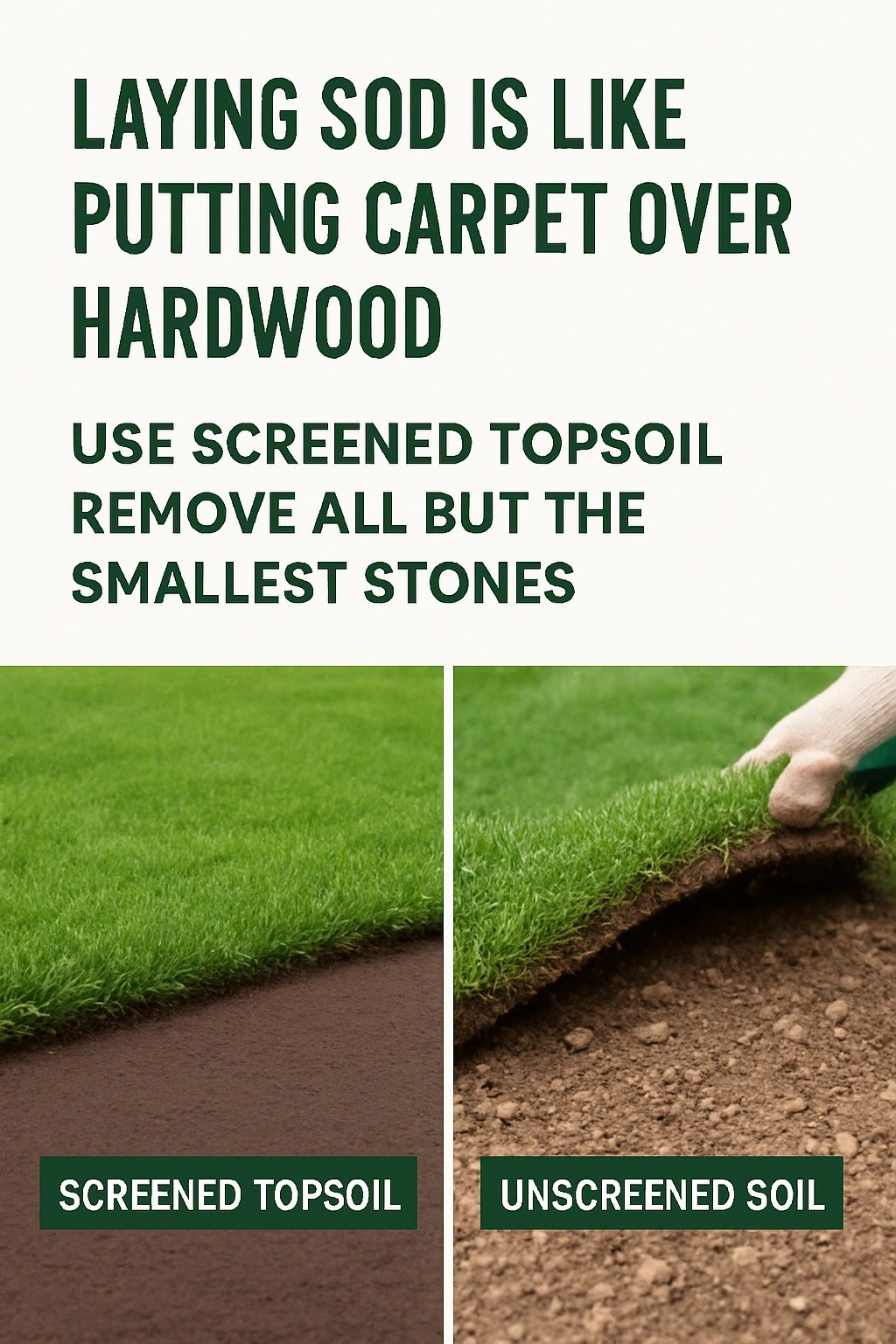
The single most important factor in a successful sod installation is the soil underneath it — not the sod itself. Installing sod is a lot like laying carpet over a hardwood floor: if the base isn't smooth, level, and properly prepared, every bump, dip, and stone underneath will telegraph through and undermine the finished lawn. At CT Sod, we see the same pattern every season: the customers who invest in proper soil prep get lawns that root deeper, green up faster, and hold their shape for years. The ones who skip it end up replacing rolls by midsummer.
Below is how to prep soil for sod the right way — topsoil depth, stone removal, grading, clay amendment, and what to do when new topsoil isn't in the budget.
Why Screened Topsoil Matters
Screened topsoil is the underlayment for your sod "carpet" and the single biggest upgrade you can make to a sod installation. Screened topsoil has been sifted through a mechanical screen to remove sticks, clumps, roots, and stones, leaving behind a fine, consistent, nutrient-rich soil that sod roots can penetrate immediately. Unscreened or native soil forces roots around obstructions and creates air pockets that starve the sod.
Three things screened topsoil does that rough soil cannot:
It gives roots a clean path to grow down into — the first two to three weeks of shallow rooting happen in the top two inches of soil, so whatever is in those two inches determines whether the sod lives or dies.
It holds moisture evenly. Screened topsoil has balanced particle size that retains water long enough for shallow roots to drink without going anaerobic. Rocky or clay-heavy soil either drains too fast or not at all.
It eliminates air gaps. Sod laid over lumpy soil develops voids underneath where roots cannot bridge to the soil, and those sections brown out even when watered correctly.
For most installations, spread two to four inches of screened topsoil before sod, with four to six inches being ideal if you're starting from a poor or newly-graded base. Our deeper breakdown is here: Is 2 Inches of Topsoil Enough for Sod?
How Deep Should Topsoil Be for Sod?
The ideal topsoil depth for sod is four to six inches of quality screened topsoil worked into the existing subsoil. Two inches can be enough if the base beneath it is good and the topsoil is properly tilled in, but two inches sitting on top of compacted clay or construction fill will fail — sod roots hit the hard layer and stop. [Estimated — exact requirements vary with existing soil type and drainage.]
The reason depth matters: Kentucky bluegrass sends shallow feeder roots down two to three inches during establishment, and tall fescue pushes a deep taproot system that can eventually reach four feet. If the top layer of soil is only an inch or two of quality material over hardpan, both grasses stall out. Four to six inches gives the root system room to establish and the lawn long-term resilience through Connecticut summers.
Stone Removal: What Has to Go and What's Fine
Remove every stone larger than a dime before laying sod. Stones smaller than that won't hurt, but anything half-inch or bigger creates uneven rooting, visible bumps through the finished lawn, and dead spots where the stone sits directly under the sod root zone. The rule of thumb: if it would annoy you to step on barefoot, it needs to come out.
The most efficient method is to rake the area with a landscape rake (the metal-tined kind, not a leaf rake), pull out everything larger than a dime, and finish with a hand pass on any areas where the sod will be most visible. For larger projects, a power landscape rake or Harley rake on a skid steer will do in 30 minutes what takes a full day by hand.
Grading: Why "Level" Isn't the Goal
Grade the soil so water runs off gently without puddling — the goal is a smooth, consistent slope, not a perfectly flat surface. Flat lawns create the "bathtub effect" where water pools, drowns roots, and invites fungal disease. A gentle pitch away from the house (roughly one to two percent grade, or about one inch of drop per four to eight feet) keeps water moving without washing out the sod.
Key grading rules:
Slope away from foundations, walkways, and patios.
Keep the finished grade one inch below sidewalks, driveways, and patios so the sod sits flush after it's rolled and settled.
Fill low spots before you install. Water a prepped area and watch where puddles form — those are the spots that will drown sod later.
What If New Screened Topsoil Isn't in the Budget?
If you can't bring in new screened topsoil, you can still install sod successfully by preparing the existing soil carefully. It takes more labor and gets worse results than fresh topsoil, but it works.
First, remove all debris, old grass, and stones larger than a dime. Skipping this step is the #1 reason DIY sod installations fail. See our full guide on how to remove grass before laying sod.
Second, till the existing soil four to six inches deep. A rental rototiller does the work of ten hours of hand digging in one hour and is the single most valuable tool rental in a DIY sod install. Tilling breaks up compaction, mixes in organic matter, and creates the soft soil bed that shallow sod roots need.
Third, level the grade with a landscape rake and fill low spots with whatever clean topsoil you do have.
Fourth, water the prepped area the day before installation to settle the soil and reveal any remaining low spots.
For a full step-by-step, see our Sod Installation Guide and Is It Hard to Lay Sod Yourself?
Will Sod Grow on Clay?
Sod will not grow well directly on hardpan clay without amendment. Clay holds water like a bathtub, compacts into a hard layer roots cannot penetrate, and causes shallow rooting that leaves sod vulnerable to summer drought. If your existing soil is heavy clay, you have two options:
Option one (best): Bring in four to six inches of screened topsoil and till the bottom two inches into the clay layer. This creates a transition zone that prevents a hard interface between the new soil and the clay underneath — roots grow through the transition instead of hitting a wall.
Option two (minimum): Till two to three inches of compost or sandy loam into the top four inches of clay, then add a thin layer of screened topsoil on top. This works for mild clay but is not sufficient for pure hardpan.
The Cost of Skipping Soil Prep
Skipping soil prep is the most expensive shortcut in sod installation. Poor prep commonly results in sod that takes root unevenly, browns in patches through the first summer, stays shallow-rooted and dies in drought, or has to be lifted and redone within one to two seasons.
Sod pallets typically run $300 to $600 each depending on grass type, volume, and market, and a typical residential lawn needs four to six pallets. Compared to a few yards of screened topsoil and one day of prep work, the cost of doing prep right is a small fraction of what it costs to redo a failed install. Skipping prep means risking paying for the sod twice.
Frequently Asked Questions
_Can I lay sod directly over existing soil without topsoil?_
You can, but results are inconsistent. If the existing soil is rocky, compacted, or heavy clay, sod will struggle to root and the lawn will likely fail or look patchy. At minimum, remove stones larger than a dime, till the top four to six inches to break compaction, and level the grade. For best long-term results, add two to four inches of screened topsoil.
_How deep should topsoil be for sod?_
Four to six inches of screened topsoil is ideal. Two inches is the practical minimum and only works if the underlying soil is already decent and the topsoil is tilled in rather than just spread on top. New construction sites and areas over clay need the full four to six inches.
_Do I need to remove every single pebble before laying sod?_
No. Stones smaller than a dime won't affect rooting or the look of the finished lawn. Focus on removing anything larger than a half-inch, plus sticks, roots, and debris. The goal is a smooth, consistent surface, not a perfectly clean one.
_Will sod grow on hardpan clay?_
Not without amendment. Clay needs to be broken up and topped with four to six inches of screened topsoil, with the bottom couple of inches tilled into the clay to create a transition zone. Laying sod directly on untreated hardpan typically leads to shallow rooting, poor drainage, and lawn failure within the first year.
_What happens if I skip soil prep entirely?_
Sod installed without proper soil prep typically fails within the first season. Common outcomes include patchy browning, shallow root systems that can't survive drought, uneven surface, and the need to replace sod within 12 to 24 months. With sod pallets running $300 to $600 each and most lawns needing four to six pallets, skipping prep means risking paying for that material twice.
_Is 2 inches of topsoil really enough for sod?_
Two inches is enough only if the native soil beneath it is already loose, well-draining, and free of compaction — and only if the topsoil is tilled into the existing soil rather than sitting on top as a separate layer. For most Connecticut properties, especially new construction, four to six inches is the realistic minimum.
_Should I fertilize the soil before laying sod?_
A light application of starter fertilizer raked into the top few inches of soil before installation gives the sod roots an immediate nutrient source. Do not add high-nitrogen fertilizer after installation — sod is pre-fertilized at the farm, and extra nitrogen in the first few weeks burns developing roots.
_What is the best grade or slope for a new sod lawn?_
A gentle one to two percent slope away from the house is ideal — roughly one inch of drop per four to eight feet. The goal is a smooth, consistent pitch rather than a perfectly flat surface. Keep the finished grade one inch below sidewalks and driveways so the sod sits flush after rolling.
Bottom Line
Your sod is only as good as the soil beneath it. Screened topsoil, stone removal, proper grading, and four to six inches of root-ready soil are what separate a lawn that roots in two weeks from one that struggles for two years. If the prep is right, the sod almost takes care of itself. If the prep is wrong, no amount of watering or fertilizer will fix it.
Ready to start fresh? Call CT Sod at (203) 806-4086 for farm-cut Kentucky bluegrass and tall fescue delivered across CT, MA, NY, NJ, and RI. We also deliver screened topsoil and can coordinate both in a single drop so your prep and sod line up the way they should.
Ready To Order?
Fresh-Cut Sod Delivered
CT Sod delivers Kentucky Bluegrass, Tall Fescue & RTF sod across CT, MA, NY, NJ, RI, NH, VT & ME.
Keep Reading
1,000 Square Foot Sod Prep and Installation in Wilton, CT
April 11, 2026
Amending Sandy Soil with Compost for Sod Installation CT, NY, MA
August 25, 2025
Best Drought-Tolerant Sod Varieties: Northeast Guide
April 30, 2026
Best Sod for Connecticut Lawns: Complete Regional Guide
April 28, 2026